
Beyond the Spec: Why Forums are the Lifeblood of Software Crowdsourcing
How Online Forums Complement Task Documentation in Software Crowdsourcing
This paper explores the interaction between formal task documentation and informal forum communication in Software Crowdsourcing (SW CS) platforms like Topcoder. By analyzing 25 challenges, the authors demonstrate how online forums serve as a critical extension to official documentation, filling gaps in technical requirements and operational details.
TL;DR
In the high-stakes world of software crowdsourcing (SW CS), a "perfect" task description is a myth. This study reveals that even the most detailed documentation fails to prevent developer dropouts unless paired with active forum communication. By analyzing 25 Topcoder challenges, the researchers found that developers use forums not just for clarification, but to "patch" missing technical requirements, negotiate deadlines, and solve environment-setup hurdles in real-time.
Background: The "Ghosting" Problem in Crowdsourcing
A recurring frustration for companies using Topcoder or uTest is the high number of registrants who never submit a solution. Why do talented developers sign up and then disappear? The answer often lies in Information Asymmetry. In SW CS, the developer has no face-to-face contact with the client and only a fragmented view of the overall project architecture. When documentation is "weak," developers don't just guess—they quit.
The Core Insight: Documentation is Just the Starting Point
The authors argue that SW CS is a socio-technical activity. It is not enough to look at "What is written" (Documentation); we must look at "How they talk" (Communication).
Methodology
The researchers analyzed two distinct groups of tasks:
- Group 1 (Explicit Recommendation): Documentation that told users, "Go to the forum for details."
- Group 2 (No Recommendation): Documentation intended to be self-standing.
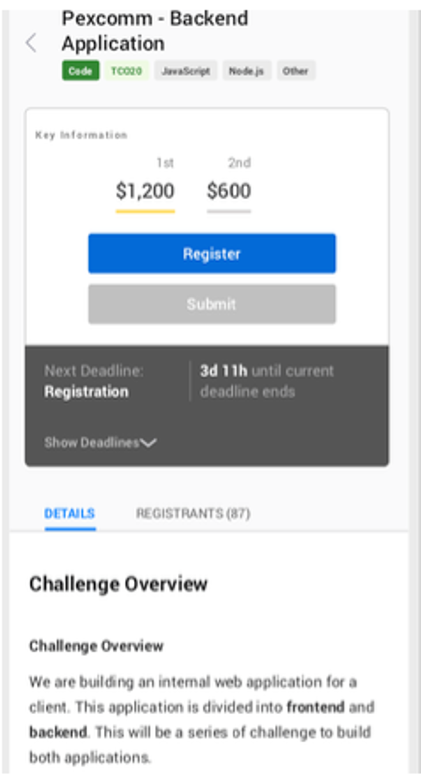 Figure 1: The standard structure of a Topcoder task, which often lacks the nuance required for complex coding.
Key Findings: The "Extra-Topic" Phenomenon
The study discovered a fascinating trend in Group 1. Even when the documentation told users to use the forum for specific things (like "Access"), the crowd naturally started discussing "Extra-Topics."
- Requirements are never finished: "Requirements" was the #1 discussed topic across both groups. This suggests that "Requirements Engineering" in crowdsourcing is a continuous process that happens during the competition, not just before it.
- The Copilot as a Bridge: The "Copilot" (a mediator) is essential for translating the vague needs of the client into the technical realities of the crowd.
- The Group 2 Surprise: Even when tasks didn't recommend the forum, developers flocked there anyway to discuss Libraries, Deadlines, and Processing errors. This proves that a communication channel is not an "optional feature"—it’s a requirement.
Topic Distribution Table
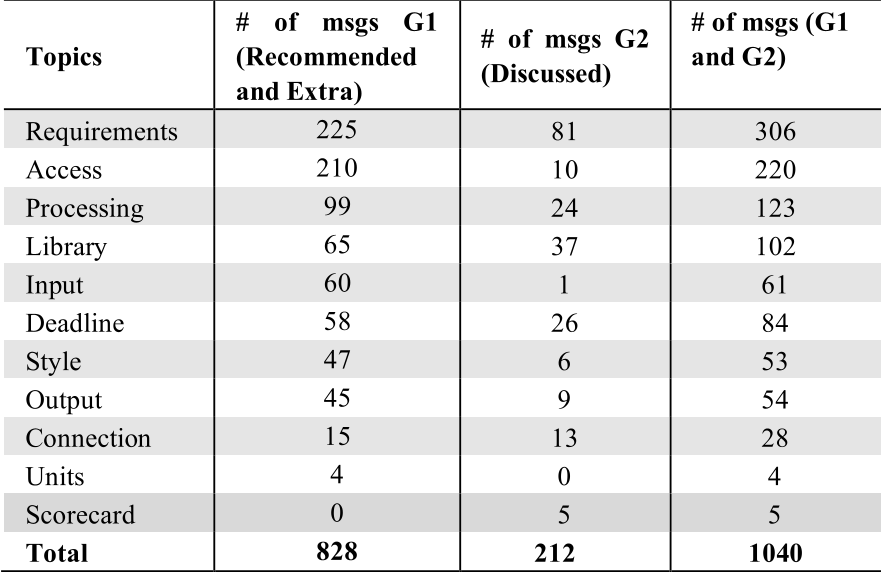 The data confirms that Requirements and Access remain the high-friction points in every challenge.
Depth Discussion: Why Documentation Fails
The paper posits three reasons why documentation in SW CS is uniquely difficult compared to traditional development:
- Geographical Barriers: Zero informal "water cooler" talk.
- Limited Mediated Communication: All questions must pass through a Copilot, creating a bottleneck.
- Scarce Global View: Developers are building a "brick" without ever seeing the "building."
Critical Analysis & Conclusion
This work serves as a wakeup call: Documentation is a static artifact in a dynamic environment.
The authors suggest that future platforms should move away from slow, asynchronous forums and toward more agile, synchronous tools like Slack or Discord, potentially integrated with Bots to automatically answer common setup questions.
The Takeaway: If you are a platform owner or a requester, don't focus on writing the "perfect spec." Focus on building an "active community." The success of your software depends less on your initial PDF and more on the conversation that follows it.
Limitations
While insightful, the study is limited to the Topcoder "Coding" subcategory. Other areas, like Data Science or Design, might rely more on visual artifacts than forum threads. Additionally, the qualitative nature of the study means that while we understand the what, the speed of these interactions (latency) remains a ripe area for future analysis.