
The Ripple Effect of Weight Loss: Quantifying Social Influence in Online Health Networks
Analysis of an online health social network
This paper presents an empirical analysis of FatSecret, a large-scale health-centered Online Social Network (OSN). By analyzing data from over 107,000 users over five months, the study evaluates how social interactions and self-monitoring influence weight-change performance, establishing a quantifiable link between online social influence and health outcomes.
TL;DR
Can an online friend actually help you lose weight? According to this large-scale study of the FatSecret OSN, the answer is a resounding yes. Researchers found that weight-change progress is not just an individual effort—it is a social phenomenon. A user's success probability jumps by 60% when a friend succeeds, and this "health contagion" ripples through the network up to four degrees away.
Background: Beyond the Digital Bulletin Board
While general-purpose social networks like Facebook and Twitter changed how we share photos, the role of Health-centered Online Social Networks (OSNs) was historically viewed with skepticism. Critics argued that health data is too sensitive to share and that "digital support" might not lead to "physical results." This paper bridges that gap by providing the first detailed, large-scale empirical analysis of 107,000 users in a modern health ecosystem.
The Core Challenge: Motivation and Accountability
Weight management is notoriously difficult because it requires sustained behavioral change. Prior work by Christakis and Fowler suggested that obesity spreads through real-world social ties. The authors of this paper wanted to know:
- Does this same "contagion" exist in the virtual world?
- Does the anonymity of an OSN encourage or hinder progress?
- How far does a single person's success travel through their digital network?
Methodology: Mapping the Social Graph of Health
The researchers tracked three primary metrics: Social Connections (Friendships), Self-Monitoring (Weigh-ins), and Outcome (Weight Change).
1. User Engagement Patterns
The study categorized users into "on-track," "not on-track," and "steady." Interestingly, the majority of users (84.4%) opted for public profiles, suggesting that the desire for community support outweighs the sensitivity of weight data in an anonymous setting.
2. The Influence of the "Buddy System"
The authors analyzed the correlation between a user's performance and their social circle. As shown in the architecture of the study, they didn't just look at immediate friends but also "friends of friends."
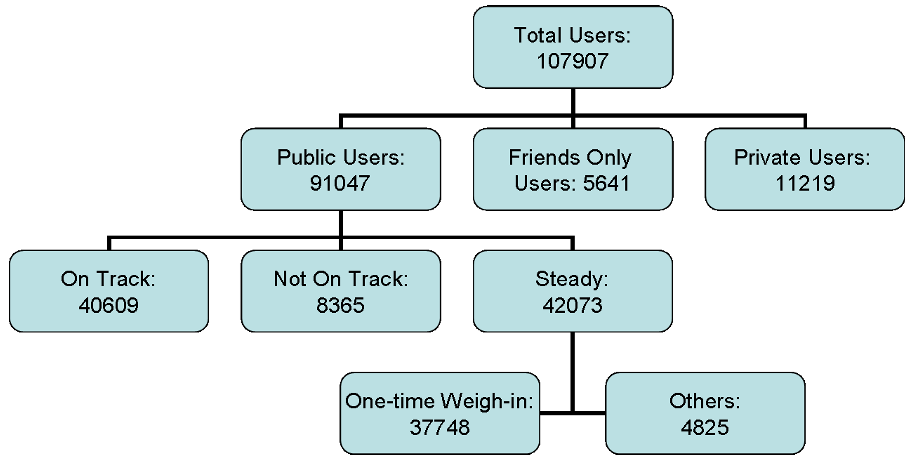 Figure 1: Classification of FatSecret users based on sharing preferences and weight goals.
Key Insights: Why Your Online Circle Matters
The Power of "Weighing In"
There is a direct, linear correlation between the frequency of weigh-ins and the Achieved Goal Percentage (AGP). Users who record their weight more often are significantly more likely to reach their targets. This confirms the psychological "awareness effect"—the more you measure, the more you manage.
Social Contagion and the 4-Degree Ripple
The most striking finding is the propagation distance. In real-world networks, health influences usually stop at three degrees of separation. In the FatSecret OSN, however, the influence reaches four degrees.
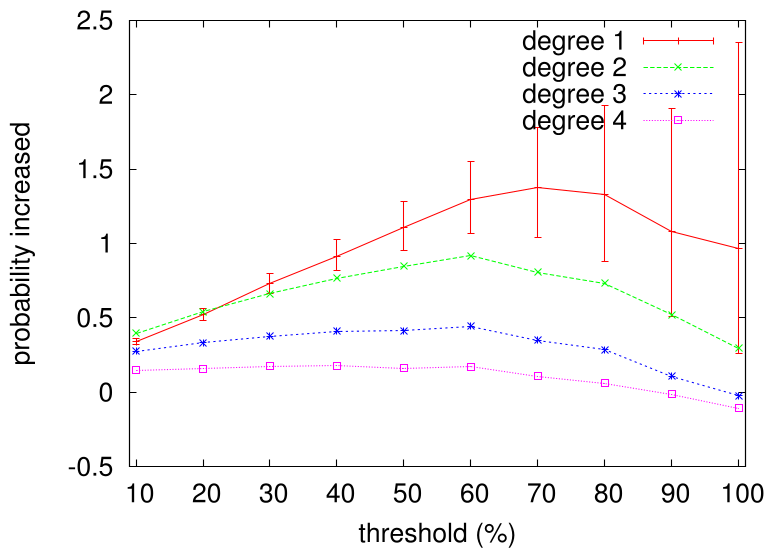 Figure 2: Probability of success based on social distance (Degree 1 to Degree 5).
When the "success threshold" is set high (e.g., 60% of goal achieved), the probability of a user succeeding is 106% higher if their direct friend is also successful compared to a random synthetic network. This suggests that online health communities are "denser" in terms of shared goals and mutual motivation than general real-world acquaintance networks.
Experimental Results: The Data Speaks
The researchers used logistic regression to prove that success is "contagious."
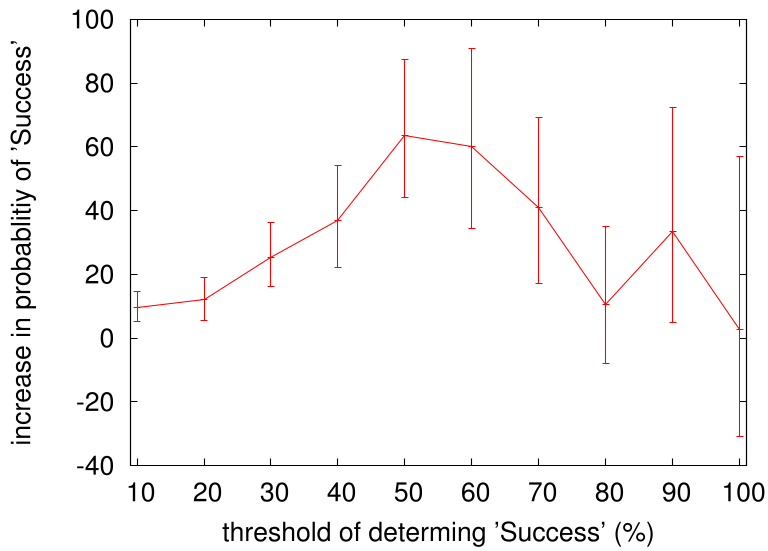 Figure 3: The likelihood of a user becoming successful increases significantly as their friends cross the success threshold.
- SOTA Comparison: Unlike general bulletin boards (e.g., Maloney-Kichmar studies), this work quantified that having more than 8 friends leads to a plateau in benefits, possibly due to "information overload" or the inclusion of friends who do not actively participate.
- Correlation: Friends' start weights and current weights are highly correlated (Coefficent ~0.94), indicating that users tend to "flock" together with peers who share similar physiological profiles and goals.
Critical Analysis & Conclusion
Takeaway
The value of a Health OSN lies in its Social Capital. Knowledge sharing and mutual accountability are the primary engines of behavioral change. For developers and researchers, the message is clear: To improve health outcomes, don't just build a better tracker—build a better community.
Limitations & Future Work
The study relies on self-reported weight, which may be subject to bias (users might not report setbacks). Future systems should integrate with IoT devices (Internet-connected scales) to eliminate manual entry friction and reporting bias. Furthermore, the interplay between different health behaviors (e.g., smoking or sleep) and weight in an OSN context remains an open area for multi-modal analysis.
Final Thought: If you want to lose weight, find a friend who is already doing it. In the digital age, their success is statistically likely to become yours.