
Online Kron Reduction: A New Paradigm for Economical Microgrid Control
2609_Online Kron Reduction for Economical Frequency Control of Microgrids.
This paper proposes a distributed switched control system for microgrids that simultaneously achieves frequency regulation and economic dispatch (ED). The method introduces an online distributed Kron reduction mechanism to reconfigure the communication network, ensuring optimal power sharing and stability even when distributed generators (DGs) hit operational limits or are disconnected.
TL;DR
Researchers have developed a distributed switched control system that tackles two major challenges in microgrids: keeping the frequency stable (SFC) and keeping the costs low (ED). By utilizing a unique Online Kron Reduction strategy, the system can "rewire" its logic in real-time to bypass generators that hit their limits, ensuring the rest of the grid continues to operate at peak economic efficiency.
Problem & Motivation: The Conflict of Stability vs. Economy
In islanded microgrids, Droop Control is the industry standard because it doesn't require communication. However, it has two major flaws:
- It causes frequency to drop as load increases.
- It shares power proportionally, not economically (expensive generators work as hard as cheap ones).
While secondary controls exist to fix frequency, they rarely account for the Equal Incremental Cost (EIC) principle or physical line power flow limits. Most importantly, if a generator hits its maximum limit, it should logically "exit" the optimization pool. In standard consensus algorithms, a node hitting a limit can "stall" the entire network's progress.
Methodology: Distributed Online Kron Reduction
The core innovation lies in how the controller handles "Violated" modes (where a DG hits a power limit or a line is congested). Instead of just stopping the optimization, the system performs an Online Kron Reduction.
1. The Switched Logic
The controller monitors each DG. If a DG is "Normal," it participates in the consensus to equalize incremental costs. If it becomes "Violated," it switches to a mode where it injects a fixed power (Max/Min), and—critically—it acts as a data bridge.
2. Bypassing without Breaking
Using Kron reduction principles, the bypassed node passes the average of its neighbors' data through itself. This ensures that even if node 2 is "off-duty" economically, node 1 and node 3 can still communicate through it.

Fig 1: The proposed hierarchical structure shows how local measurements and neighbor data feed into the secondary frequency control (SFC) and economic dispatch (ED) logic.
Experiments & Results: Resilience Under Pressure
The authors tested their system using a 4-DG microgrid. The results proved the controller's versatility:
- Economic Dispatch: When load increased at , the system updated costs across all DGs to maintain the EIC principle.
- Constraint Management: When DG 2 reached its 20% overload limit, it successfully switched modes without destabilizing the frequency of other units.
- Physical Limits: The system successfully throttled DGs 3 and 4 to prevent power lines and from overheating.
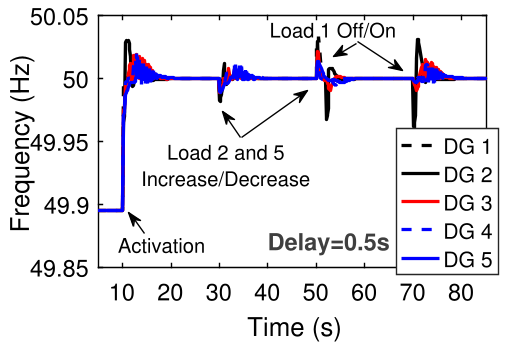
Fig 2: Simulation results showing (a) frequency restoration to 50Hz and (b) consensus of incremental costs () while respecting DG power limits.
A comparative study against existing SOTA (Fig 6 in the paper) showed that while other methods could restore frequency, they failed to respect line power flow constraints, often leading to unsafe operating conditions that the proposed Kron reduction method avoids.
Critical Insight: Beyond Simple Consensus
What makes this work stand out is the mathematical proof that the "bypassing" logic preserves the Spanning Tree of the communication graph. In network theory, if you lose a node, you might lose the path between other nodes. By using Kron reduction, the authors guarantee that the network remains "connected" in a mathematical sense, even when physical generators are constrained.
Limitations & Future Work
- Resistive Grids: The current work assumes inductive line impedances (common in high-voltage). Low-voltage resistive grids would require virtual impedance loops to decouple P and Q.
- Communication Delay: While tested up to 0.5s, extremely high-latency environments might require predictive compensation.
Conclusion
This paper elevates microgrid control from simple "stability maintenance" to "intelligent economic orchestration." The Online Kron Reduction is a powerful tool for any distributed system where agents might periodically reach physical capacity and need to step out of the collective optimization without breaking the chain.