
Harmonizing Social Media and Education: A Facebook-Integrated LMS Approach
An Implementation of Online Learning and Course Management System Based on Facebook
This paper presents a Facebook-based Online Learning and Course Management System (LMS) that integrates traditional academic administrative functions with social networking features. By utilizing the Facebook Graph API, the authors developed a platform that supports course registration, assignments, and real-time notifications within a familiar social ecosystem.
TL;DR
Current Learning Management Systems (LMS) are often silos of information that students find tedious to visit. This paper proposes a paradigm shift: instead of dragging students to a dedicated portal, why not bring the portal to where they already live? The authors implemented a course management system built entirely on the Facebook ecosystem, merging formal grading and assignments with the high-engagement notification loops of social media.
Problem & Motivation: The "Login Barrier"
Standard platforms like Moodle or Blackboard are functionally robust but experientially isolated. Research indicates that users often suffer from "system switching" fatigue, leading them to use an LMS only for the bare minimum requirements (like file uploads).
The authors' insight is grounded in the reality of the 2010s: with over 1.39 billion active users, Facebook became the de facto "Virtual Community." By building an LMS as a Facebook App, the researchers aimed to solve three specific pain points:
- Registration Friction: Eliminating the need for new credentials.
- Notification Lag: Leveraging Facebook’s real-time alerts to ensure students never miss a deadline.
- Fragmented Discussions: Bringing the casual interaction of social groups into a structured academic framework.
Methodology: The Architecture of Social E-Learning
The system was designed to be a bridge between the Facebook Graph API and a custom educational backend.
Core Components:
- Authentication: Uses Facebook's OAuth for seamless login.
- Interface Consistency: The UI is designed to mirror Facebook's own look and feel (CSS/JQuery) to minimize the cognitive load on the user.
- Data Strategy: Unlike traditional relational databases used by Moodle, this system employs MongoDB (NoSQL), which is better suited for the polymorphic and high-volume data structures typical of social interactions.
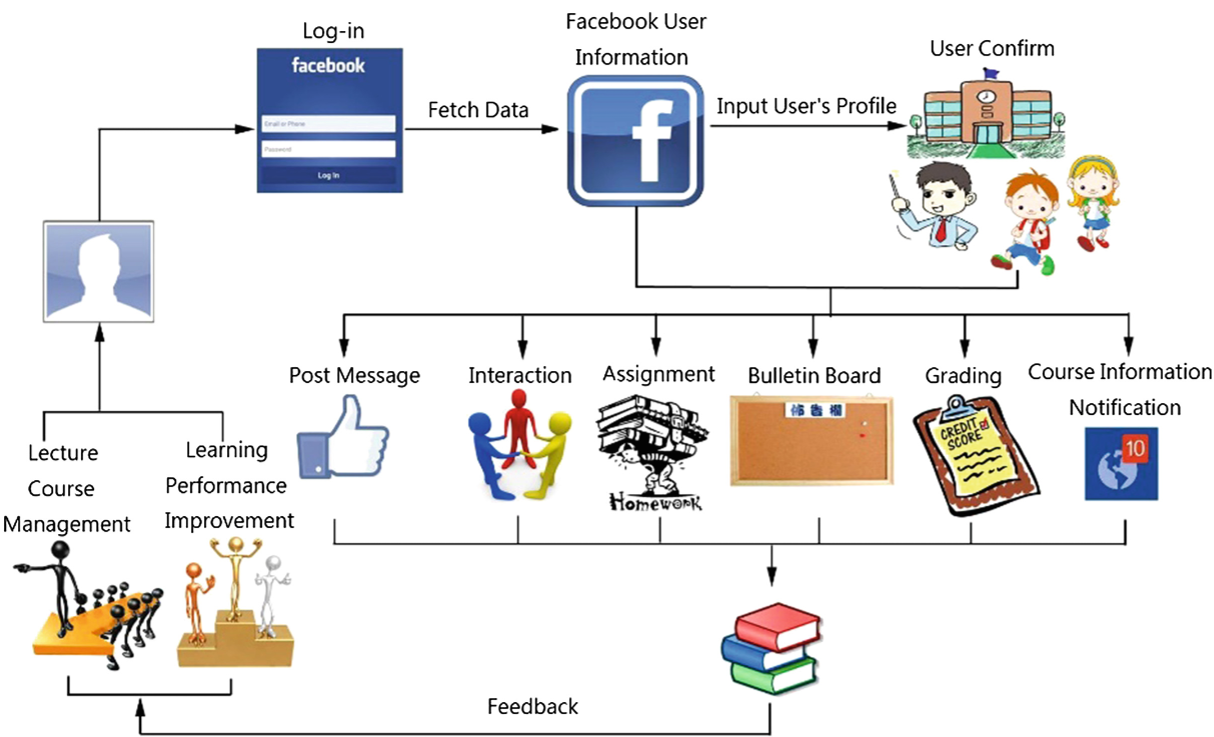 The architecture demonstrates a hybrid flow where user data is authorized via Facebook API, while course meta-data is managed by the application server.
Experiments & Functional Implementation
The implementation focuses on transforming social "Groups" into structured "Classrooms."
Key Features:
- Integrated Bulletin Boards: Announcements posted by lecturers trigger Facebook's native "Red Dot" notifications, significantly increasing the "open rate" of course updates.
- Submission Workflow: Supports three assignment types: plain text, Q&A, and file uploads.
- The Notification Loop: The authors highlight that "Type 1" notifications (pop-up alerts) and "Type 2" (world icon notifications) are the system's greatest strengths in maintaining student attention.
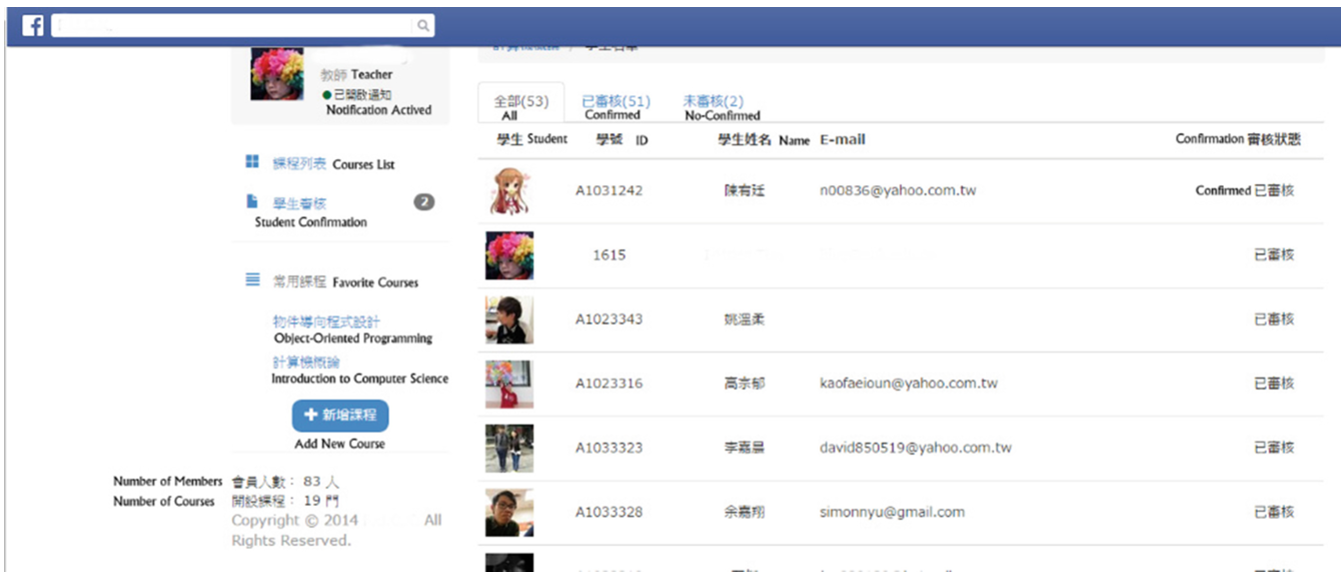 The main interface translates academic functions into the social layout, labeling users clearly as "Teacher" or "Student" within the social context.
Critical Analysis & Conclusion
Takeaway
This work serves as an important bridge in the evolution toward Cloud-learning. By lowering the barrier to entry, it successfully addresses the engagement gap found in traditional software.
Limitations
As a technical implementation paper, it lacks a large-scale longitudinal study on learning outcomes. Furthermore, the reliance on a third-party API (Facebook) introduces significant platform risk—if Facebook changes its API permissions (as it has done post-Cambridge Analytica), the entire LMS could become non-functional.
Future Outlook
The authors suggest that the goldmine of "access logs" collected by this system can eventually be used for User Behavior Analysis to predict student success. The logical next step for this research is the transition to mobile-first educational apps that utilize similar social psychology triggers to improve retention.