
GOMA: Revolutionizing Real-Time Task Allocation in Spatial Crowdsourcing
Online mobile Micro-Task Allocation in spatial crowdsourcing
This paper introduces Global Online Micro-task Allocation (GOMA), a framework for matching dynamic tasks and workers in spatial crowdsourcing. It proposes the TGOA and TGOA-Greedy algorithms, which achieve constant competitive ratios (1/4 and 1/8 respectively) under the Random Order Model, significantly outperforming adversarial-based baselines in real-world scenarios.
TL;DR
Spatial crowdsourcing (SC) platforms like Uber or Gigwalk face a daunting challenge: how to match tasks and workers when both appear sporadically and unpredictably. This paper formalizes the Global Online Micro-task Allocation (GOMA) problem and introduces the TGOA framework. By leveraging the Random Order Model (ROM), the authors move beyond pessimistic "worst-case" algorithms to provide high-utility matches with a guaranteed 1/4 competitive ratio.
The Shift from Offline to Two-Sided Online Matching
Traditional SC research operates in an "offline" bubble where we assume we know every task's location and every worker's shift in advance. In reality, a platform is a chaotic stream. Previous online attempts often simplified the problem by assuming workers are static and only tasks are dynamic.
The GOMA problem tackles the "Two-Sided Online" reality:
- Dynamic Arrival: Both tasks and workers arrive and vanish (deadlines) at any time.
- Immediate Decision: Matches must be made instantly without knowing future arrivals.
- Spatiotemporal Constraints: Workers have limited ranges and capacities.
Why "Worst-Case" Analysis Fails in the Real World
Most online algorithms are evaluated via the Adversarial Model, which assumes an "enemy" determines the arrival order to break your algorithm. While mathematically robust, this leads to overly cautious strategies (like the baseline Extended-Greedy-RT) that perform poorly in daily operations where arrivals are essentially random.
The Two-Phase Insight (Prophet Inequality & Secretary Problem)
The authors suggest that if we assume arrival orders are random, we can spend the first half of the timeframe "learning" the landscape.
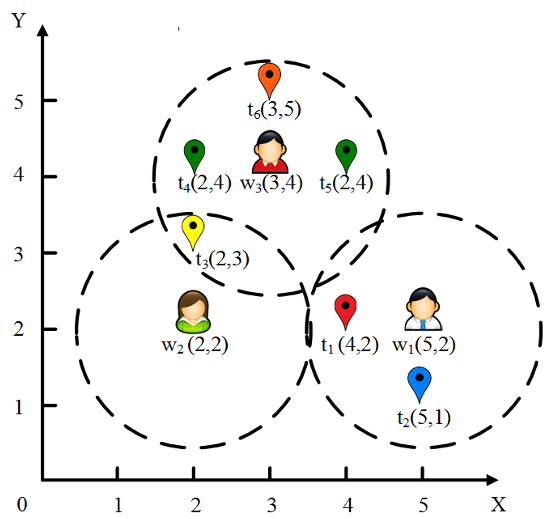 Fig 1: Spatial distribution of tasks and workers within restricted activity ranges.
Methodology: The TGOA Framework
The core contribution is the Two-phase-based Global Online Allocation (TGOA) algorithm. It splits the timeline into two parts:
- Phase 1 (Observation/Greedy): For the first arrivals (where is half the expected total), the system uses a standard greedy matching strategy. This establishes a baseline and utilizes early-arriving resources.
- Phase 2 (Optimization): For the remaining arrivals, the system doesn't just look for the best current match. It runs a "hypothetical" Global Optimal Match (using the Hungarian Algorithm) on all items seen so far. If the new arrival is part of the optimal set in this "hindsight" view, the match is executed.
Scaling Up: TGOA-Greedy
The Hungarian algorithm is computationally expensive (). To handle platforms with thousands of users, the authors proposed TGOA-Greedy, replacing the complex optimization with a faster greedy sort. While the theoretical competitive ratio drops from 1/4 to 1/8, the practical performance remains remarkably high while maintaining linear scalability.
Experimental Results
Testing on real-world data from gMission and EverySender, the TGOA algorithms consistently outperformed the baseline across several metrics:
- Utility: TGOA-based methods captured significantly more total value (Utility = Payoff × Worker Success Ratio).
- Response Time: Because TGOA avoids the "local optimum" trap, it actually matched tasks faster on average.
- Robustness: The performance edge held true across varying worker capacities () and search radii ().
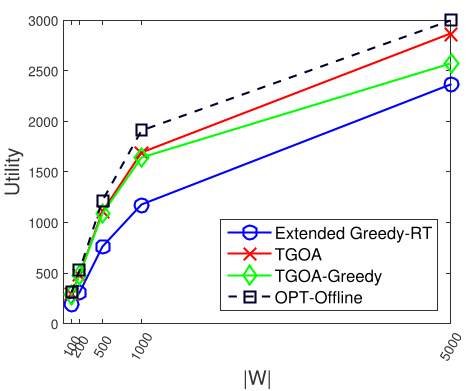 Fig 2: Utility and Efficiency comparison across different worker cardinalities.
Critical Analysis & Conclusion
Takeaway
The move from one-sided to two-sided online matching is a significant step toward making crowdsourcing research applicable to industry-scale platforms. The TGOA framework proves that "learning while doing" is a superior strategy for dynamic bipartite matching.
Limitations
- Prior Knowledge: TGOA relies on estimating the total number of arrivals () from historical data. In highly volatile or new markets, this estimation error could degrade the 1/4 competitive ratio.
- Invariable Constraint: The model assumes once matched, a pair cannot be "unmatched." Real-world systems like Uber often use "re-dispatching," which this model does not yet account for.
Future Work
The logical next step is integrating Machine Learning to predict the locations of future arrivals, rather than just assuming a random order, moving the field toward "Predictive Online Matching."