
Cultural Mirrors: Why Chinese Online Reviews Are More "True" Than American Ones
Do online reviews reflect a product’s true perceived quality? An investigation of online movie reviews across cultures
This research investigates whether online ratings accurately reflect a product's true perceived quality by comparing movie reviews across U.S. (individualist) and Chinese/Singaporean (collectivist) cultures. Using data from IMDB and Douban, the authors demonstrate that cultural dimensions significantly dictate the presence and severity of under-reporting bias in social networks.
TL;DR
Are online ratings a lie? In the United States, yes—they are often distorted by an "under-reporting bias" where only the loudest lovers and haters speak. However, this paper reveals that in collectivist cultures like China and Singapore, social norms of harmony and benevolence create a "bell-shaped" distribution that much more accurately reflects the silent majority's true opinion.
The Problem: The Vocal Minority Distortion
For years, E-commerce researchers have warned about the Under-Reporting Bias. In a typical Western context (like Amazon or IMDB), the rating distribution is U-shaped: you see plenty of 1-star rants and 5-star raves, but very few 3-star "it was okay" reviews.
The authors argue that this makes the "Average Rating" a biased estimator. If only extremists talk, the average doesn't represent the population; it represents the conflict between two small, loud groups. The core question of this paper is: Is this a human universal, or just a Western cultural byproduct?
Methodology: Crossing the Individualist-Collectivist Divide
The researchers utilized a dual-track approach:
- Big Data Analysis: They scraped thousands of movie reviews from IMDB (U.S.) and Douban (China).
- Experimental Validation: They conducted surveys with students in Singapore and China to capture the "silent" opinions—the ratings people would give if they were forced to rate every movie they watched.
They mapped these findings against Hofstede’s Cultural Dimensions, focusing on:
- Individualism vs. Collectivism: Do you value self-expression (U.S.) or group harmony (China)?
- Long-term Orientation: Does the Confucian ethic of benevolence make you less "harsh" on bad products?
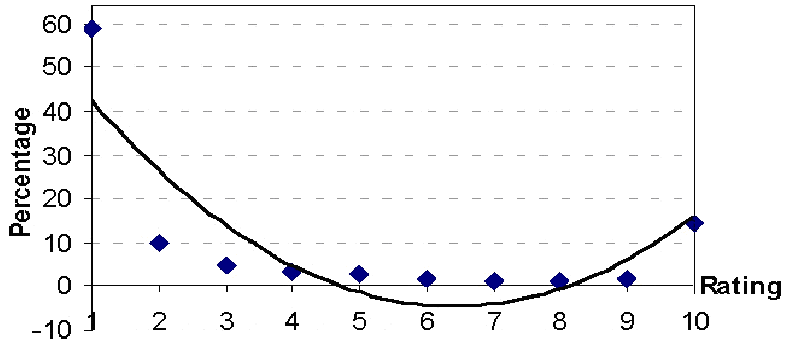 Figure: The U-shaped distribution of IMDB (left) vs. the Bell-shaped distribution of Douban (right).
Key Insights: Why the Curves Differ
1. The Pull of the Consensus
The study found that Chinese reviewers are heavily influenced by the "social norm" of the existing average. If a movie has a certain rating, new Chinese reviewers tend to stay within that boundary. Conversely, U.S. reviewers—especially when dissatisfied—intentionally push outside the boundary to signal their individualistic dissent.
2. The "Benevolence" Factor
In the "Bottom 100" movie category, the difference was staggering.
- IMDB (U.S.): Exploded with 1-star reviews. Americans are more than happy to "punish" a bad movie publicly.
- Douban (China): Maintained a unimodal (normal) distribution. Chinese reviewers were more "generous," avoiding extreme vitriol even for poor-quality films to maintain social harmony.
3. The Singapore "Hybrid" Case
Singapore served as a fascinating middle ground. Despite being highly Westernized in education, Singaporean students still exhibited the collectivist "bell-curve" reporting behavior, suggesting that deeply rooted Eastern values of "avoiding extremes" outweigh Western individualist influence in public forums.
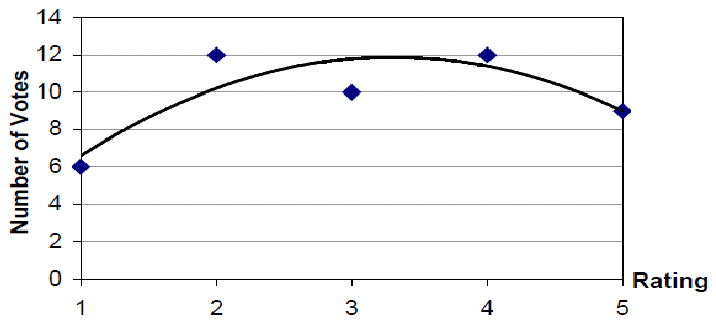 Figure: Experimental survey results proving that when the "silent" majority speaks in China, the curve remains normal.
Critical Analysis & Conclusion
The takeaway for global businesses is profound: A 3.5-star rating in China might mean the same thing as a 2.5-star rating in the U.S.
Takeaways:
- Trust the Bell, Question the U: If you see a bell curve, the average is likely "true." If you see a U-curve, it’s a battle of extremes.
- Marketing Interpretation: Film distributors might under-estimate the U.S. market because of a few "vicious" reviewers, or over-estimate the Chinese market because reviewers are too "polite" to tank a movie completely.
Limitations:
The study relies heavily on student populations for its experimental phase. Future work should investigate if these cultural traits persist across older demographics and different product categories (like high-stakes electronics vs. low-stakes movies).
In summary: Our culture dictates not just what we think, but if we choose to speak at all. In the West, we speak to stand out; in the East, we speak to belong.