
LIME: Bridging the Gap Between Multi-Armed Bandits and Real-World Crowdsourcing
Online Pricing for Mobile Crowdsourcing with Multi-Minded Users
This paper introduces LIME, an online posted-pricing mechanism designed for mobile crowdsourcing with multi-minded users. Unlike traditional "all-or-nothing" models, LIME addresses users with heterogeneous costs across various tasks, achieving a logarithmic regret bound of O(ln W) relative to the optimal Bayesian utility.
TL;DR
The paper introduces LIME (onLine prIcing for Multi-minded usErs), the first online incentive mechanism for mobile crowdsourcing (MC) that handles users with diverse task preferences and unknown cost distributions. By framing the problem as a novel variation of the Multi-Armed Bandit (MAB) problem, the authors achieve logarithmic regret while ensuring the system remains truthful and budget-feasible.
Background & Motivation: Moving Beyond "Single-Minded" Users
Most academic models for crowdsourcing assume a "single-minded" user: someone who looks at a bundle of tasks and says, "I'll do all of these for $X, or I'll do none of them."
In reality, platforms like Amazon Mechanical Turk (AMT) prove users are far more granular. A user might be willing to label an image for 0.50 because the latter requires more effort or specific hardware. This is Multi-Mindedness. Furthermore, task owners usually don't know the "market price" (cost distribution) in advance and must learn it on the fly while staying within a strict budget.
Methodology: The DSMKR Framework
The authors identify a unique technical challenge they call the DSMKR (Dummy Semi-Bandits with Multiple Knapsacks and Random Costs) problem.
1. The Multi-Armed Bandit Analogy
In LIME, every possible price for every type of task is treated as an "arm."
- Semi-Bandit: Multiple prices (arms) must be chosen simultaneously for each arriving user.
- Dummy Arms: If a user isn't interested in a specific task type (due to limited battery or skill), the task owner gets zero feedback—the arm is "dummy" for that round.
- Random Costs: The actual cost is a hidden variable sampled from an unknown distribution.
2. High-Efficiency Pricing (Algorithm 2)
Selecting the optimal price vector from thousands of combinations is computationally expensive (). LIME utilizes a specialized algorithm to solve a non-linear fractional optimization problem in time, making it practical for real-time mobile applications.
 Figure 1: The core index formula used to balance exploration of prices vs. exploitation of known low-cost users.
Experiments & Results
The researchers compared LIME against two state-of-the-art adaptations: CUCB (Combinatorial Upper Confidence Bound) and UCB-Simplex.
- Utility Lead: LIME consistently achieved higher total utility because it explicitly accounts for the budget constraint (), whereas CUCB often exhausts the budget too early by overpaying.
- Regret Growth: As the budget () grows, LIME’s regret increases only logarithmically, while the baselines show linear regret growth—meaning LIME gets "smarter" faster as more users interact with the system.
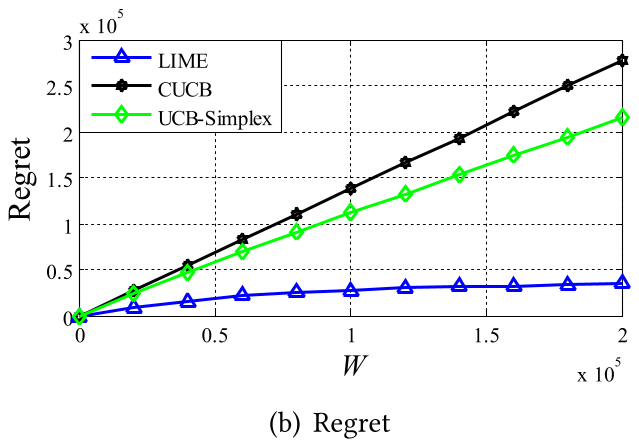 Figure 2: Regret comparison showing LIME's superior efficiency over budget-blind and structure-blind benchmarks.
Critical Insight: Why LIME Works
The "magic" of LIME lies in its Cost-Performance Ratio index. Rather than just looking for the cheapest users (high cost-efficiency) or the most tasks (high utility), LIME dynamically adjusts its confidence intervals based on how many "meaningful" (non-dummy) samples it has collected for each task-price pair. This prevents the "starvation" of exploration for rare task types.
Conclusion & Future Outlook
LIME represents a significant step toward making crowdsourcing theory match the "messiness" of human behavior. By proving that you can learn a market's cost structure without prior data—and while preserving user truthfulness—the authors provide a blueprint for autonomous, budget-aware procurement systems.
Future work could extend this toward dependent task costs, where performing Task A might lower the marginal cost of performing Task B (e.g., if both tasks are at the same geographic location).