
LIME: Mastering Online Pricing for Multi-Minded Crowdsourcing Users
Online Pricing for Mobile Crowdsourcing with Multi-Minded Users
This paper introduces LIME, an online posted-pricing mechanism designed for Mobile Crowdsourcing (MC) featuring multi-minded users. It addresses the challenge of incentivizing users who have heterogeneous private costs for different tasks and arrive sequentially, achieving SOTA results in utility regret reduction.
Executive Summary
Mobile Crowdsourcing (MC) has evolved beyond simple "yes/no" participation. Modern platforms like Amazon Mechanical Turk (AMT) involve "multi-minded" users—individuals who pick and choose specific tasks based on individual price tags and their own shifting internal costs.
The paper "Online Pricing for Mobile Crowdsourcing with Multi-Minded Users" introduces LIME (onLine prIcing for Multi-minded usErs). It bridges the gap between theoretical mechanism design and practical crowdsourcing by abandoning unrealistic assumptions like "single-mindedness" or pre-known cost distributions. LIME is a groundbreaking approach that treats pricing as a complex bandit problem, achieving nearly optimal utility with a proven logarithmic regret.
The "Multi-Minded" Real-World Challenge
Traditional incentive mechanisms usually fall into two categories:
- Bidding-based: Users report costs, and the system decides. (High overhead, prone to manipulation).
- Single-Minded Pricing: Users are offered a bundle; they take all or nothing.
In reality, a user might be willing to "label an image" for 0.50 to "record a 1-minute audio clip." If the platform posts 0.30 respectively, the user will only perform the image task. Existing models fail because they don't account for this selective participation and the hidden costs associated with heterogeneous tasks.
Methodology: The DSMKR Framework
The authors identify that this isn't just a simple Multi-Armed Bandit (MAB) problem. They define it as DSMKR (Dummy Semi-Bandit with Multiple Knapsacks and Random Costs):
- Semi-Bandit: Multiple prices (arms) are set simultaneously for different task types.
- Dummy Arms: If a user isn't interested in a task (outside their "preference set"), the platform learns nothing about that specific cost—the arm is "dummy."
- Multiple Knapsacks: The platform has a limited total budget () and a limited number of users ().
High-Efficiency Algorithm: LIME
LIME uses an "Upper Confidence Bound" (UCB) style logic but applies it to the cost-performance ratio. The algorithm maintains empirical estimates of user costs () and preference probabilities ().
To solve the resulting non-linear optimization problem in real-time, the authors developed Algorithm 2, which reduces a potentially exponential search space into an efficient operation using fractional optimization techniques.
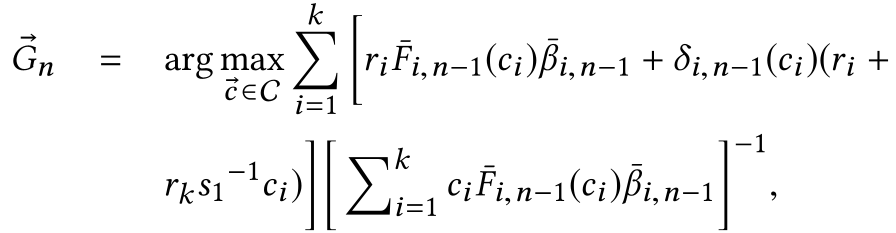 Figure 1: The core pricing selection formula balancing empirical utility and exploration bonuses.
Experiments: Proving the Regret Bound
The researchers tested LIME against standard MAB variations like CUCB (Combinatorial UCB) and UCB-Simplex.
Key Findings:
- Convergence: LIME's utility closely tracks the theoretical "OPT*" (the omniscient benchmark).
- Robustness: It maintains high performance regardless of whether user costs follow Gaussian, Uniform, or Exponential distributions.
- Regret Control: While baselines show linear regret growth (growing errors over time), LIME's regret growth slows down logarithmically as the budget increases.
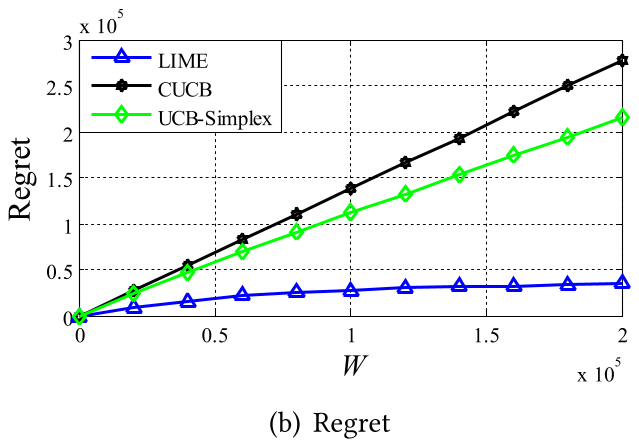 Figure 2: Performance evaluation showing LIME (solid line) consistently outperforming CUCB and UCB-Simplex.
Critical Insight & Conclusion
The genius of LIME lies in its bid-independence. Because prices are posted before users arrive, the mechanism is inherently truthful—users have no incentive to lie because their actions don't change the current price.
Takeaway for the Future: LIME isn't just for crowdsourcing. Any "procurement market" (where a central buyer tries to get services from diverse, strategic sellers)—be it in smart grids, data marketplaces, or ad-tech—can leverage this framework to maximize utility under a strict budget.
Limitations: The current model assumes a user's tasks are additive in utility. Future work could investigate "combinatorial preferences," where completing Task A makes Task B more or less valuable to the user.