
The Glass Office: How LinkedIn Profiles Leak Your Corporate DNA
A study of the online profile of enterprise users in professional social networks
This study investigates the transparency of corporate structures through professional social networks (PSNs). By analyzing 130 "Core IBMers" and their extended network of 40,000 LinkedIn profiles, the authors demonstrate that organizational hierarchies and internal roles can be accurately reconstructed using publicly available profile data.
TL;DR
A case study of 130 IBM employees reveals that professional social networks (PSNs) like LinkedIn are not just digital resumes—they are accidental blueprints of a company's internal hierarchy. By comparing public headlines with internal data, researchers found they could accurately identify managers, map reporting lines, and predict employee influence with high precision.
Background: The "Outside-In" Perspective
In the era of "Social Business," most companies focus on how they can use social media to reach out to customers. This paper flips the script, asking: what can someone looking in see? As employees naturally seek to boost their professional standing by detailing their roles, they often mirror the company's internal architecture, exposing the "bones" of the organization to competitors and analysts alike.
The Core Challenge: Self-Promotion vs. Corporate Secrecy
The fundamental tension lies in Motivation. An employee is incentivized to be as specific as possible (e.g., "Lead Architect for Project X") to attract recruiters. However, this specificity allows external observers to:
- Map specific projects to specific locations.
- Identify key decision-makers (managers) versus individual contributors.
- Estimate the scale of departments based on the density of connections.
Methodology: Bridging Public and Private Data
The team at Delft University of Technology and IBM used a "Seed and Crawl" approach. They started with 130 "Core IBMers" who granted API access, which bridged out to 40,000 users, including 9,000 IBM employees.
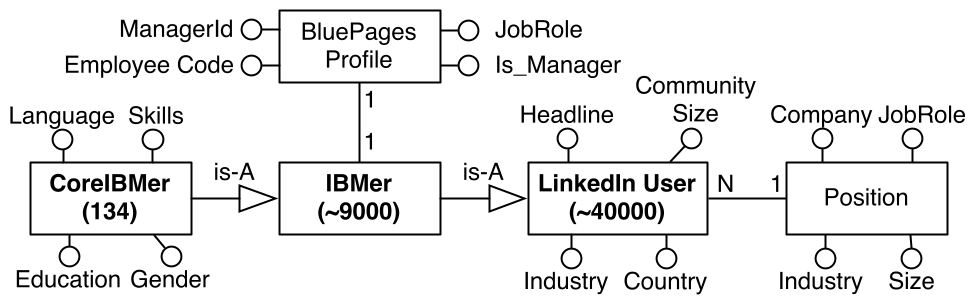 Figure 1: The researchers linked public LinkedIn entities with "BluePages" (IBM’s internal directory) to verify accuracy.
Key Findings 1: The "Headline" Honesty
The researchers manually categorized the similarity between public LinkedIn headlines and official internal job titles. The result?
- 75% were identical.
- 13% were semantically similar (e.g., generalized for the public).
- Only 12% were different, often because the employee used "captivating" or generic language (e.g., "Passionate provider of Competitive Advantage").
Key Findings 2: Manhunting (Identifying Managers)
Can you find the bosses? Yes. Through linguistic bigram analysis, the study showed clear "linguistic clusters." While the word "manager" is used frequently by everyone, specific terms like "Vice President," "Project Executive," and "Director" effectively isolated the management layer from the "IT Specialists" and "Architects."
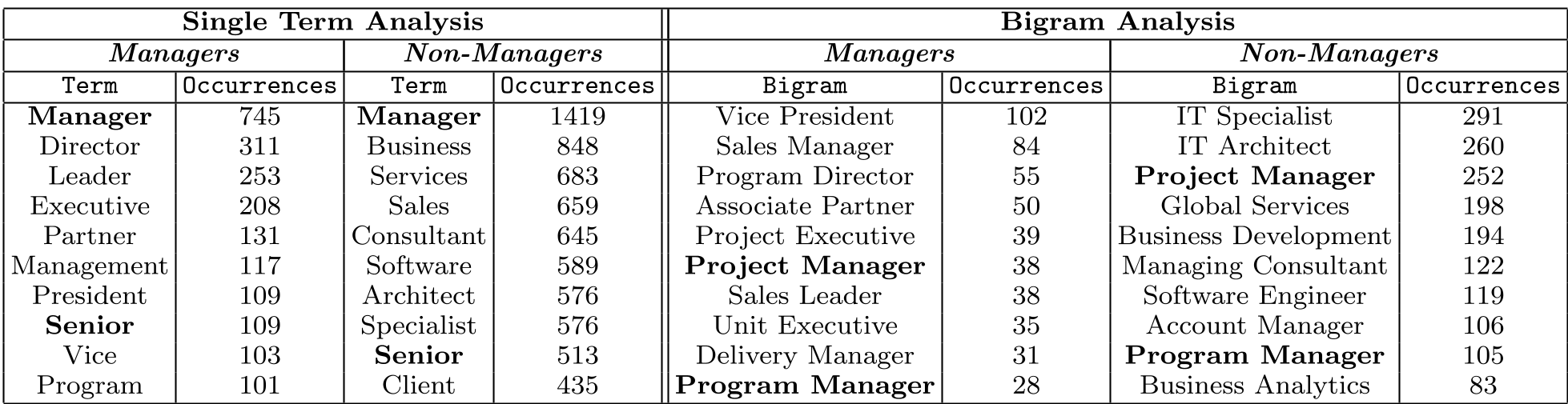 Table 2: Linguistic patterns that betray organizational rank.
The Dynamics of Influence (Social Reach)
The paper introduces a fascinating metric: Social Reach. They found that an employee's number of connections isn't just about how "social" they are; it's a reflection of their position in the corporate web.
- The Manager Multiplier: Managers generally have larger networks and are more likely to be connected to the "Manager’s Manager."
- Skip-Level Power: Employees connected to both their direct boss and their boss's boss had a significantly larger average community size (633 connections) compared to those who weren't (327 connections).
 Table 6: How vertical internal connections correlate with broader external reach.
Critical Analysis & Takeaways
Why this matters for Competitive Intelligence
If a competitor can map 75% of your internal roles and identify your "High-Reach" influencers just by scraping LinkedIn, your "Secret Projects" are rarely secret. The study proves that organizational hierarchy is leaking through individual social behavior.
Limitations
The study is focused on IBM, a tech giant with a specific culture of social media usage. Results might vary in more secretive industries (like Defense) or in different cultural contexts (e.g., East Asia vs. Western Europe). Furthermore, LinkedIn's API restrictions have tightened since this 2014 study, though the data remains public to any browser.
Final Word
Companies shouldn't necessarily block LinkedIn, but they must realize that their employees’ online profiles collectively form a distributed organizational chart. Understanding this "outside-in" view is essential for modern business intelligence and cybersecurity.