
[MIT Research] ORCA: Why Static Calibration Fails LLM Reasoning—and How Test-Time Training Fixes It
Online Reasoning Calibration: Test-Time Training Enables Generalizable Conformal LLM Reasoning
The paper introduces Online Reasoning Calibration (ORCA), a framework that combines Test-Time Training (TTT) with Conformal Prediction to adaptively scale LLM reasoning compute. By meta-learning a calibration probe that updates its weights online during a single reasoning chain, ORCA achieves SOTA efficiency, saving up to 67% of compute on OOD MATH tasks while maintaining strict risk guarantees.
Executive Summary
TL;DR: MIT researchers have unveiled Online Reasoning Calibration (ORCA), a framework that allows Large Language Models to "sense" when they have reached a correct answer and stop thinking. By embedding a Test-Time Training (TTT) loop within the calibration process, ORCA adapts to specific reasoning patterns in real-time, slashing compute costs by up to 67% while providing rigorous statistical guarantees on accuracy.
Background: Within the landscape of "Reasoning Models" (like DeepSeek-R1 or OpenAI's o1), scaling test-time compute is the standard for solving complex math and code. However, models often overthink "easy" problems or fail to recognize shifts in prompt distributions. ORCA moves calibration from a static post-processing step to a dynamic, meta-learned inference process.
The Core Insight: From Static to Dynamic "Stopping Power"
Current state-of-the-art methods typically use a static probe to estimate confidence. These probes are trained once and fixed. The problem? Reasoning is a moving target. A pattern that signals success in a 10-step math problem looks completely different from one in a 100-step software engineering task.
ORCA’s breakthrough is treating calibration itself as a learning problem during inference. It introduces a bi-level optimization:
- Inner Loop (Inference): The probe updates its own "fast weights" for every new reasoning step, adapting to the current problem's unique hidden state.
- Outer Loop (Meta-Training): The probe learns "slow weights" (initialization and feature projections) that allow it to learn efficiently across different domains.
Methodology: How ORCA Works
ORCA utilizes a "Score-then-Update" protocol. At each reasoning step , it extracts the LLM's hidden state .
1. The Adaptive Architecture
The probe employs two variants:
- No-QK: A simple linear probe updating in the full embedding space.
- QK Variant: Uses learned projections () to focus on specific dimensions of the hidden state before updating.
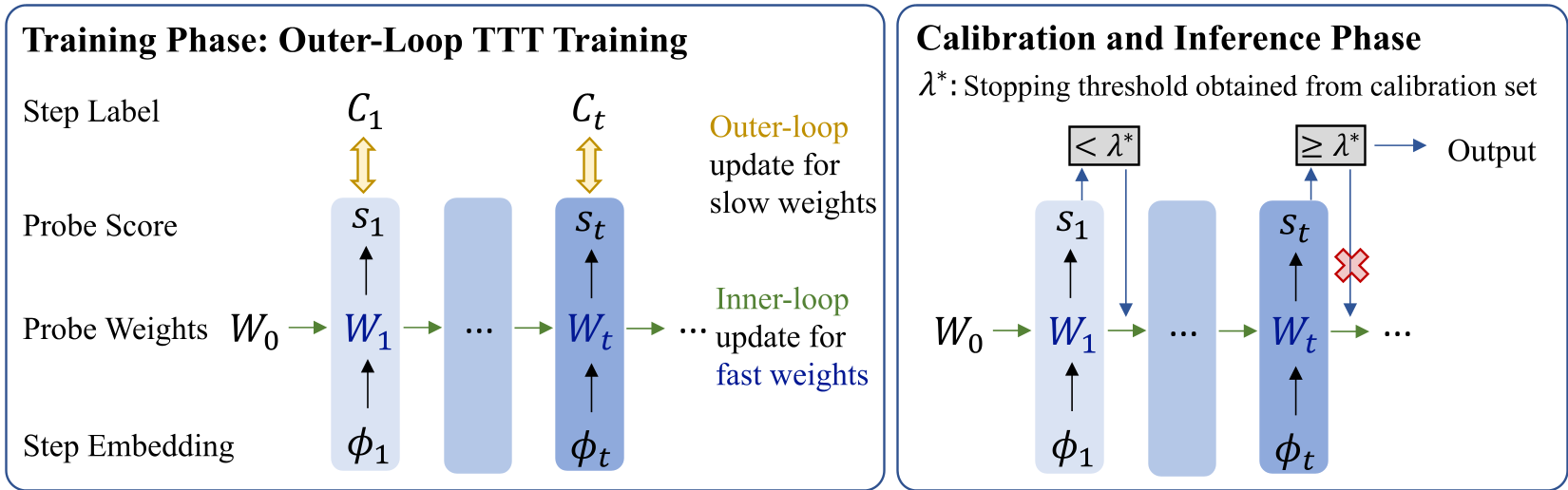 Figure 1: The ORCA architecture showing the meta-training (outer) and online-adaptation (inner) loops.
2. Risk-Controlled Early Stopping
To ensure the model doesn't stop too early (leading to errors), ORCA uses Learn-then-Test (LTT). It calibrates a threshold on a held-out set such that the probability of the error rate exceeding a risk level is strictly bounded (e.g., ).
Experimental Results: Efficiency Meets Robustness
The most striking result is ORCA's performance under Out-of-Distribution (OOD) shifts. While static probes degrade when faced with unfamiliar subject matter, ORCA’s TTT mechanism allows it to generalize.
- MATH-500 Achievement: ORCA improved compute savings from 24.8% (static baseline) to 67.0% while maintaining the target error rate.
- Cross-Model Stability: The benefits held steady across Qwen2.5-32B, QwQ-32B, and Llama-3.3-70B.
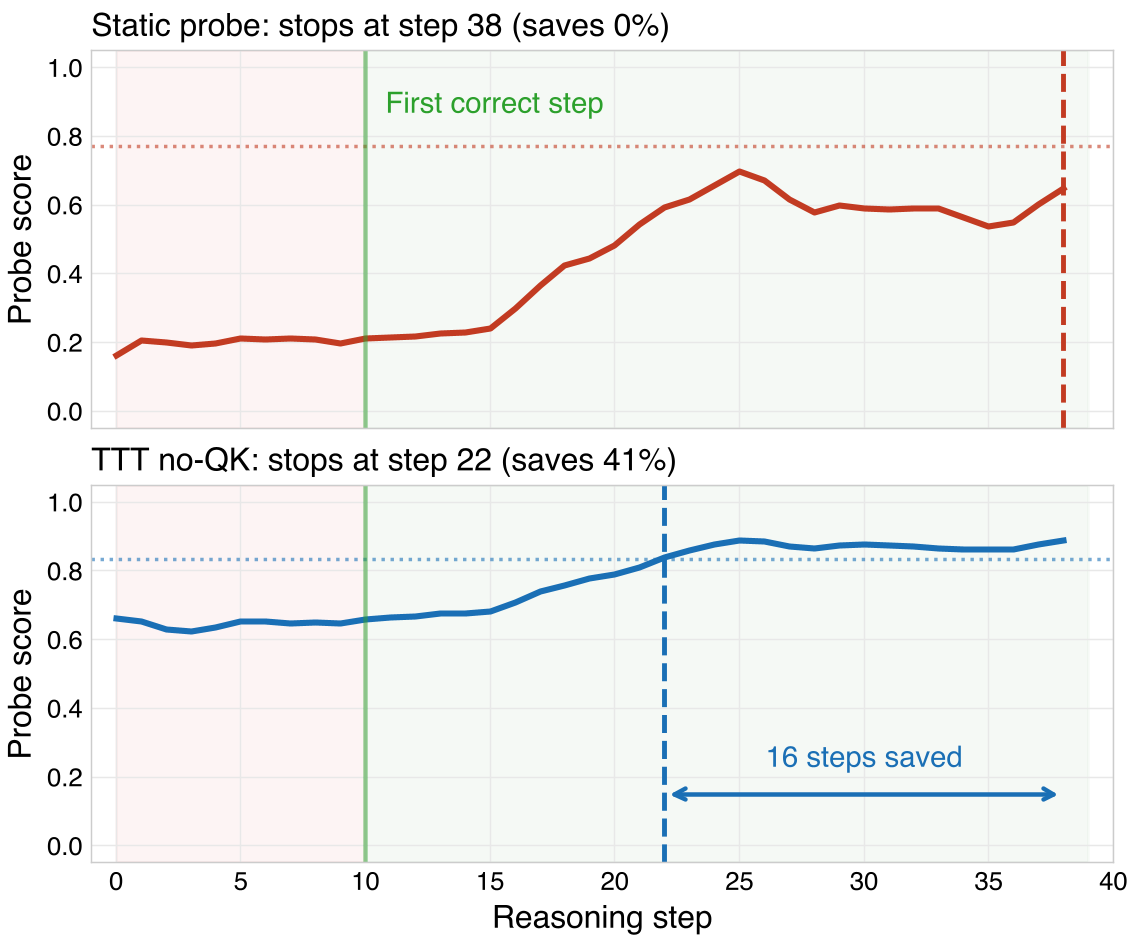 Figure 2: Score trajectories showing the "Static Probe" failing to reach the threshold, while the "TTT Probe" (ORCA) successfully identifies the breakthrough point and stops early.
Deep Insight: Why Does It Work?
ORCA acts as an implicit novelty detector. By training the inner loop to adapt to "pre-transition" (incorrect) reasoning steps, the probe becomes very good at identifying what a "wrong" path looks like for a specific problem. When a "reasoning breakthrough" happens—an actual correct insight—the hidden state shifts significantly. Because the probe was adapted to the "wrong" patterns, this breakthrough appears as a high-confidence "novelty," triggering an early stop.
Conclusion and Future Outlook
ORCA represents a fundamental shift in how we think about LLM "thinking." Instead of blindly scaling tokens, we should scale adaptive intelligence. The integration of meta-learning with conformal risk control provides a blueprint for future reasoning agents that are both efficient and statistically reliable.
Limitations: The framework currently relies on hidden states from the base LLM. If the base model's internal representations are severely uninformative for a given task, the probe's adaptation will suffer. Future work may explore updating the base LLM weights themselves during reasoning.