
The Digital Mirror: How Attachment and Personality Shape the SNS Behaviors of Chinese Youth
Online social networking behaviors among Chinese younger and older adolescent: The influences of age, gender, personality, and attachment styles
This study investigates the online social networking behaviors of 531 Chinese adolescents on Renren (a Facebook-like SNS). Using Exploratory Factor Analysis (EFA) and Structural Equation Modeling (SEM), the research identifies three core behavioral dimensions—utilization, socializing, and privacy disclosure—and examines how they are influenced by developmental factors.
TL;DR
Social Networking Sites (SNSs) are the modern "arenas" where adolescents forge their identities. This study zooms in on Chinese youth using Renren, revealing that their online lives are governed by a complex interplay of age, gender, personality, and attachment styles. The most striking finding? A massive gap in privacy awareness compared to Western peers and the profound influence of internal "attachment security" on how much a teen reveals to the digital world.
Background: The Renren Context
In the early-to-mid 2010s, Renren was the "Facebook of China." For adolescents aged 10–19, it was the primary platform for peer approval and identity construction. However, this digital migration brought risks: sexual advances, aggression, and privacy leaks. This study seeks to understand why some teens are more vulnerable than others.
Problem & Motivation: Beyond "One Size Fits All"
Most existing research focuses on adults or Western samples. Adolescence is a unique life phase where social determinants change rapidly. The authors hypothesized that online behaviors aren't just random acts but are reflections of offline developmental patterns. They specifically questioned if the trade-off—sharing more to gain more social utility—is mediated by a teen's psychological "hard-wiring."
Methodology: Mapping the Behavioral Latent Space
The researchers didn't just use standard scales; they started with unstructured interviews to capture the "slang" and real-world habits of Beijing middle schoolers.
The Three-Factor Model
Through Factor Analysis, they identified three distinct types of SNS behavior:
- Utilization: Frequency of use, checking profiles, and updating status.
- Socializing: Developing real-life relations with online contacts and following peer events.
- Privacy Disclosure: The degree to which a user opens their profile, albums, and logs to the public.
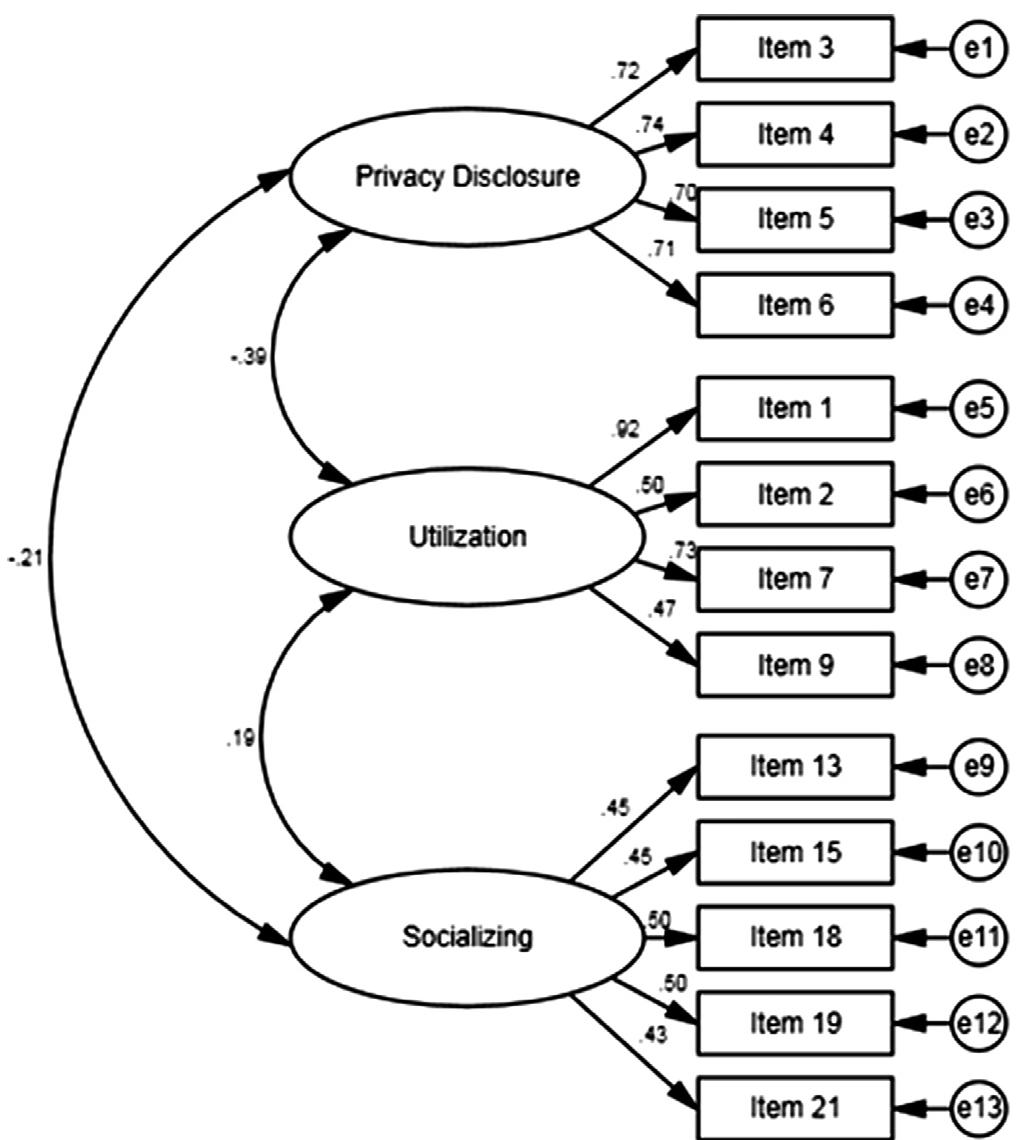 Fig 1. The structural equation model showing the negative correlation between utilization/socializing and privacy disclosure.
Key Findings: The "Insecure" Disclosure Gap
The study produced several counter-intuitive results that challenge global assumptions:
- The Attachment Factor: This is perhaps the most critical insight. Insecurely attached adolescents disclosed significantly more personal information than their securely attached peers. Why? They likely use the digital space to compensate for offline social anxieties, seeking "addictive" levels of online validation at the cost of their privacy.
- Age Matters (But Not How You Think): Junior students were actually more likely to socialize with strangers than senior students. Older teens used the site more efficiently (Utilization) but were more selective about their intimacy.
- The Gender Paradox: Unlike Western studies where girls disclose more, Chinese girls in this study disclosed less than boys, suggesting cultural expectations of "shyness or inhibition" translate to the digital realm.
 Table 1. Demographic breakdown of Renren usage, highlighting that over 70% of senior students post real names and photos.
Personality: Dimensions vs. Clusters
The study found that simply looking at "Extraversion" or "Neuroticism" scores (dimensions) didn't tell the whole story for Chinese youth. Instead, the authors used K-medoids clustering to identify "types" of personalities. They found that in a collectivist culture, personality traits are often overlapped and homogenous, styled by a unified education system.
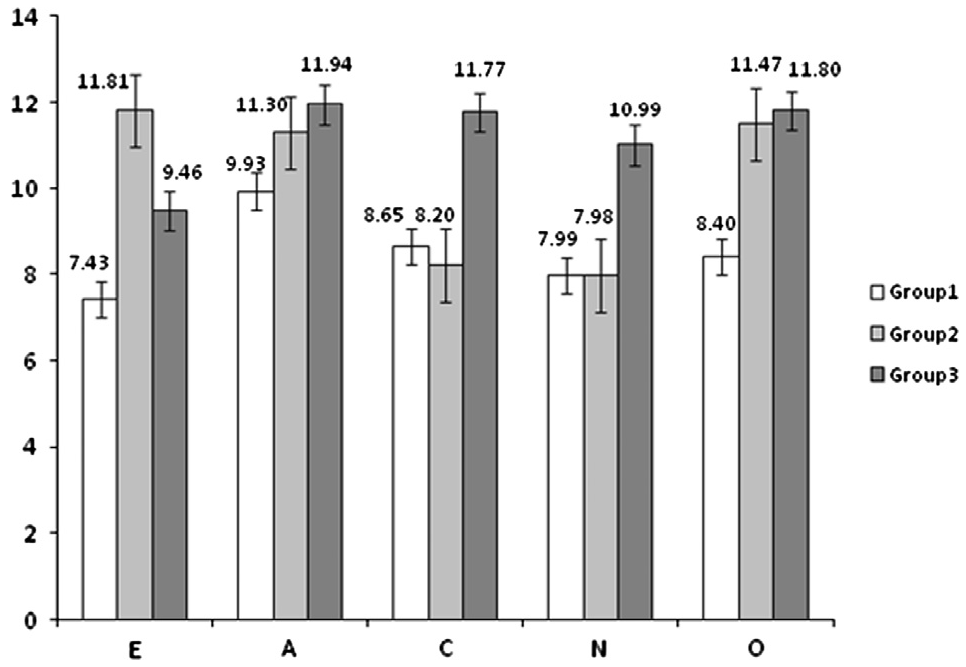 Fig 3. Visualization of the five-factor personality scores across three identified adolescent clusters.
Critical Insight & Conclusion
This paper serves as a wake-up call for digital education in China. The "alarmingly high" rates of real-name and photo disclosure suggest that adolescents view SNSs as "walled gardens" when they are actually "open stages."
Takeaway for Practitioners:
- Safety Education: Focus on younger adolescents (Junior High) who are most likely to bridge the gap between "online strangers" and "offline meetings."
- Psychological Screening: SNS behaviors can be a diagnostic tool. Extreme over-sharing or "socializing" with strangers may be a red flag for underlying attachment issues or an insecure home environment.
- Cultural Sensitivity: Western models of "Individualism" don't perfectly map onto Chinese digital behaviors. Personality is "smoother" and more influenced by group solidarity in this context.
Limitations: The study relies on self-reported data from 2014. In the age of TikTok (Douyin) and AI-driven algorithms, the "Utilization" factor has likely evolved from manual profile-checking to passive consumption, which warrants further research into "Algorithm-Induced Disclosure."