
Digital Kinship: How Facebook Data Unlocks the Dynamics of High-Risk HIV Networks
The potential of online social networking data for augmenting the study of high-risk personal networks among young men who have sex with men at-risk for HIV
This study investigates the use of Facebook data to augment the longitudinal study of high-risk personal networks among young Black men who have sex with men (YBMSM) in terms of HIV risk. By integrating digitally archived social networking data with traditional self-reported (confidant and sexual) networks, it achieves a cross-domain analysis of relational stability.
TL;DR
Researchers from the University of Chicago successfully linked traditional "offline" survey data with Facebook friendship networks among young Black men who have sex with men (YBMSM). While online activity levels don't predict sexual risk behavior directly, the study discovered that Facebook "friendship" serves as a survival signal for relationships: confidants who are connected online are significantly more likely to remain in a person's life over time.
Background: The Invisible Network
In the fight against HIV, understanding who is in a person's circle is vital, but how long they stay there is even more critical. High network turnover is a known driver of HIV risk. However, traditional methods—simply asking people to list their friends—are plagued by "satisficing" and forgetting. Digital footprints on Social Networking Sites (SNS) offer a potential "gold standard" for real-time network tracking.
Methodology: Bridging the Digital Divide
The researchers combined longitudinal survey data (collecting names of confidants and sex partners) with API data from Facebook. The core challenge was Entity Resolution: matching a handwritten or spoken name like "AJ" or "John Smith" to a specific digital profile.
The Entity Resolution Pipeline:
- Phonetic Matching: Using metaphones to account for spelling variations.
- String Similarity: Normalized Levenshtein distance to calculate the "closeness" of names.
- Contextual Scoring: Grading matches based on shared city, age, and sex.
Key Insights: Why Online Ties Matter
The study’s most provocative finding isn’t about "what" people do online, but rather the structural durability of digital ties.
1. Multiplexity equals Stability
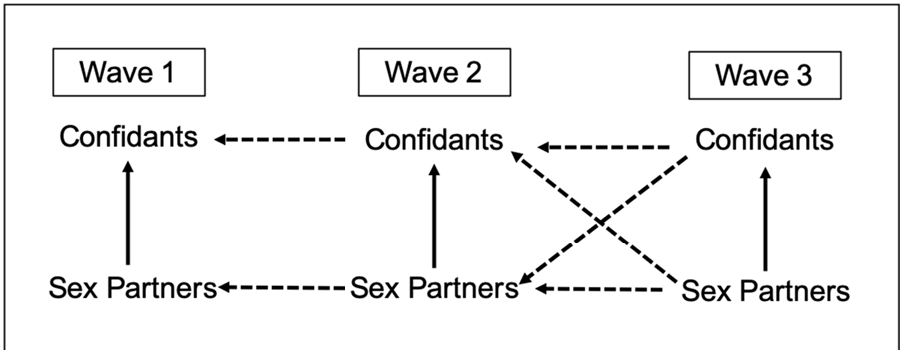
If a confidant appears in both your "real world" list and your Facebook friends list, they are statistically more likely to be there a year later. This is described as Relational Multiplexity: when a relationship spans multiple contexts (e.g., family, sex, and digital friends), it is harder for that tie to decay.
2. The Orthogonal Nature of Online/Offline Stability
Surprisingly, having thousands of Facebook friends does not mean your sexual network is unstable. The "churn" in your digital list (unfriending/adding) operates on completely different logic than the "churn" in your sex life. Therefore, digital data cannot replace traditional interviews—but it can augment them.
Limitations and Ethical Considerations
The authors acknowledge significant hurdles:
- The "Pseudonym" Problem: In the Ballroom community (an elective kinship system for LGBTQ African Americans), individuals often use "House Names" on Facebook, making entity resolution difficult.
- API Restrictions: Since the data collection, platforms like Facebook have restricted API access, necessitating new "manual data download" approaches for researchers.
Conclusion: A New Tool for Public Health
The future of HIV prevention may lie in SNS-enhanced network testing. By using digital friend lists as memory aids during clinical visits, healthcare providers can identify a broader range of "at-risk" associates who might otherwise be forgotten. This study proves that while our online and offline worlds are distinct, the digital threads between them are surprisingly strong indicators of our social stability.
Takeaway for Researchers
Don't look at Facebook metrics as a proxy for risk behavior. Instead, look at the overlapping ties as a map of the "core" network that remains stable during life transitions.