
Beyond the Census: Using Social Networks to Map the Digital Economy
Online Social Networks Analysis for Digitalization Evaluation
This paper explores the utility of Online Social Networks (OSNs), specifically VKontakte (VK), as a proxy for evaluating regional digitalization levels. By analyzing user distribution via API and comparing it with official Rosstat census data, the study demonstrates that OSN metrics can serve as high-frequency, large-sample sub-indicators for digital economy indices.
TL;DR
Is the official census the best way to measure a country's digital maturity? This research argues that Online Social Networks (OSNs) like VKontakte provide a more immediate and granular view of digitalization than traditional government statistics. By correlating account density with regional populations, the authors provide a framework for real-time digital economy monitoring.
Context: The Lag of "Analog" Statistics
Traditional digitalization indices, such as the ITU's ICT Development Index (IDI) or the UN's E-government rankings, are often based on "hard" infrastructure data (e.g., number of fixed telephone lines or broadband subscriptions). However, digitalization today is less about access and more about usage—what the authors call "secondary digitalization."
The problem with official data, like that from Russia's Rosstat, is twofold:
- Latency: Data is often 1 to 3 years old by the time it is published.
- Granularity: Surveys are based on selective samples rather than the total population.
Methodology: Tapping into the VK Ecosystem
The researchers focused on VKontakte (VK), the dominant OSN in the post-Soviet space, as their primary data source. They developed software to interact with the VK API to perform an "advanced search" across Russian cities and regions.
The Core Workflow:
- Data Extraction: Gathering account counts for specific geolocations via API.
- Normalization: Supplementing OSN counts with official population figures from the 2010 census and subsequent updates.
- Comparative Analysis: Using Pearson correlation to evaluate the reliability of OSN data as a surrogate for population-level activity.

Insights from the Data: The "Account-to-Resident" Paradox
The study revealed a fascinating discrepancy in the relationship between residents and digital accounts.
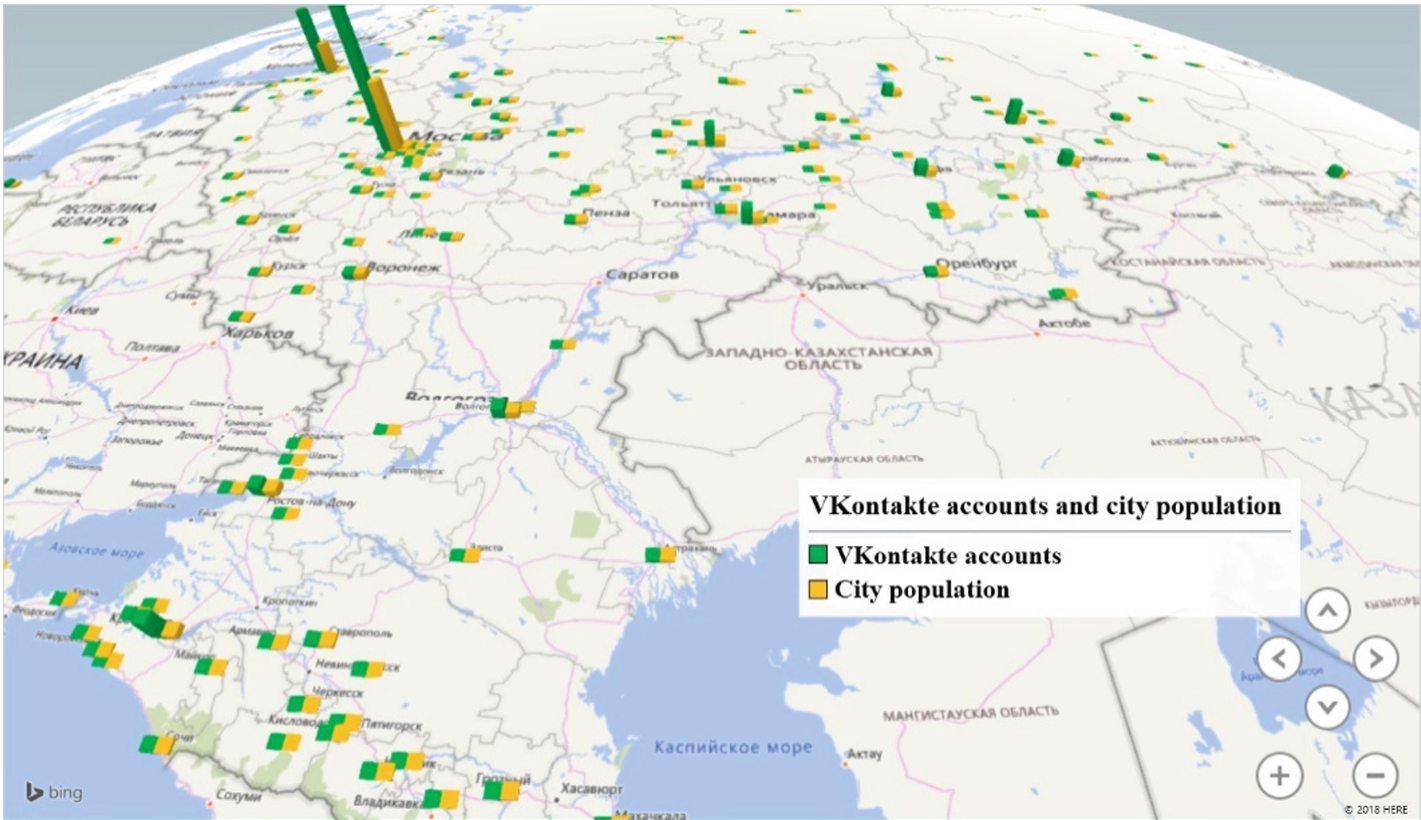
1. The Super-Digital Hubs
In cities like Moscow and St. Petersburg, the number of VK accounts significantly exceeds the official population. The authors attribute this to:
- Urban Gravity: Residents of smaller regions label themselves as living in the capital to reflect social aspirations.
- Economic Intensity: High levels of business activity lead to more "bot" accounts, organizational profiles, and secondary accounts used for marketing.
2. The Digital Laggards
In some remote or southern regions (e.g., parts of the North Caucasus), the population outweighs the number of accounts. This highlights:
- Lower Internet accessibility.
- A higher proportion of elderly citizens.
- Lower economic "digital involvement."
Critical Analysis: The Noise in the Signal
While the correlation coefficient of 0.85 to 0.96 proves the utility of this method, the authors are transparent about the "dirty" nature of social data. OSN statistics suffer from:
- Data Unreliability: Users lie about their age or location.
- Ghost Populations: Inactive accounts and bots inflate numbers.
- Legal Scrutiny: Tightening regulations like GDPR and Russian personal data laws (FZ-152) limit what can be scraped.
Conclusion: A Supplement, Not a Replacement
The study concludes that while OSN analysis cannot yet replace the national census, it is an invaluable sub-index for digitalization. It offers a "high-resolution" lens that captures migration flows and economic activity that official spreadsheets often miss. For future policy-making, the ability to monitor society "on the fly" via API may become as critical as the decennial census.
Takeaways for the Future
The next step in this research involves moving beyond simple "account counting" toward semantic contextual analysis. By using machine learning to analyze what users are posting, researchers can move from measuring "access" to measuring "digital sentiment and economic competence."