
The Tail Wagging the Dog: Hyperactive Users and Algorithmic Bias in Political Social Media
Online social networks and media
This study investigates the role of "hyperactive users" in political discourse on Facebook and their impact on recommender systems. Using geometric topic modeling (GTM) and simulated networks, the authors demonstrate that these users act as opinion leaders and agenda setters, significantly biasing algorithmic suggestions.
In the digital age, we often assume that social media platforms like Facebook provide a democratic "town square" where the most popular ideas reflect the collective will. A provocative study by Papakyriakopoulos et al. titled "Political communication on social media: A tale of hyperactive users and bias in recommender systems" shatters this illusion. The research reveals that a tiny, "hyperactive" minority is essentially hijacking the political agenda, and the algorithms we trust to filter our news are making the problem worse.
TL;DR
This research quantitatively proves that "hyperactive users"—the top ~5% of active accounts—dominate political discourse on Facebook, functioning as the platform's actual "opinion leaders." More disturbingly, the recommender systems used by these platforms are highly susceptible to the skewed data produced by these users, creating a feedback loop that distorts public opinion and leaves systems vulnerable to strategic "graph poisoning" attacks.
The "Loudest Minority" Problem
The core of the issue lies in the activity distribution. While most users are passive observers, a small segment is over-proportionally active.
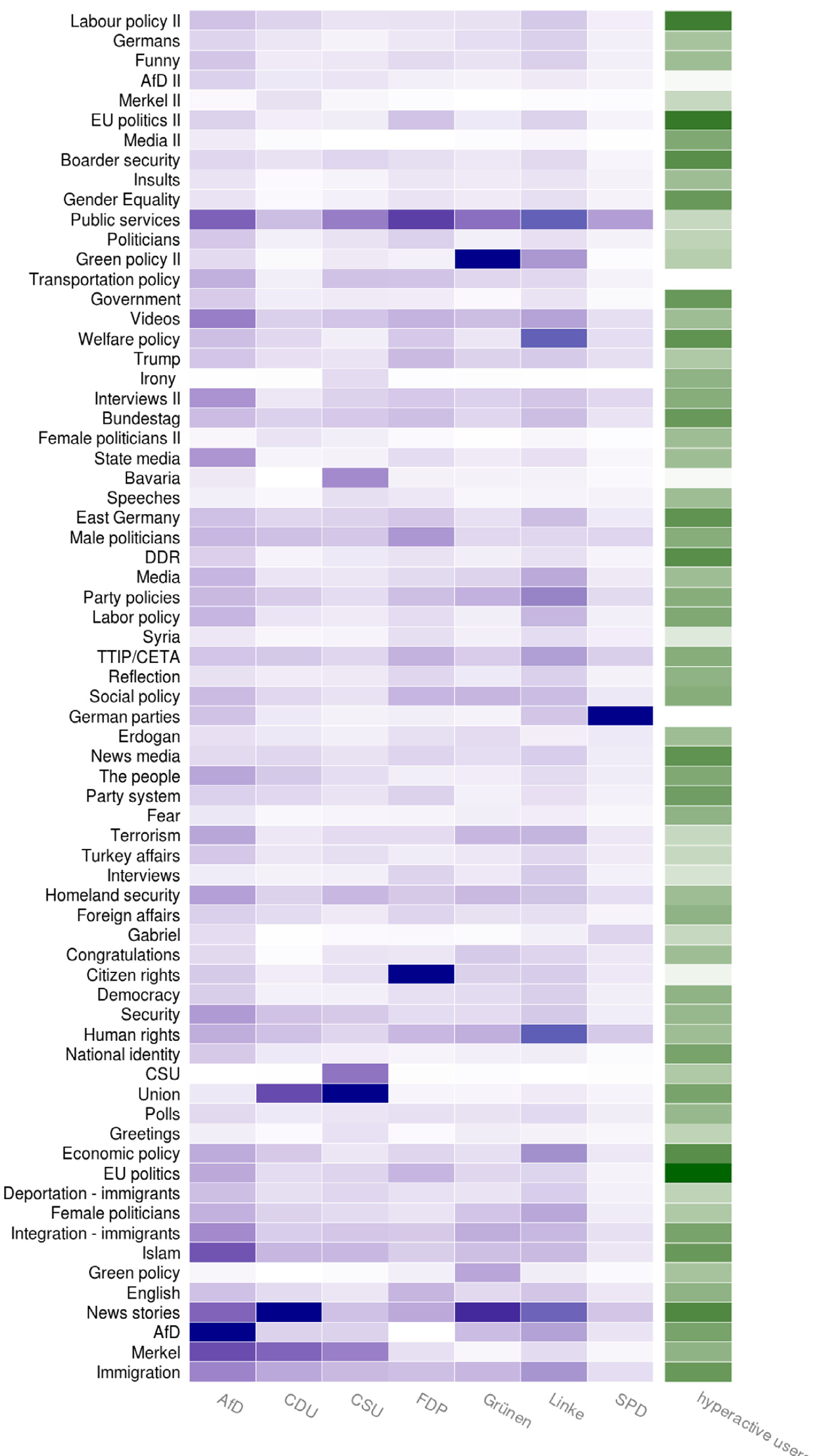
The authors discovered that these activities do not follow a "normal" bell curve but rather a log-normal distribution. In the context of German political parties (CDU, AfD, SPD, etc.), hyperactive users were responsible for:
- 74% of all comments on party pages.
- 26.4% of all likes.
- Significantly higher engagement rates, effectively making them the agenda setters of the digital space.
Methodology: How the Distortion is Measured
To understand this phenomenon, the researchers employed a two-step technical approach:
- Geometric Topic Modeling (GTM): Using a Conic Scan-and-Cover (CoSAC) algorithm, they identified 69 distinct political topics. This allowed them to see not just how much people post, but what they are talking about.
- Algorithmic Training: They simulated a Facebook-like social network and trained two types of recommendations:
- Hybrid Collaborative Filtering (HCF): A standard model looking at user-item interactions and friendship structures.
- DNN-BWMRB: A deep learning model using a specialized "Batch Weighted Margin-Rank Loss" function designed to handle sparse and asymmetric data.
The Content Gap
The study found a major shift in interest: hyperactive users didn't just talk more; they talked differently. They were significantly more likely to engage with polarizing topics like the refugee crisis, immigration, and sovereign identity, while normal users focused on broader social welfare or general news.
Recommender Systems: The Invisible Hand
The most critical finding involves how these activities influence what you see in your feed. Standard recommendation algorithms (like HCF) failed to capture the nuanced interests of average users because they were "drowned out" by the sheer volume of hyperactive data.
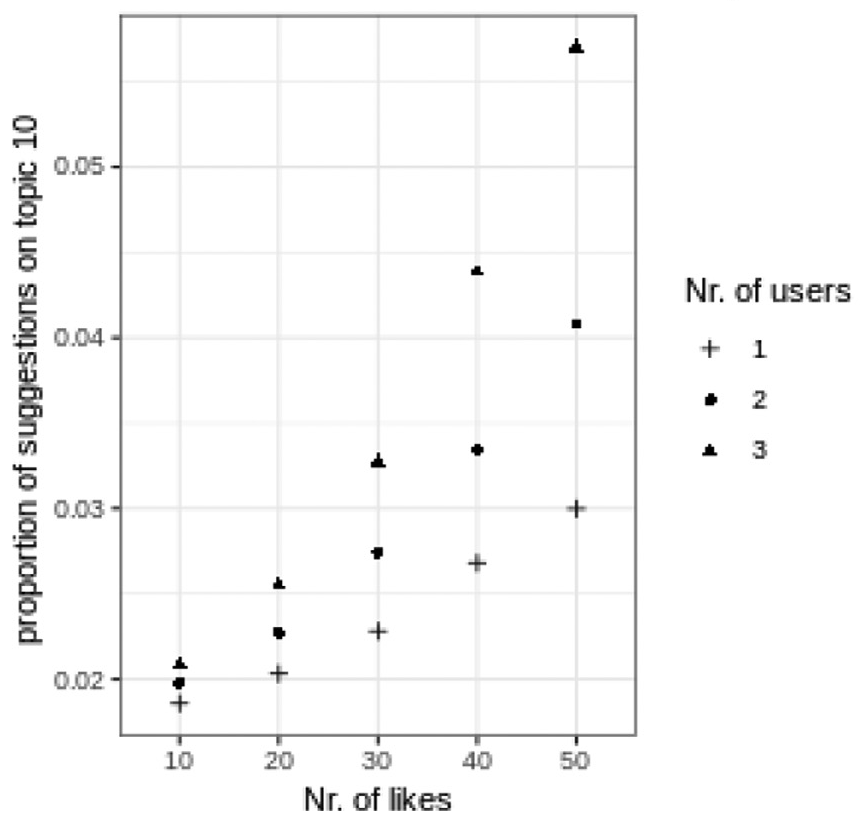
Even the more advanced DNN-BWMRB model, while more accurate, remained a "black box" that could be easily manipulated. Through Graph Poisoning, attackers can insert a few hyperactive accounts into a specific community to "force" a specific topic (e.g., Topic 10: Deportation of Immigrants) into the top suggestions of innocent users.
Critical Insight: Why This Matters for Democracy
The authors conclude that social media platforms are "not per se designed to foster political discussions." Their primary goal—maximizing engagement—inherently favors hyperactive users because they provide the most data points.
This creates a social influence bias:
- Macro-level: The public's perception of "what people are talking about" is based on a tiny, extreme subset of the population.
- Algorithmic-level: Recommendation systems replicate this asymmetry, effectively muting the "silent majority" and amplifying potential misinformation or polarizing rhetoric.
Future Outlook
The study calls for Algorithmic Transparency. As long as the exact cost functions and training sets of social media giants remain hidden, the vulnerability to manipulation remains high. To protect democratic discourse, we must move beyond engagement-based metrics and develop models that account for human activity asymmetries.
Takeaway: Next time you see a "trending" topic or a specific political post in your feed, remember: it might not be the will of the people, but the echo of a hyperactive few and the algorithm that can't stop listening to them.