
Beyond Socializing: OSNs as the New Frontier for Public Safety and Crisis Management
Online Social Networks: Emerging Security and Safety Applications
This paper explores the integration of Online Social Networks (OSNs) into public safety and security frameworks, proposing a novel data correlation architecture. It specifically examines how platforms like Twitter and Facebook can transition from simple communication tools into robust mechanisms for crisis management, law enforcement, and military intelligence.
TL;DR
Online Social Networks (OSNs) are evolving from mere digital diaries into vital infrastructure for public safety. This paper analyzes real-world case studies—ranging from aviation emergencies to mass protest planning—to demonstrate how OSN data often outpaces official intelligence. To harness this "firehose" of information, the authors propose a Semantic Correlation Framework designed to transform noisy, heterogeneous social streams into actionable intelligence for law enforcement and crisis responders.
Problem & Motivation: The Latency of Official Channels
In high-stakes environments like urban operations or emergency landings, every second counts. Traditional reporting remains bottlenecked by verification protocols, often leaving a "truth gap" where the public knows more than the responders.
The authors identify a critical disconnect: while citizens are increasingly using mobile devices to share real-time multimedia content during crises, public safety agencies often struggle to ingest and make sense of this data. The primary obstacle isn't a lack of info—it's Semantic Heterogeneity. Data is messy, slang-heavy, and scattered across multiple platforms, making manual monitoring impossible during mass events.
Methodology: The Data Correlation Framework
The core contribution of this work is a shift from monitoring to correlating. Instead of looking at a single tweet or post, the proposed framework aims to build a coherent picture from "scattered data."
The Architecture of Awareness
The authors outline a multi-layered approach to process OSN data:
- Common Interface Layer: Ingesting raw streams from API-connected platforms (Twitter, Facebook, etc.).
- Automated Understanding: Using pattern recognition and clustering to assign semantic tags (labels) to raw text.
- Correlation Engine: Linking documents and posts that share the same context or event markers.
- Decision Support: Presenting high-level situational awareness to human operators.
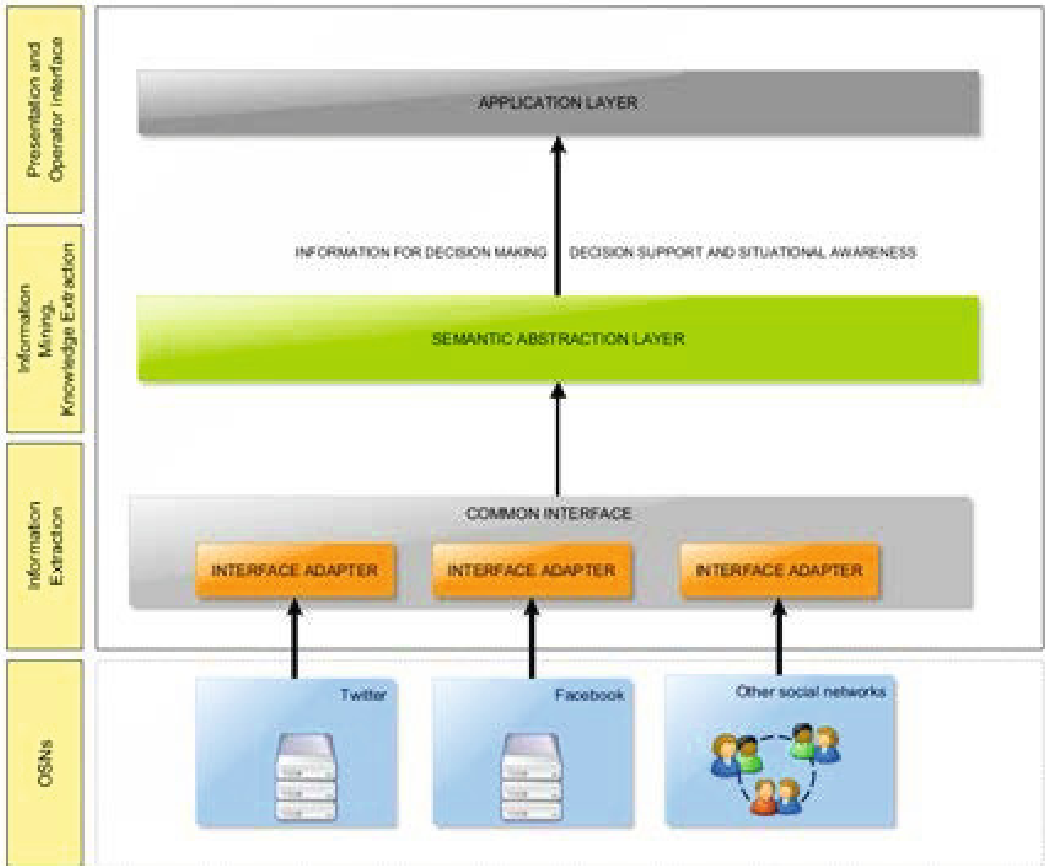
Figure: The proposed framework for correlating and understanding the meaning of scattered OSN data.
Real-World Evidence (Case Studies)
The paper provides compelling "war stories" where social media outperformed traditional systems:
- The 1.5-Hour Lead: During a Boeing 737 emergency landing at Katowice Airport, Internet users tracking flight paths via online tools posted alerts over an hour before official news portals confirmed the incident.
- Preventative Policing: By analyzing open-source intelligence (OSINT) from forums and OSNs, Poznań police were able to deploy forces effectively to prevent riots during a mass march, contrasting with the violence seen in Warsaw just days earlier where such data wasn't successfully leveraged.

Figure: Comparison showing social media alerts appearing significantly earlier than official reports.
The Dark Side: Security Threats
The paper doesn't ignore the risks. From a military perspective, OSNs serve as double-edged swords. Adversaries use "E-fleets" and social platforms for:
- Propaganda & Recruitment: Reaching global audiences instantly.
- Low-Cost Planning: Using mobile notifications to coordinate activities.
- Targeted Research: Exploiting "oversharing" by military personnel to gather intelligence on assets.
Critical Analysis & Conclusion
Takeaway
The shift towards Future Internet safety requires moving beyond simple keyword searches. The value of OSN data lies in its correlation—connecting a tweet in one city with a photo in another to predict a larger threat.
Limitations & Future Work
While the paper provides a strong conceptual framework, the authors acknowledge that quickly changing language and context (slang, emojis, sarcasm) remains a major hurdle for automated systems. Specifically, the "Van Bryan" case—where a tourist was detained for using the slang "destroy" (meaning to party)—highlights the dangers of automated sentiment analysis without deep cultural context.
Future research must focus on semantic-based languages that can bridge the gap between human nuance and machine processing to prevent such "false positives" while maintaining public safety.