
Beyond Networking: Validating TAM for Global HR Staffing via Social Networks
Acceptance of Online Social Networks as an HR Staffing Tool: Result from a Multi-country Sample
This study investigates the adoption of Online Social Networks (OSNs) by Human Resources professionals for organizational staffing across a multi-country sample (Taiwan, India, Spain, and Guatemala). By extending the Technology Acceptance Model (TAM) with Subjective Norms (SN), the research utilizes Partial Least Square-based Structural Equation Modeling (PLS-SEM) to validate factors influencing behavioral intention.
Executive Summary
TL;DR: This research validates that the adoption of online social networks (OSNs) by HR professionals for staffing is primarily driven by three factors: how useful they find the tool (Perceived Usefulness), the social pressure from peers and organizations (Subjective Norms), and the simplicity of the interface (Perceived Ease of Use).
Background: Positioned as a cross-cultural validation study, this work extends the classic Technology Acceptance Model (TAM) to the niche but high-stakes field of HR staffing. It moves beyond general consumer usage to analyze how professionals in India, Taiwan, Spain, and Guatemala integrate social tools into formal business processes.
The Professional Hurdle: Why Just "Being Popular" Isn't Enough
Organizations have shifted from using OSNs for simple job postings to more complex (and controversial) activities like applicant screening. However, the transition from personal scrolling to professional staffing isn't automatic.
The researchers identified a gap: while TAM is a "robust" model, its application to HR professionals—who operate under strict organizational policies and ethical considerations—requires an understanding of Subjective Norms. If other "important people" (peers or bosses) don't value the tool, will HR practitioners actually use it for hiring?
Methodology: The Extended TAM Framework
The study utilizes a structural equation modeling (SEM) approach, specifically focusing on three independent variables to predict Behavioral Intention:
- Perceived Usefulness (PU): Will this improve my hiring quality?
- Perceived Ease of Use (PEOU): Is the platform intuitive?
- Subjective Norm (SN): Do my colleagues think I should use this?
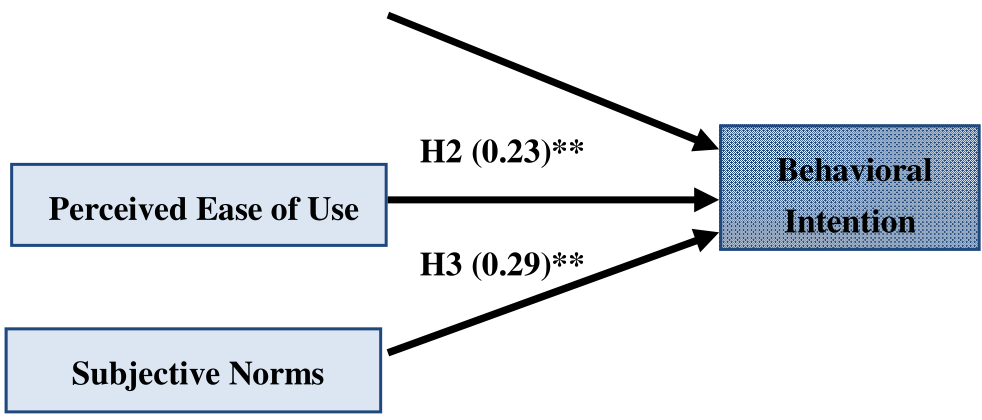
The data was screened using partial least square (PLS) analysis to ensure that the measures for "Usefulness" and "Ease of Use" were distinct and reliable across different languages (Chinese, English, and Spanish).
Key Results: What Drives HR Decisions?
The study analyzed 101 valid responses from a diverse demographic. As shown in the table below, the constructs showed high internal consistency (Composite Reliability > 0.90).
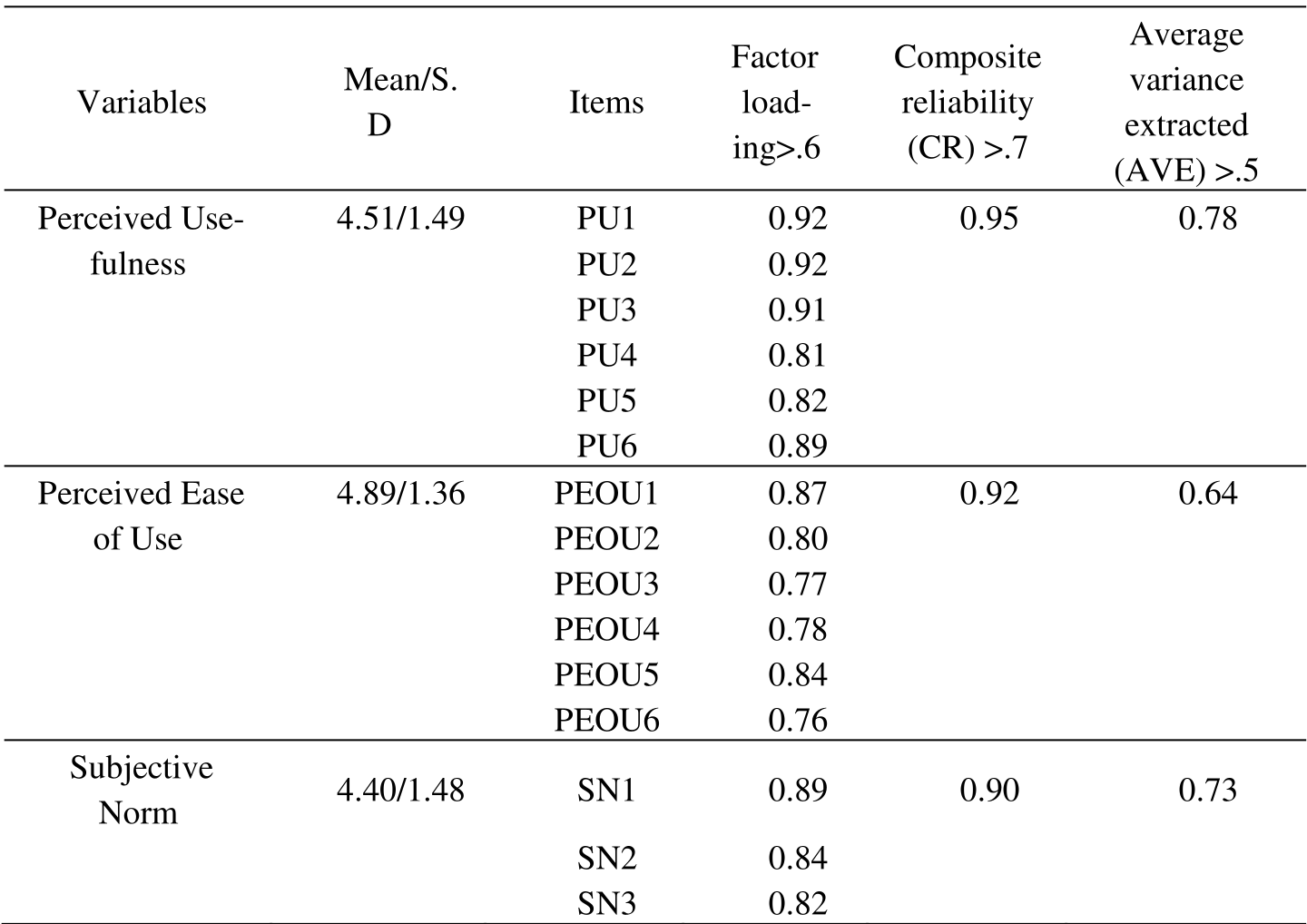
Critical Findings:
- Usefulness is King: With a path coefficient of β=0.34, PU is the strongest predictor. HR professionals prioritize performance gains over all else.
- The Power of Social Influence: Subjective Norms (β=0.29) proved more influential than Ease of Use, suggesting that HR is a socially-driven profession where industry trends and peer behaviors dictate tool adoption.
- Global Robustness: Despite the diverse sample (Asia, Europe, Latin America), the TAM held steady, suggesting that the logic of technological utility transcends cultural boundaries in a professional HR context.
Critical Analysis & Conclusion
Takeaway
For developers of HR tech, the message is clear: Functionality and peer-endorsement outweigh UI/UX. To penetrate the HR market, a tool must demonstrate a clear ROI on "job performance" and foster a community where "Social Proof" can influence individual practitioners.
Limitations & Future Outlook
While the study provides a vital cross-country snapshot, the authors acknowledge a few caveats:
- Self-Reporting Bias: HR professionals might overstate their tech-savviness.
- Sample Size: Though multi-country, a sample of 101 prevents deep "country vs. country" comparisons (e.g., does Taiwan value SN more than Spain?).
- Future Work: Integrating Hofstede’s Cultural Dimensions (like Uncertainty Avoidance or Power Distance) could explain why PU or SN might fluctuate in importance between Western and non-Western samples.
In conclusion, OSNs are no longer just for "socializing"—they are formally entering the HR toolkit, governed by the same rigorous logic of utility and social influence that defines professional software adoption.