
Decentralizing Privacy: The Architectural Shift in Online Social Networks
Online social networks and media
This paper provides a comprehensive review of privacy-preserving services for Decentralized Online Social Networks (DOSNs). It categorizes and evaluates technical solutions across three critical pillars: data storage/replication, access control, and identity/fake content management, highlighting the shift from centralized data ownership to distributed peer-to-peer (P2P) architectures.
TL;DR
As centralized social media platforms face increasing scrutiny over data exploitation, Decentralized Online Social Networks (DOSNs) offer a path toward user sovereignty. This paper explores the transition from "Big Brother" centralized models to peer-to-peer architectures, dissecting the massive technical hurdles in data storage, access control, and identity management that must be cleared to make privacy-by-design a reality.
Background: The Price of "Free"
Traditional OSNs operate on a logically centered architecture. While convenient, this model fuels a business strategy where user data—tastes, habits, and metadata—is the primary product. Decentralization aims to return data ownership to the user, but it replaces a single point of failure with a complex distributed coordination problem.
The Three Pillars of DOSN Privacy
1. Data Storage and the Replication Dilemma
In a P2P network, your data cannot stay only on your device; if you go offline, your profile vanishes. Thus, data must be replicated across other peers.
- The Conflict: Replicating data to "trusted friends" (as seen in the Matryoshka model) ensures availability but poses a privacy risk, as friends have the most "background knowledge" to deanonymize encrypted content.
- The Insight: Authors suggest a move toward Selective Storage, where peers are chosen based on specific trust metrics, though this yields challenges in uniform resource utilization.
 Figure 1: Overview of the interplay between privacy preservation and decentralization.
2. Access Rights: Beyond Simple Locking
Managing who sees what in a network of millions without a central "gatekeeper" is notoriously difficult.
- Encryption-Based: Methods like Attribute-Based Encryption (ABE) allow users to define policies (e.g., "Only friends in Sweden can see this"). However, if you unfriend someone, revoking their access in a decentralized way causes a massive "key redistribution" overhead.
- Non-Encryption/Audit-Based: This approach allows for more flexibility, using decentralized "auditors" to report bad behavior after the fact, incentivizing honesty through reputation scores.
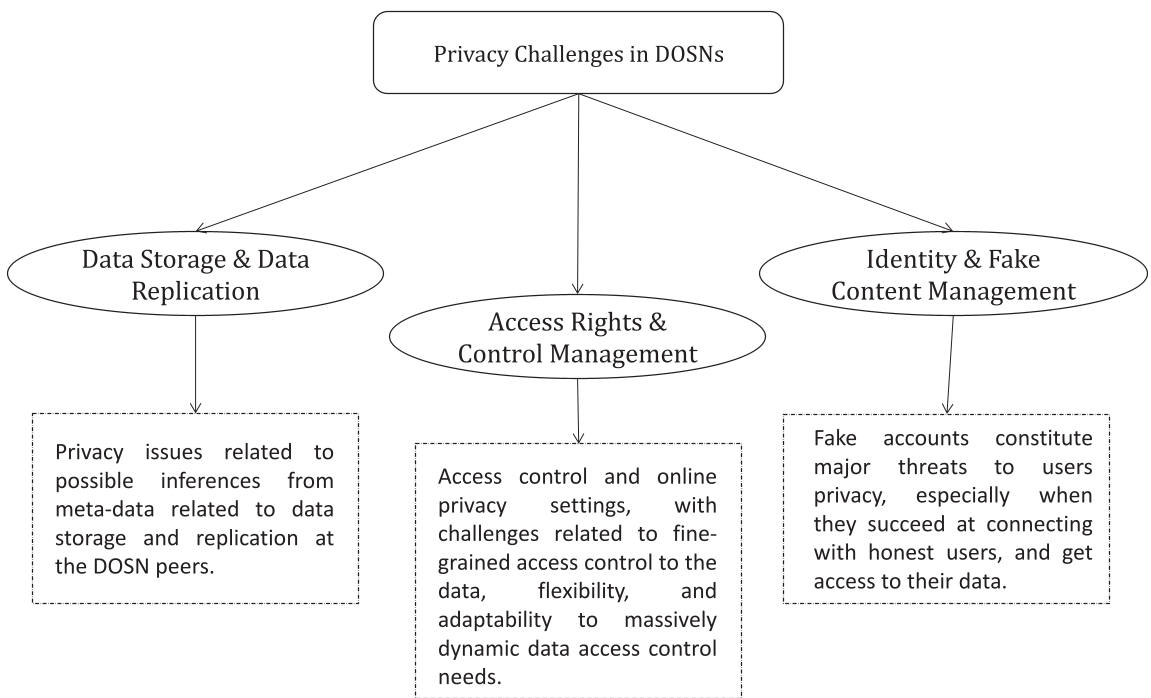 Figure 2: Categorization of privacy challenges including storage, access control, and identity.
3. Identity Validation and Fake Content
Without a central "Clearance" (like Twitter's blue checkmark), how do you know a peer is real?
- Sybil Defense: In decentralized settings, attackers can create thousands of fake identities.
- Decentralized Identity Validation (DiVA): This method leverages Gossip-based learning. Peers exchange local models of what "honest behavior" looks like until the network converges on a shared understanding of identity trends, effectively filtering out anomalies without a central server.
Critical Insight: The Role of Blockchain
The paper highlights an emerging frontier: Blockchain. While typical OSNs require high performance that traditional blockchains struggle to provide, the ledger property is perfect for:
- Tamper-proof Logging: Recording who accessed what data.
- Consensus: Agreeing on the state of access policies across the network.
Conclusion & Future Outlook
Decentralization is not a silver bullet. While it solves the "Offline Privacy" problem by removing the central data-harvester, it makes "Online Privacy" management significantly more complex. The future of DOSNs lies in:
- Efficient Revocation: Resolving the ABE performance bottleneck.
- Hybrid Models: Integrating lightweight consensus algorithms (like those found in modern Blockchains) to manage metadata while peers handle actual content delivery.
The path to a private social web is as much about distributed trust as it is about sophisticated mathematics.