
The Social Trust Dilemma: A Deep Dive into OSN Privacy and Security
Online social networks and media
This paper provides a comprehensive survey and taxonomy of privacy and security challenges in Online Social Networks (OSNs). It categorizes threats into user-centric leakages (data exposure to other users, apps, and aggregators) and network-centric attacks (Sybil, DDoS, and malware), while evaluating state-of-the-art mitigation strategies ranging from automated privacy settings to decentralized P2P architectures.
TL;DR
Online Social Networks (OSNs) like Facebook and Twitter have bridged the global gap but created a "Gold Mine" for attackers. This survey by Kayes and Iamnitchi deconstructs the OSN threat landscape into a rigorous taxonomy, covering everything from accidental data leaks to sophisticated "Sybil" identity attacks, and evaluates the engineering solutions—like Decentralized Social Networks—that aim to fix them.
The Paradox of Implicit Trust
In an OSN, trust is the currency. We connect with friends, share locations, and link third-party apps with a "click to agree." However, this trust is a double-edged sword. Research shows that:
- 87% of the US population can be uniquely identified by just gender, ZIP code, and birth date—all commonly available on OSN profiles.
- The "Curious" Provider: Centralized OSNs are often the very entities users need protection from, as they aggregate data for targeted advertising, often in ways users don't fully comprehend.
Methodology: The Taxonomy of Defense
The authors categorize the sprawling field of OSN security into two main axes: Leakages & Linkages (User-centric) and Attacks on the OSN (Infrastructural).
1. Putting the User in Control (Fine-Grained Privacy)
The biggest hurdle isn't the lack of settings, but the "Cognitive Task" for the user. Solutions like Lefevre’s Privacy Wizard use machine learning to predict your settings by asking a few "seed" questions, significantly reducing user friction.
2. Defending the Social Graph: Sybil Attacks
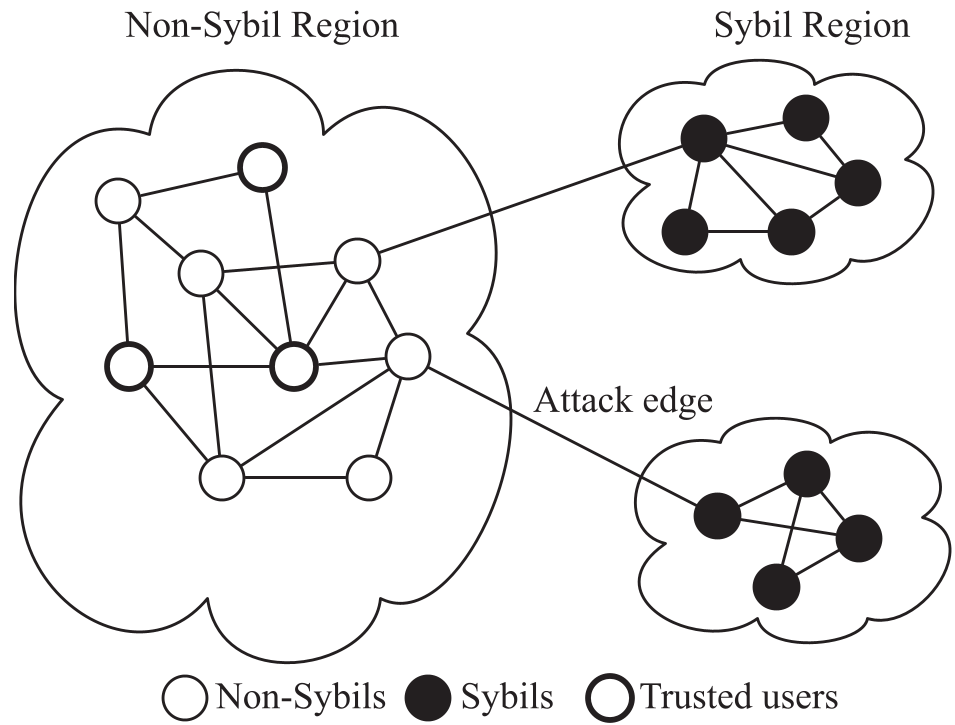
A Sybil attack occurs when one person creates thousands of fake identities to manipulate elections, spread spam, or influence search results.
- Insight: Sybil regions usually have a "Sparse Cut" between them and the honest network because it's hard for a fake account to gain thousands of real friends.
- Visual Evidence: The graph below illustrates how the honest region and Sybil region remain structurally distinct.
Radical Solutions: Decentralization and Data Hiding
When you can't trust the platform, you change the architecture. The paper examines:
- Information Hiding (Encryption): Systems like FlyByNight and FaceCloak use browser extensions to encrypt your posts before they hit Facebook's servers. The OSN only sees "Ciphertext," while your friends see your real post.
- Decentralization (P2P): Moving away from a central server entirely. Safebook and Vis-a-Vis utilize Peer-to-Peer (P2P) overlays where your data lives on your own device or your friends' devices, not in a corporate data center.

Critical Results & Metrics
- Anonymization Accuracy: Methods like SpikeStrip prevent massive data scraping by link encryption with only a 7% performance penalty.
- Sybil Detection: Systems like SybilRank are highly effective for large-scale networks but struggle against "Social Engineering," where fake accounts successfully trick legitimate users into becoming "friends."
Critical Analysis: What’s Next?
Despite a decade of research, our social lives remain vulnerable. The author points out a major limitation in current research: Intertwined Attacks. A crawler gathers data, which fuels a phishing attack, which compromises an account to launch a DDoS. We need a Unified Defense Framework rather than point solutions.
The Roadmap to Secure Socializing
- AI Moderation: Leveraging GANs and Large Language Models to detect "Social Spambots" that mimic human behavior.
- Privacy-by-Design: Moving legislative theory into hard-coded protocol requirements.
- User Experience (UX): If privacy isn't "Invisible and Automatic," users will continue to ignore it.
Conclusion
Privacy in OSNs isn't just about hiding; it's about the Contextual Integrity of information flow. As we move into an era of even greater social integration (Web 3.0/Metaverse), the lessons from this survey—on structural trust, decentralized storage, and automated policy—are more relevant than ever.