
Who Framed Roger Reindeer? Unveiling Censored Identities via Snippet Classification
Online social networks and media
This paper introduces a snippet classification methodology to de-censor identities in online news using Facebook comments. By training a specific "Candidate Entity Recogniser" (CER) on contextual data, the system can identify obscured names (e.g., "Corporal S.") with an accuracy exceeding 50% in a 10-candidate scenario.
TL;DR
In an era where news organizations and governments often censor identities for legal or security reasons, a new study reveals that this protection is remarkably thin. Researchers have developed a system that uses Facebook comments and short text snippets to "guess" censored names. By training a specialized classifier on the context surrounding names, they successfully identified censored individuals among 10 candidates in over 50% of cases—crushing traditional baselines.
Background: The Fragility of Online Censorship
Censorship typically involves redacting a name (e.g., "John Doe" or "Corporal S.") to protect a minor, a victim, or a military officer. However, the "Collaborative Web" is redundant by nature. The same fact is often reported across multiple outlets with varying censorship policies. More importantly, users in the comments section often display a "proven aptitude" to disclose the very data the news article intends to withhold.
The Problem: Redundancy is the Enemy of Privacy
Prior work in de-censorship often relied on Social Graph Analysis—looking at who is friends with whom to infer a redacted name. This paper takes a more difficult path: Text Analytics.
Why is this hard?
- Short Contexts: Facebook snippets and comments are often less than 200 characters.
- No Metadata: The system doesn't know who the commenters are; it only sees raw text.
- Ambiguity: "Trump" could refer to Donald, Hillary (in context), or Melania.
Methodology: The Candidate Entity Recogniser (CER)
The authors propose a multi-stage pipeline that treats de-censorship as a specialized classification task rather than a simple search.
- Generic NER: Use standard tools (like spaCy) to identifies all "Persons" in a large corpus of news and comments.
- Censorship Simulation: In a target post, a name is replaced with a unique token (e.g.,
ANON). - Candidate Fetching: The system looks at the comments section to find the most frequent names mentioned, forming a candidate list (e.g., the top 10 names).
- Specialized Training: The system retrieves snippets from the entire database where these candidate names appear. It then replaces the names in those snippets with placeholder labels (e.g.,
DUMBO1,DUMBO2). - Classification: A custom classifier is trained to recognize the "shape" of the context. When it sees the
ANONtoken in the censored post, it predicts which of the candidates fits that linguistic environment best.
 Figure 1: The logic flow for training a CER to spot censored identities.
Experiments and Breakthrough Results
The researchers crawled 25 US newspapers, collecting over 39,000 posts and 2 million comments. They focused on "popular" identities (Politicians and Celebrities) to ensure enough training data existed.
Performance Metrics
The results prove that textual context is a powerful "fingerprint" for identity:
- CER Accuracy (Top-10): 54%.
- Global Accuracy: 62%.
- Baseline (Most Frequent): Only 19%.
- Random Success: 10%.
Interestingly, for certain figures like Paul Ryan or Rick Scott, the system achieved 100% accuracy. This suggests that some public figures have highly distinct "contextual footprints" in how the public discusses them.
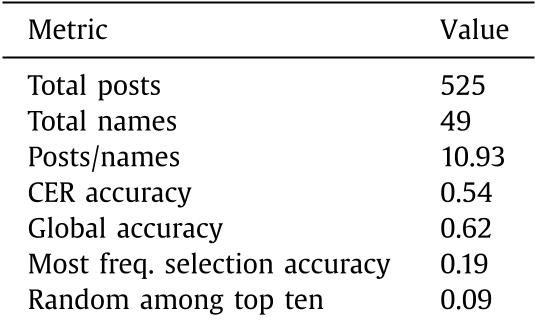 Table 1: Overall statistics showing the CER outperforming baselines.
Critical Analysis: Why This Matters
The core takeaway is that linguistic context is as revealing as a social graph. Even without knowing the relationship between a commenter and a subject, the way people talk about a subject (using specific verbs, locations, or associated brands) is enough to break pseudonymization.
Limitations and Future Work
- Data Dependency: The system requires the identity to be "popular" enough to have appeared elsewhere in the corpus (at least 200 times). It would likely fail on "long-tail" Private Citizens.
- Window Size: The authors used very short snippets (50-200 characters). Expanding the context window could significantly improve accuracy but might introduce more noise.
- Platform Versatility: Since the snippets are short, the authors believe this could easily be applied to Twitter (X) or Tumblr.
Conclusion
This study serves as a warning for privacy advocates and news organizations: simply scrubbing a name from a post is insufficient if the "Commentsphere" remains active. In the interconnected web, "perfect" censorship is becoming an impossible task. Contextual redundancy allows automated systems to frame the redacted subject with surprising precision.