
Reclaiming the Social Graph: A Deep Dive into Decentralized Online Social Networks (DOSNs)
Online social networks and media
This survey evaluates Decentralized Online Social Networks (DOSNs) as an alternative to centralized platforms, focusing on data management strategies. It categorizes existing proposals into DHT-based, Social Overlay (SO)-based, and External Resource-based architectures, while addressing critical challenges in data availability, information diffusion, and privacy.
TL;DR
The current social media landscape is dominated by central giants that trade user privacy for profit. This survey explores Decentralized Online Social Networks (DOSNs), which replace central servers with P2P architectures. We analyze how these systems solve the "Availability-Privacy-Performance" trilemma by using social-theoretic concepts like Dunbar’s Number and Matryoshka-style encryption.
Background Positioning: The Privacy Crisis
Centralized OSNs are no longer just tools for connection; they are massive data-harvesting engines. The pivot to DOSNs isn't just a technical shift; it's a structural rebellion. However, moving from a server-client model to a peer-to-peer model introduces a nightmare for "Always-on" requirements. If your "friend" (the data host) goes offline, your profile disappears.
The Core Challenge: Data Management in the Wild
The survey identifies three architectural pillars for decentralization:
- DHT-based: Using Distributed Hash Tables (like Kademlia) for global indexing and storage.
- Social Overlay (SO): Building the network topology to mirror real-life friendships.
- External Resource-based: Leveraging personal clouds (VISs) or untrusted third-party storage (Amazon S3) with heavy encryption.
1. Data Availability & The "Dunbar" Insight
One of the most elegant methods discussed is using Dunbar's number (the cognitive limit of ~150 stable social relationships) to guide replication. Instead of broadcasting data to the entire network, nodes replicate content only among their most "trusted" social circles.
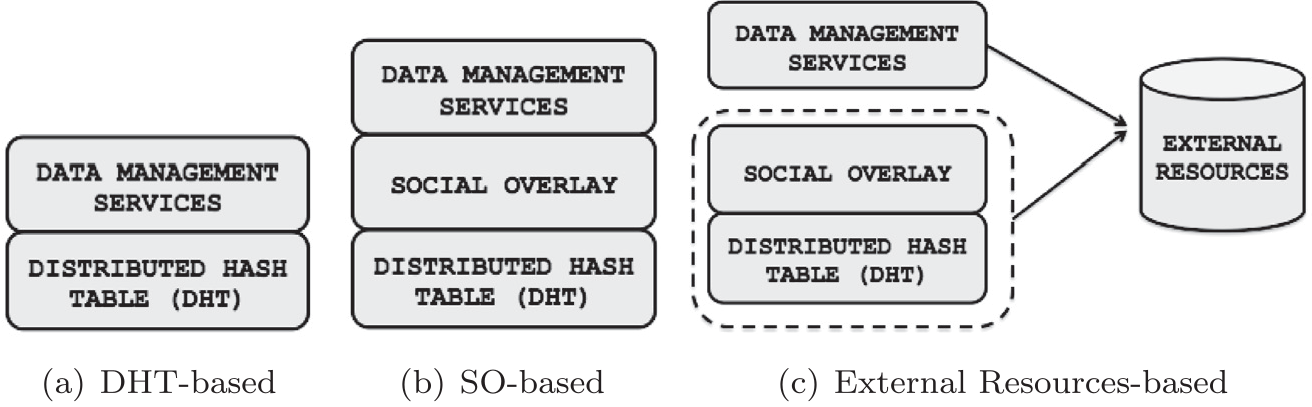 The architectural stack of DOSNs, separating Social Services (SNS) from the Communication and Transport (CT) layer.
Methodology: Spreading Information without a Central Hub
In a world without a "News Feed" server, how do updates reach you? The paper compares:
- Request-Reply: The passive approach where users pull data from trusted proxies.
- Active Dissemination (Epidemic/Gossip): Where updates spread like a virus through the social graph.
The effectiveness of these methods relies on Tie Strength. By analyzing how often you interact with a peer, the system can predict which nodes are likely to be online simultaneously, optimizing the "Gossip" path.
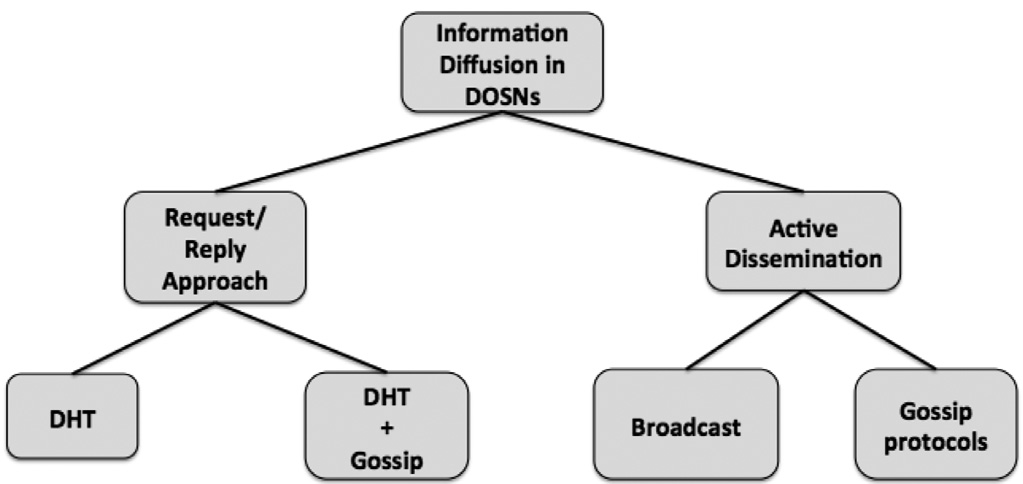 Comparing the pull-based Request-Reply vs. the push-based Active Dissemination (Epidemic/Gossip) protocols.
Privacy & Security: The Metadata Devil
Encryption is the baseline, but the survey warns that Metadata is the real leak. Even if your messages are encrypted, the fact that you communicated with a specific person at 2 AM reveals your social structure.
Systems like SafeBook utilize "Matryoshka" rings—layers of trusted nodes that act as concentric obfuscation shields—to provide anonymity and prevent traffic analysis.
SOTA Comparison & Summary
The paper provides a comprehensive breakdown of the "Big Players" in the DOSN research space:
| Feature | DHT-based (e.g., PeerSon) | SO-based (e.g., DiDuSoNet) | Hybrid/Cloud (e.g., Vegas) |
|---|---|---|---|
| Discovery | Global (DHT) | Local Graph Crawling | Centralized/Federated |
| Privacy | Low (Public Index) | High (Social Trust) | Medium (Cloud Trust) |
| Availability | High (Replication) | Variable (Churn-heavy) | 100% (SLA-backed) |
Critical Insight: Why Haven't We Switched?
Despite the technical brilliance of protocols like Prometheus or Safebook, the "Network Effect" remains the primary barrier. Users are reluctant to leave the "feature-rich" (but privacy-poor) centralized platforms. The study concludes that the future likely belongs to Hybrid Models—where we use cloud resources for availability but keep the keys and the social graph decentralized.
Conclusion
This survey serves as a blueprint for the next generation of social internet. By aligning P2P algorithms with human cognitive constraints (Dunbar's number) and social behavior (Tie Strength), we can build a web that is as robust as it is private.
Limitations & Future Work
- Mobile Battery Life: Constant P2P communication is a power drain.
- Link Prediction: Decentralized discovery of "People You May Know" is computationally expensive without a global view.
- Blockchain Integration: The survey (from 2018) identifies early potential for Blockchain to solve the "Identity/Trust" problem, a field that has since exploded.