
From Associations to Sarcasm: How Twitter Mining Reveals the Partisan Shift of the Supreme Court
Online social networks and media
This study utilizes a large-scale Twitter mining framework to analyze public opinion shifts regarding the U.S. Supreme Court during the 2018 Brett Kavanaugh confirmation. By processing over 29 million tweets using Latent Dirichlet Allocation (LDA) and VADER sentiment analysis, the researchers identified a significant post-confirmation emergence of associations between the Court and partisanship, while also quantifying how sarcasm compromises the accuracy of automated sentiment classification.
TL;DR
The 2018 confirmation of Judge Brett Kavanaugh was a watershed moment for the U.S. Supreme Court's public image. This study analyzes 29 million tweets to prove a permanent shift in public perception: the Court became inextricably linked with "partisanship" only after the confirmation. Furthermore, the authors expose a "technical trap"—sarcasm—which causes standard AI tools to mistakenly report that the public "loves" judicial partisanship, when in fact, they are mocking it.
Problem & Motivation: The Invisible Barrier of Sarcasm
While qualitative political science provides depth, it cannot process millions of data points. Conversely, "Twitter Mining" offers scale but often lacks the "ear" for human irony. Existing SOTA methods for sentiment analysis frequently fail in political discourse because users often use positive words ("Great job, GOP!") to express negative vitriol.
The researchers set out to solve two problems:
- The Dynamic Shift: Did the Kavanaugh hearing fundamentally change how the public views the Supreme Court?
- The Sarcasm Gap: Can automated methods survive the high levels of incivility and irony found in political Twitter?
Methodology: Mapping Mental Associations
The study utilizes a robust pipeline consisting of data collection, pre-processing (lemmatization and noise removal), and a conceptual mapping framework.
The Conceptual Framework
The authors defined a model of seven key nodes: Supreme Court, Partisan, Kavanaugh, Trump, #MeToo, Republicans, and Democrats. They then used Latent Dirichlet Allocation (LDA) to see which of these concepts "clung" together in the public consciousness across two waves of data.
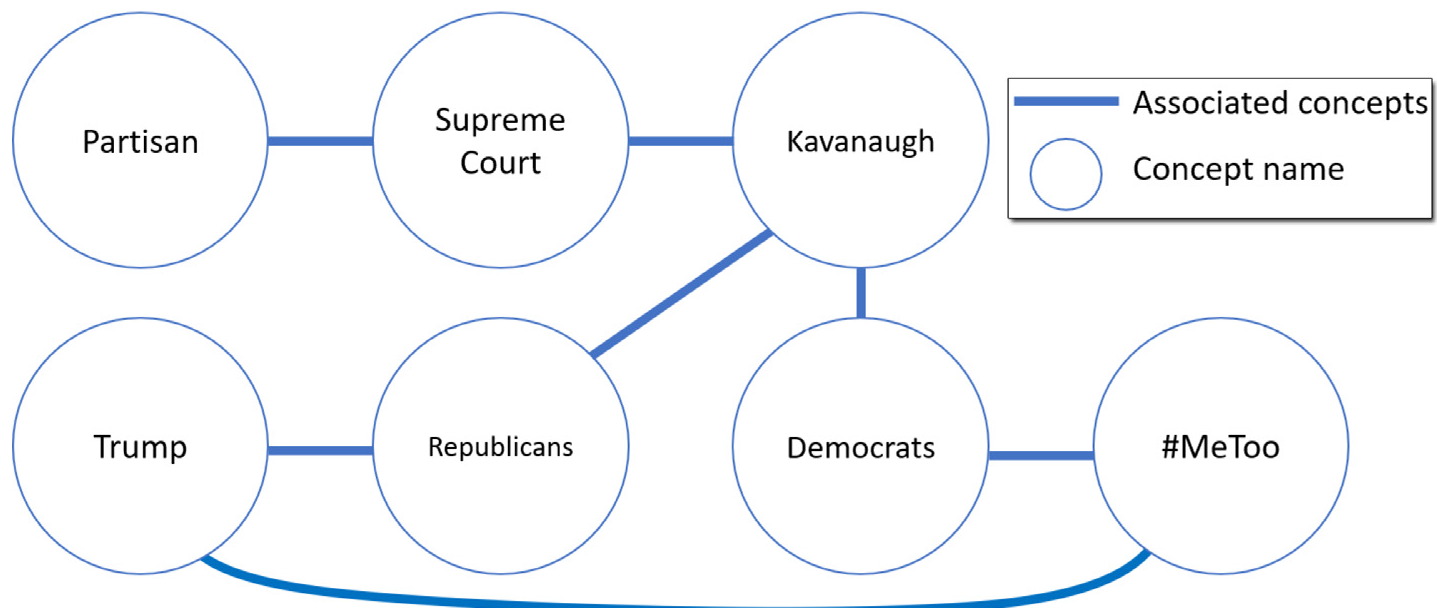 Figure 1: The initial conceptual model used to guide the association mining.
The Sarcasm Detector
To verify Research Question 2, the authors implemented a deep neural network (based on the work of Ghosh and Veale) that utilizes Convolutional Neural Networks (CNN) to extract features and Long Short-Term Memory (LSTM) to understand the sequence and context—the "vibe"—of the tweet.
Experiments & Results: The Birth of a Partisan Court
The most striking finding was the change between Wave 1 (October) and Wave 2 (November).
- The Shift: In Wave 1, there was no statistical association between the "Supreme Court" and "Partisanship." However, by Wave 2, a month after the confirmation, the association was validated with 71% significance. This suggests the "partisan" label became a lasting attribute of the Court in the public mind.
- The Sentiment Paradox: Initial results suggested that the "Supreme Court + Partisan" association was viewed positively. This defied political intuition.
- Sarcasm Correction: After applying the Ghosh-Veale neural network, the truth emerged. In the "Supreme Court + Partisan" cluster, 41% of all positive-labeled tweets were actually sarcastic.
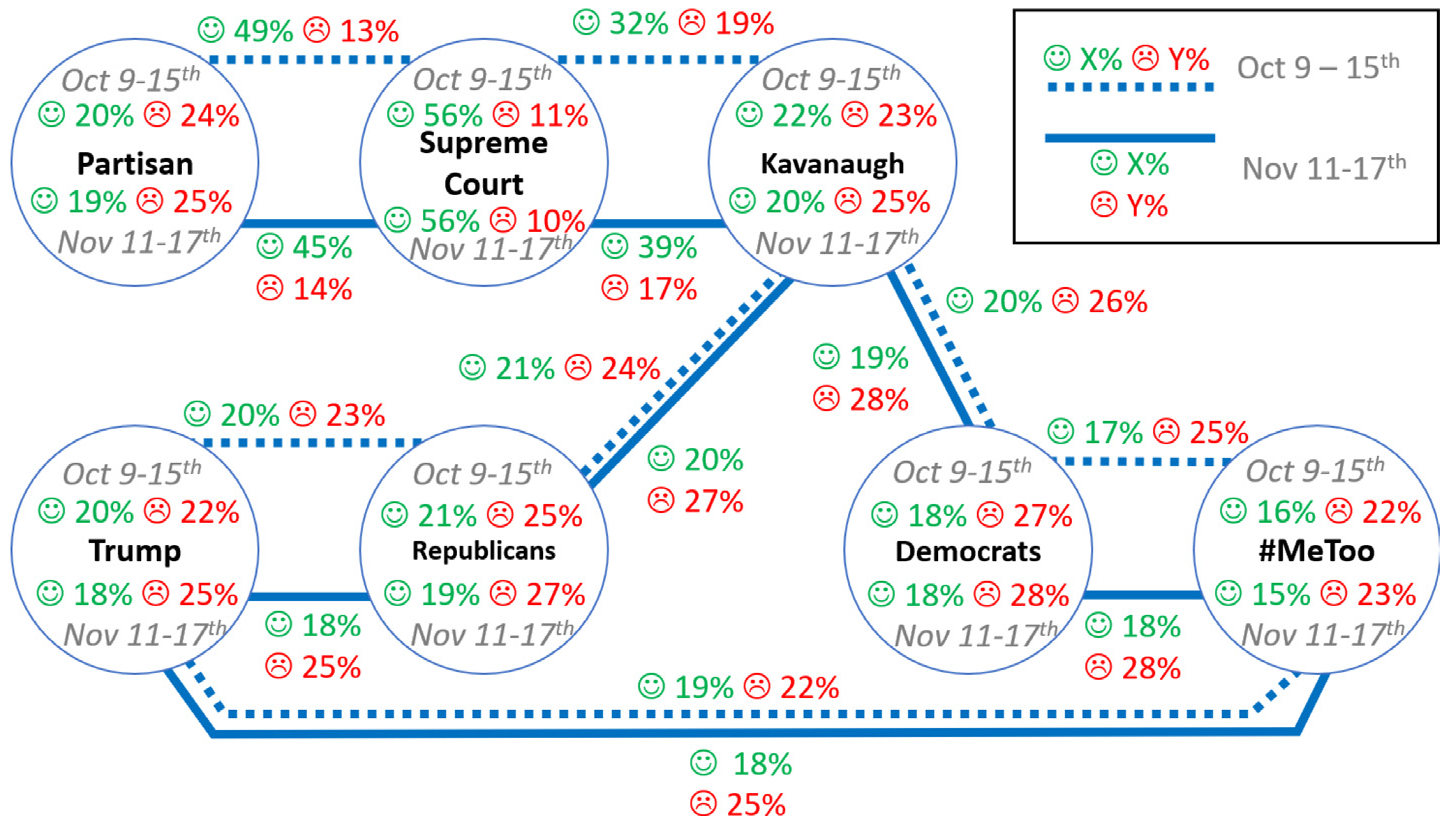 Figure 2: Sentiment analysis at node and edge levels. Notice how sarcasm significantly skews the "Positive" perception of partisanship.
Critical Analysis & Conclusion
This paper provides a sobering look at both American politics and the limitations of AI.
The Takeaway: The Supreme Court’s identity underwent a "partisanship shift" in late 2018. From a technical standpoint, the study proves that sentiment analysis without sarcasm detection is fundamentally flawed in political contexts.
Limitations: The study’s cleaning process removed emojis and hashtags (like #sarcasm), which are themselves high-value signals for sentiment. Future work should integrate these "lexical irregularities" rather than discarding them as noise.
Future Outlook: As we move into an era of Multimodal LLMs, the techniques used here—combining statistical topic modeling with deep-learning-based nuance detection—will be essential for understanding the increasingly complex and ironic landscape of digital democracy.