
OSSINT: How Your Friends-of-Friends Are Leaking Your Private Identity
Online social networks and media
The paper introduces OSSINT (Open Source Social Network Intelligence), a system designed to infer "private" information from Facebook profiles by analyzing a victim's 2-hop friendship network. It effectively uncovers hidden attributes like hometown, current city, and education, while predicting an average of 11 new "private" friendships per victim with high precision.
Executive Summary
TL;DR: Your Facebook privacy settings might be useless. This paper presents OSSINT, a tool that proves your "hidden" information (hometown, school, friend list) can be mathematically inferred with high accuracy just by looking at the people two steps away from you. By analyzing the 2-hop friendship network, OSSINT achieves a 75% accuracy in guessing sensitive life details that users explicitly set to "Private."
Strategic Position: This work moves beyond simple data scraping and enters the realm of Social Network Intelligence (OSINT). It demonstrates a shift from attacking content to attacking topology, showing that privacy in a connected world is a collective failure rather than an individual choice.
The "Privacy Paradox" in OSNs
Most users believe that clicking a "Private" or "Friends Only" button on their profile acts as a digital vault. However, the authors argue that contextual information—the structure of who you know—is much harder to hide.
The core problem is the Surrounding Leakage:
- Direct Leakage: You hide your profile, but your friends list is public.
- Inference Leakage: You and your friends hide your lists, but the "Mutual Content" pages or common interactions still expose edges in the graph.
Previous tools like SocialSpy could reconstruct 1-hop connections. OSSINT goes the "extra mile" by reaching into the 2-hop network (friends-of-friends) to build a much more dangerous and complete profile of the victim.
Methodology: The 2-Hop Reconstruction Engine
The OSSINT system operates through a multi-stage pipeline that combines web automation (Selenium) with statistical scoring algorithms.
1. Graph Reconstruction
OSSINT doesn't just look at the victim; it runs a recursive search. If User A is a friend, it crawls User A's friends to find common links back to the victim. This populates a "Potential Friends" pool.
2. The Multi-Factor Scoring Model
To filter noise from actual private data, OSSINT uses two primary metrics:
- Information Score: It aggregates the public attributes (Hometown, Education) of all 1-hop and 2-hop neighbors. If 70% of your friends-of-friends went to "University of Rome," the system infers with high probability that you did too.
- Edges Score: It measures the density of connections. A 2-hop ID with 10 mutual friends is far more likely to be a "True Friend" than someone with only one connection.
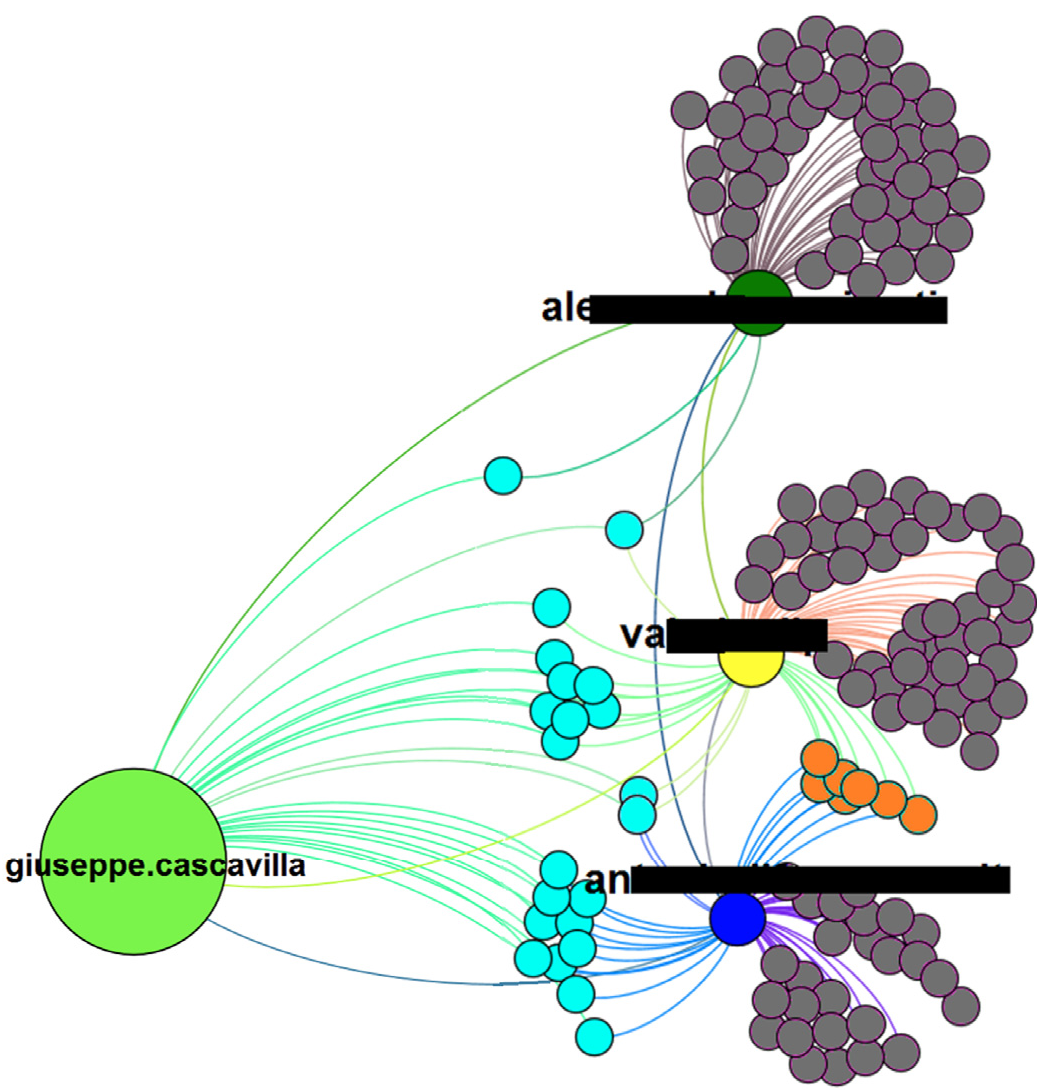 Figure 1: The complexity of the 2-hop graph where orange nodes represent high-probability hidden connections.
Experimental Proof: No Where to Hide
The researchers tested OSSINT against real Facebook profiles with "High" privacy settings (profiles with very little public info and fewer than 13 public pictures).
Key Findings:
- Friendship Prediction: OSSINT predicted an average of 11 new friends per victim. These were relationships the victim had explicitly hidden.
- Attribute Inference: The results were staggering. The system achieved a 75% accuracy (TOP 1) for Hometown and Education. This means that for 3 out of 4 users, their #1 hidden life detail was correctly identified by the algorithm.
 Figure 2: Accuracy rates for Current City, Hometown, and Education inference.
Critical Insights & Limitations
Why is this effective? OSSINT exploits the physical reality of Homophily—the tendency of individuals to associate with similar others. We live near our friends, go to school with them, and share hobbies. By measuring the "gravity" of your social circle, OSSINT identifies your location and background even if you never speak a word.
The Catch: Facebook is not defenseless. The authors noted that aggressive crawling leads to account bans. To bypass this, OSSINT implements "Human Browsing Simulation," including:
- Random delays between clicks.
- Fake browsing actions (viewing random pages).
- Distributing the payload across 20 different "fake" profiles to avoid detection.
Conclusion: A Wake-up Call
OSSINT proves that privacy is a systemic attribute. You can be the most security-conscious user on the platform, but if your friends are "leaky," your data is gone. As AI and graph analysis continue to evolve, the "hidden" parts of our digital lives will become increasingly visible to anyone with the right algorithm.
Future Outlook: The authors suggest that moving from simple statistical averages to more complex data points (like analyzing tags and comments on friends' walls) will push the inference accuracy even closer to 100%.