
SEMCON: Bridging Semantic and Contextual Intelligence for Social Media Suspect Investigation
Analysis of Online Social Networks Posts to Investigate Suspects Using SEMCON
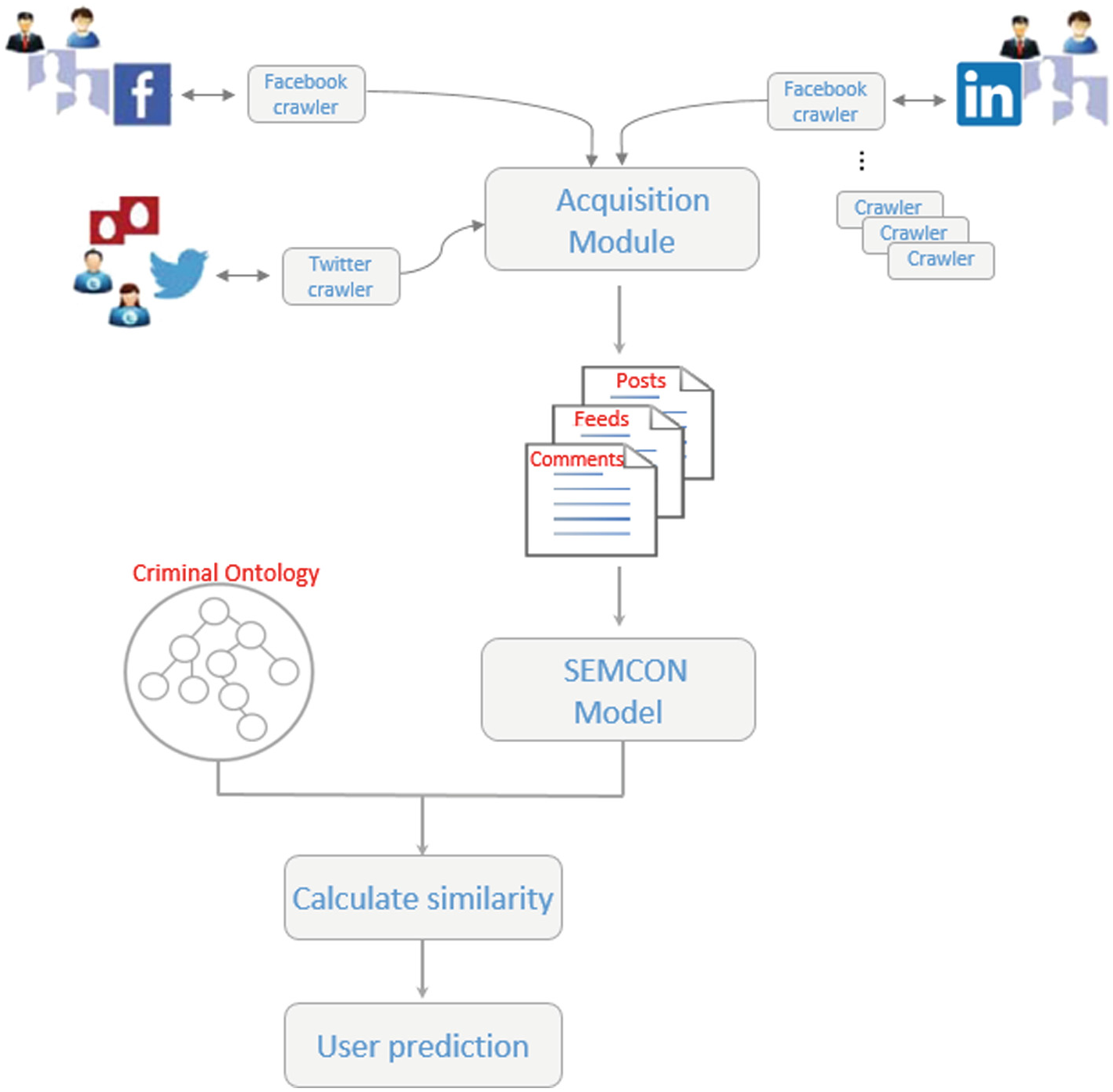
The paper introduces a framework designed for Law Enforcement Agencies (LEAs) to identify potential criminal suspects by analyzing Online Social Network (OSN) data. It leverages SEMCON, a specialized metric that combines contextual and semantic analysis of user posts, to calculate a suspicion probability score based on a predefined Criminal Ontology.
TL;DR
As social media becomes a primary trace for digital evidence, law enforcement agencies face a "data deluge." This paper presents an automated framework that crawls Facebook data and uses the SEMCON metric to map user posts against a Criminal Ontology. By calculating a hybrid score of semantic and contextual similarity, the system can autonomously flag "highly suspected" users based on the probability of their content aligning with criminal concepts.
Background Positioning: This work bridges the gap between traditional Forensic Linguistics and automated Data Mining, specifically targeting the "Semantic Gap" where raw keywords fail to capture the underlying intent of a suspect's online presence.
Problem & Motivation
Modern criminal investigations are no longer just about physical evidence; they are about digital footprints. However, the sheer volume of data on platforms like Facebook makes manual monitoring impossible.
The authors identify a critical flaw in prior automated systems: Over-reliance on co-occurrence. If a user doesn't use the exact same words in the same sentence, simple frequency-based models might miss the connection. Furthermore, social media text is notoriously noisy—filled with slang, irregular syntax, and shifting topics. The authors' intuition is that by combining where a word appears (context) with what it means in a linguistic hierarchy (semantics), they can create a more robust detection engine.
Methodology: The SEMCON Engine
The core of the system is the SEMCON Module, which processes text through three distinct layers:
- Observation Matrix: It doesn't just count words (); it considers formatting like bold, italics, and font size (), assuming that emphasized text carries higher weight.
- Contextual Score (): Uses Cosine Similarity to determine how often terms appear in the same "passages" or posts.
- Semantic Score (): Employs the Wu & Palmer algorithm to find the "Least Common Subsumer" in a linguistic tree. This ensures that even if a user switches between words like "firearm" and "weapon," the system recognizes the shared criminal root.
The final Overall Score is a weighted average ():
Experiments & Results
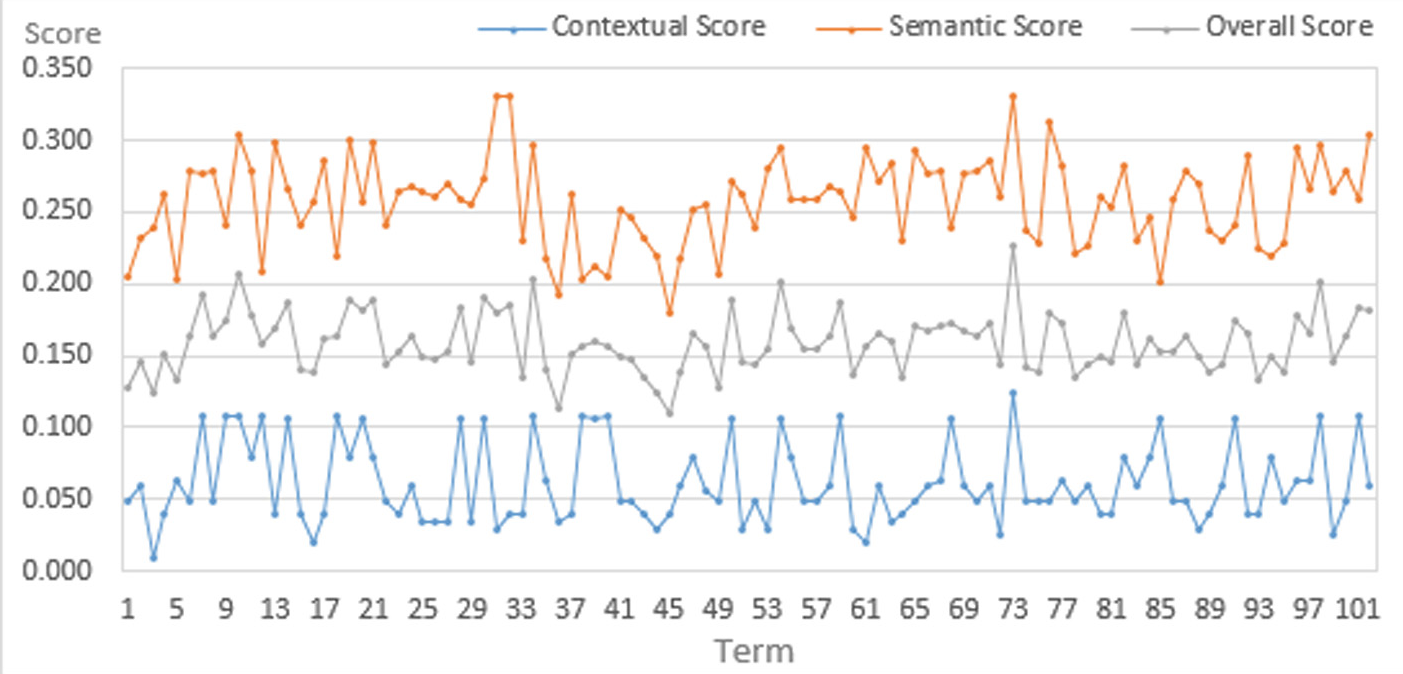
The researchers tested their model on 20 real Facebook users, analyzing nearly 200 posts. The results were telling. For "User #13," the semantic score remained high even when the contextual score dipped, indicating that the user was discussing topics that were linguistically related to crime, even if the specific word pairings varied across posts.
SOTA Benchmarking:
- High Suspects: Users who mentioned terms like "gun," "shooting," or "death" achieved a probability of 1.000, making them immediate priorities for LEAs.
- Filtering Efficiency: The system successfully filtered out "Unsuspected" users (Score = 0.000), allowing investigators to narrow their focus from 20 users to the top 7 high-risk profiles.
Critical Analysis & Conclusion
Takeaway: The SEMCON approach effectively transforms unstructured "social noise" into a structured probability heat map for law enforcement. It moves the field from "keyword searching" to "concept matching."
Limitations:
- Language Support: The current model is built on English NLP tools (TreeTagger/WordNet). Criminals often use regional dialects or coded slang that may fall outside standard semantic trees.
- Sample Size: While using real data, 20 users is a small pilot. Scaling to millions of users would require significant computational optimization of the semantic matrix.
Future Work: The authors propose developing "User Ontologies" to track behavior over time, creating a historical profile that can predict potential criminal escalation. This paves the way for predictive policing based on digital evolution.