
The Double-Edged Sword of Social Transparency: Managing Risks in Enterprise Systems
Online Social Transparency in Enterprise Information Systems: Risks and Risk Factors
The paper conceptualizes Online Social Transparency (OST) in Enterprise Information Systems and identifies its associated risks. Using a multi-stage qualitative study, the authors propose a classification for social transparency and provide a systematic taxonomy of risks affecting employee performance, wellbeing, and the workplace environment.
Executive Summary
TL;DR: In the modern digital workplace, sharing your "status," "work progress," and "availability" is seen as a cornerstone of agility. However, this paper reveals that unmanaged social transparency is a significant risk factor for employee burnout and organizational dysfunction. By categorizing transparency into distinct levels (Excessive, Normal, Lack) and practices (Symmetric vs. Asymmetric), the authors provide a roadmap for identifying when "opening up" starts hurting performance.
Background: Positioned at the intersection of Requirements Engineering and Computer-Supported Cooperative Work (CSCW), this study is a critical step toward a systematic risk assessment method for enterprise software design.
The Problem: The "Transparency Paradox"
We are told that transparency builds trust. But why does it often feel like a burden? Existing Enterprise Information Systems (EIS) often treat social data as just "more data."
The authors argue that transparency is a voluntary behavioral choice, not just a technical feature. When practiced without boundaries, it creates three major pain points:
- Cognitive Overload: Sifting through "excessive" status updates.
- Psychological Pressure: The feeling that one must constantly "signal" productivity.
- Strategic Misuse: Colleagues using shared information to "free-ride" or shift blame.
Methodology: Mapping the Transparency Landscape
The researchers categorized social transparency using a 2x2 matrix based on Awareness and Accessibility.

- Open: High awareness, high accessibility (e.g., Public Calendars).
- Regulated: High awareness, limited access (e.g., Private To-Do lists).
- Unconscious: Low awareness (e.g., A colleague sharing your location without your knowledge).
Deep Dive into Risks: The Taxonomy
The study’s most significant contribution is the detailed breakdown of risks categorized by Performance, Wellbeing, and Environment.
1. Risks of "Too Much" vs. "Too Little"
The level of transparency is subjective. What is "normal" for a manager might be "excessive" for a developer.
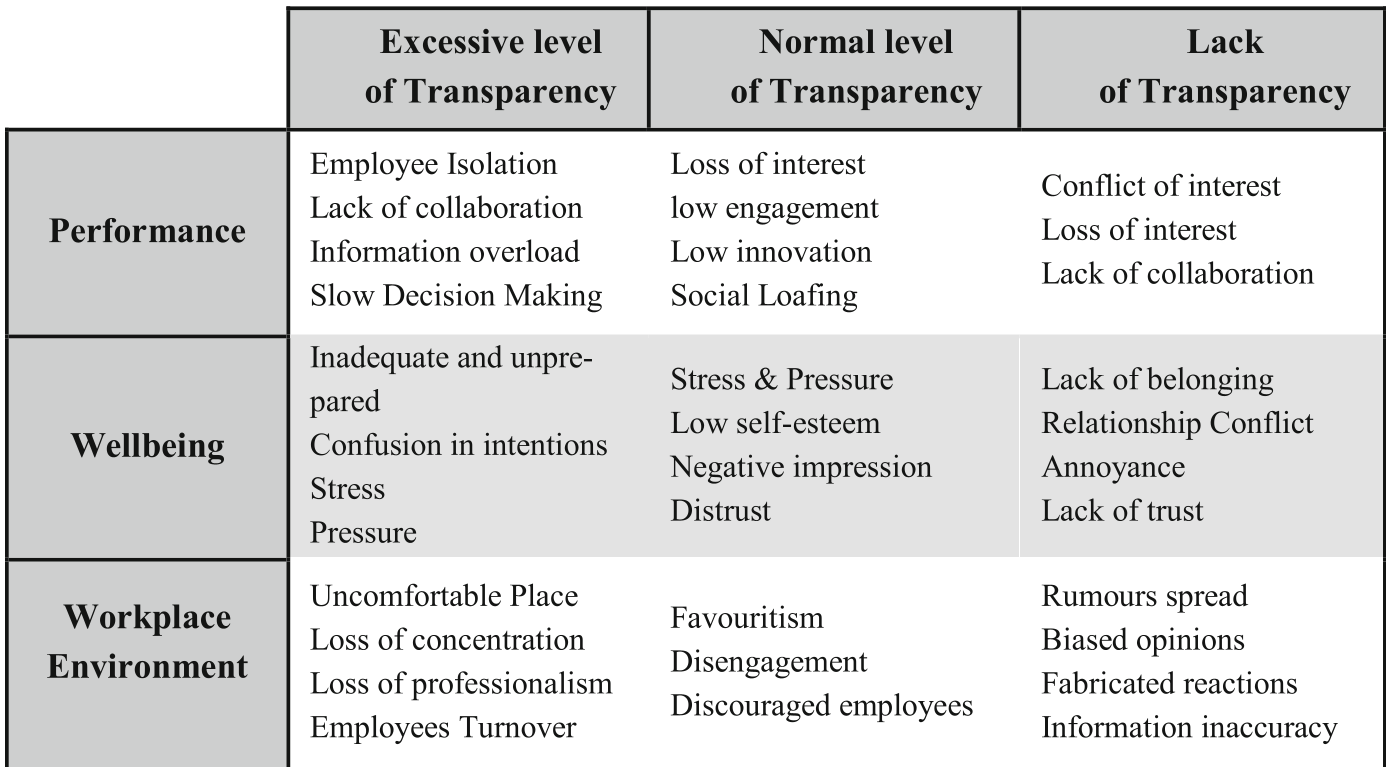
- Excessive Level: Leads to Information Overload and Employee Isolation. If you share too much, people stop listening to you to save their own cognitive resources.
- Lack of Level: Breeds Rumours and Conflict of Interest. Silence creates a vacuum filled by bias and fabrication.
2. The Asymmetry Trap
The paper highlights a critical behavioral phenomenon: Asymmetric Transparency. When one person shares everything and another shares nothing, a power imbalance is born. This leads to:
- Power Imbalance: Information becomes a weapon for personal benefit.
- Low Group Cohesion: Fragile trust because the "playing field" of awareness isn't level.
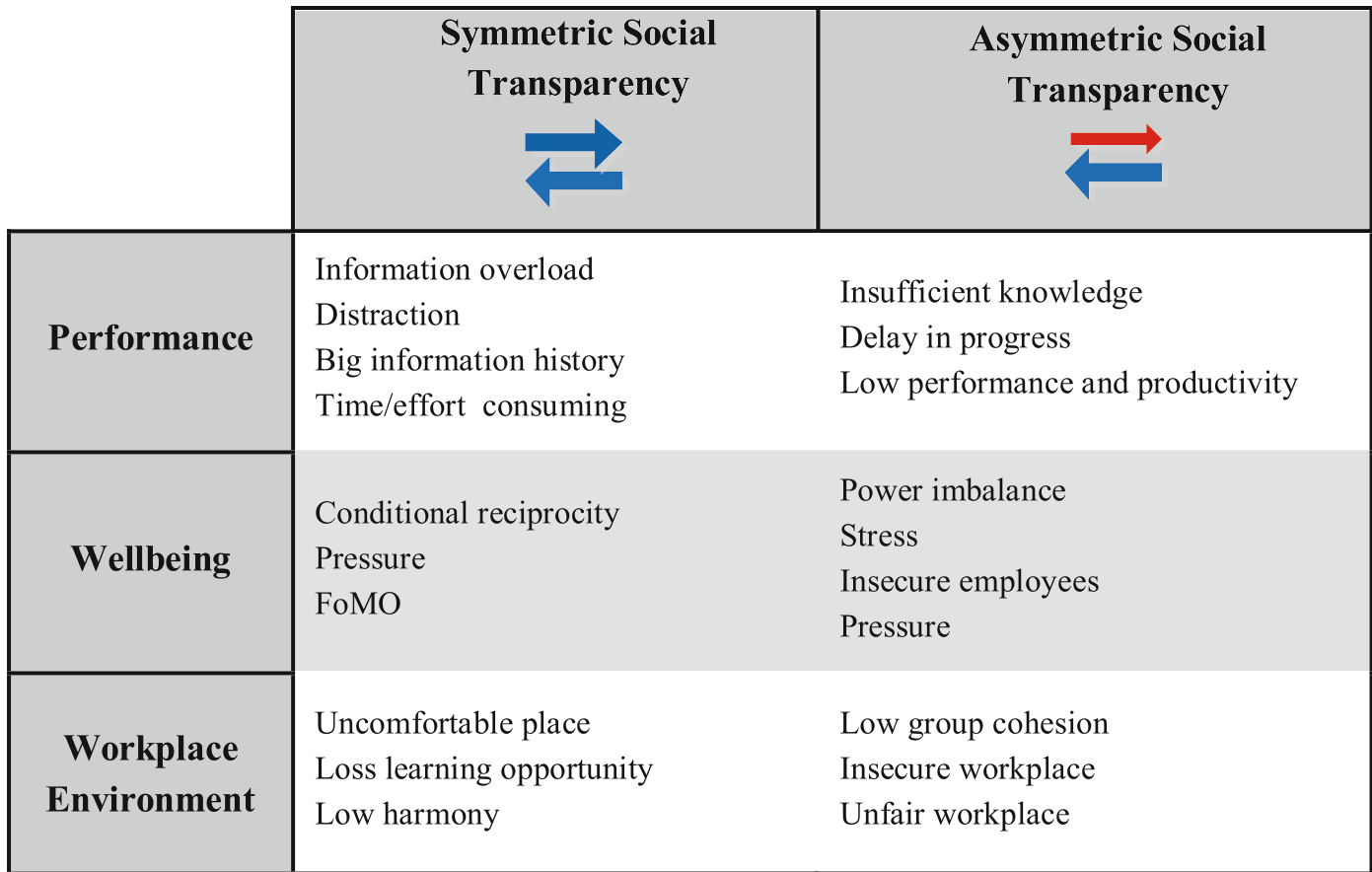
Critical Insight: Designing for "Informed Decisions"
The authors conclude that software like Slack or Teams should not just be passive pipes for information. Instead, they propose a Preparation Phase and an Analysis Phase for software design:
- Contextual Prediction: Systems should help users visualize the impact of sharing a specific status update before they post it.
- Feedback Loops: Allowing users to provide "impressions" on the transparency they receive, helping the sharer calibrate their frequency and content.
Conclusion & Future Outlook
The core takeaway is that Social Transparency is not inherently good. It is a tool that requires "shepherding." As we move toward more AI-integrated enterprise systems, the risk of "Unconscious Transparency" (where AI shares your work patterns without your explicit consent) will become the next grand challenge for organizational ethics.
Takeaway for Managers: Audit your team's ESS usage. Are you rewarding "meaningful progress" or just "noisy transparency"?