
Formed to Last: Balancing Connectivity and Fair Workload in Online Team Formation
Online team formation in social networks
The paper introduces the Balanced Social Task Assignment problem, focusing on online team formation in social networks. It proposes algorithms that simultaneously optimize for skill coverage, communication overhead (via Steiner Tree and Diameter metrics), and workload balance among experts, achieving state-of-the-art trade-offs in dynamic task environments.
TL;DR
In the modern gig economy and collaborative research environments, forming the "perfect" team isn't just about finding the right skills—it's about ensuring those experts can talk to each other and that few individuals aren't crushed under a mountain of tasks. This paper introduces a robust online framework that manages an incoming stream of tasks by picking teams that are both well-connected in a social network and fairly utilized over time.
Background: The Tension Between Coordination and Fairness
When a new project arrives, the temptation is to pick the "best" experts. However, if the same experts are picked every time (the "superstar" effect), they become a bottleneck. Conversely, if you pick a diverse set of people who have never worked together and are "far apart" in the social network, the coordination overhead—the cost of getting everyone on the same page—skyrockets.
The authors identify a gap in literature: researchers previously treated these as two separate problems. This work bridges that gap, presenting the Balanced Social Task Assignment problem.
The Core Challenge: Online Bi-criteria Optimization
The problem is difficult because it is online (tasks arrive one by one without knowledge of the future) and bi-criteria (minimizing max load while bounding communication cost).
The Methodology: ExpLoad and Modified Graphs
The researchers utilize a clever mathematical transformation. To solve for a specific task , they define an allocation cost for each person using the ExpLoad function: This exponential penalty ensures that as a person’s load () increases, they become significantly "more expensive" to pick, naturally forcing the algorithm to look for underutilized experts.
Bridging Network and Load
To solve the Steiner-tree coordination cost, the authors construct a Modified Graph:
- They take the existing social network.
- They add "dummy" nodes representing skills.
- They connect people to these skill nodes with weights proportional to their current "load cost."
By solving a Group Steiner Tree on this modified structure, the algorithm finds a set of people who cover all skills while minimizing the sum of their "cost" and the "distance" between them.
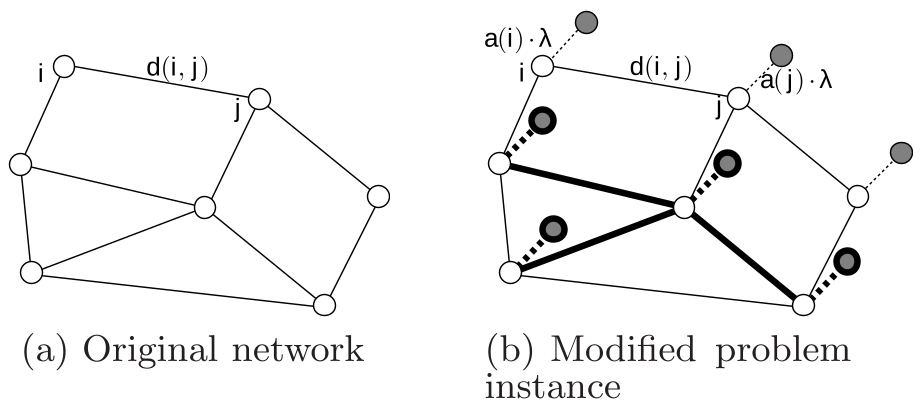 Figure 1: Transformation of the social network into a modified instance where load costs are represented as edge weights to auxiliary nodes.
Experimental Insights
The authors tested their approach on two distinct datasets: IMDB (Directors and Actors) and Bibsonomy (Research Collaboration).
The Pareto Trade-off
One of the most striking results is the visibility of the "Pareto Curve." By adjusting a scaling parameter , the system can decide how much it values a "tight-knit team" versus a "fairly loaded workforce."
- Low : Focuses on the "Dream Team" (lowest communication cost), leading to high max load.
- High : Focuses on fairness, creating slightly more spread-out teams to give busy experts a break.
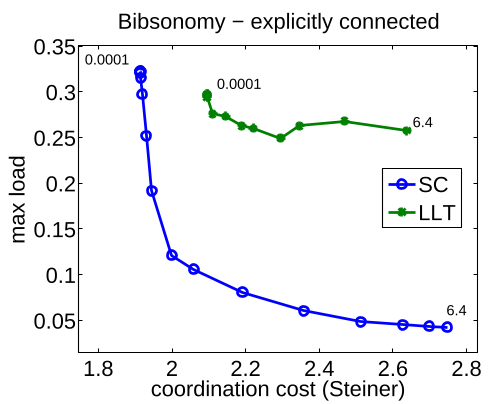 Figure 2: The trade-off between Steiner coordination cost and maximum load. The "SC" (Set-Cover) heuristic consistently yields better results than previous "LLT" baselines.
Critical Analysis & Conclusion
Takeaway
The genius of this paper lies in its online-competitive guarantee. It proves that even without knowing what tasks are coming tomorrow, we can achieve competitiveness in terms of load balancing. Practically, the 60-70% reduction in workload imbalance for a mere 5-10% increase in coordination cost is a "no-brainer" for any real-world project management system.
Limitations
While powerful, the model assumes a static social network. In reality, every time a team works together, their "social distance" should decrease (as they build rapport). The paper briefly mentions this but leaves the dynamic social evolution for future work. Additionally, the Group Steiner Tree problem is NP-hard, meaning that for massive networks with millions of nodes, even the heuristics might require optimization for real-time response.
Future Outlook
This work sets the stage for a new generation of "Socially Aware" scheduling systems—moving beyond simple skill-matching to holistic human-resource management in collaborative environments.