
Can Online User Behavior Improve Sales Prediction? Decoding the Search-to-Purchase Window
Can Online User Behavior Improve the Performance of Sales Prediction in E-commerce
This paper proposes a novel data mining framework for e-commerce sales prediction by integrating online user behavior data (search volume and page views) with historical sales. Using real-world data from a major Chinese B2C platform, the study demonstrates that Support Vector Regression (ε-SVR) with a linear kernel achieves state-of-the-art accuracy in forecasting product demand.
TL;DR
In the high-stakes world of e-commerce, predicting sales isn't just about looking at what was sold yesterday; it’s about understanding what users are looking for today. This paper introduces a data mining framework that proves online behavior—specifically search volume and page views—can significantly sharpen sales forecasts. By identifying an optimal "lag" of 1-2 days between a search and a sale, the authors provide a practical roadmap for inventory optimization using SVR and Neural Networks.
The Problem: The Uncertainty of Digital Demand
E-commerce managers face a constant "Goldilocks" problem: stock too much, and inventory costs eat your profits; stock too little, and you face "user churn" as customers head to competitors.
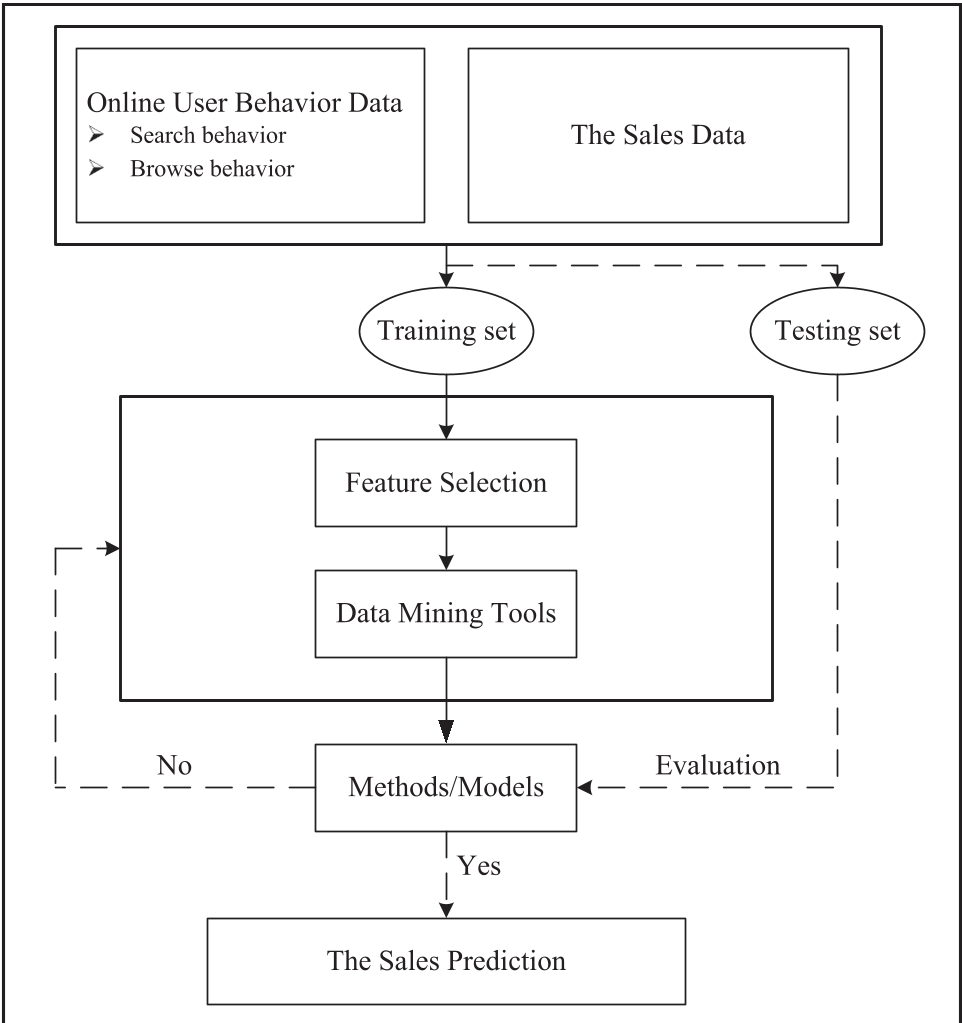
Traditional time-series models (like ARIMA or simple NNs) often treat sales in a vacuum. However, the authors argue that consumer behavior follows a specific psychological process: Recognition → Search → Appraisal → Selection. The missing link in most models is the "Search" and "Appraisal" phase, which provides an "honest signal" of intent before the transaction actually occurs.
Methodology: Bridging Behavior and Data Mining
The researchers constructed a dual-stream input framework:
- Historical Sales: The baseline trend.
- User Behavior Metrics: Specifically, the volume of internal searches and the specific Page Views (PV) of product detail pages.
They tested this against four types of models: Back-Propagation Neural Networks (BPNN), Radial Basis Function Networks (RBFNN), and two flavors of Support Vector Regression (ε-SVR and ν-SVR).
Optimal Lag Identification
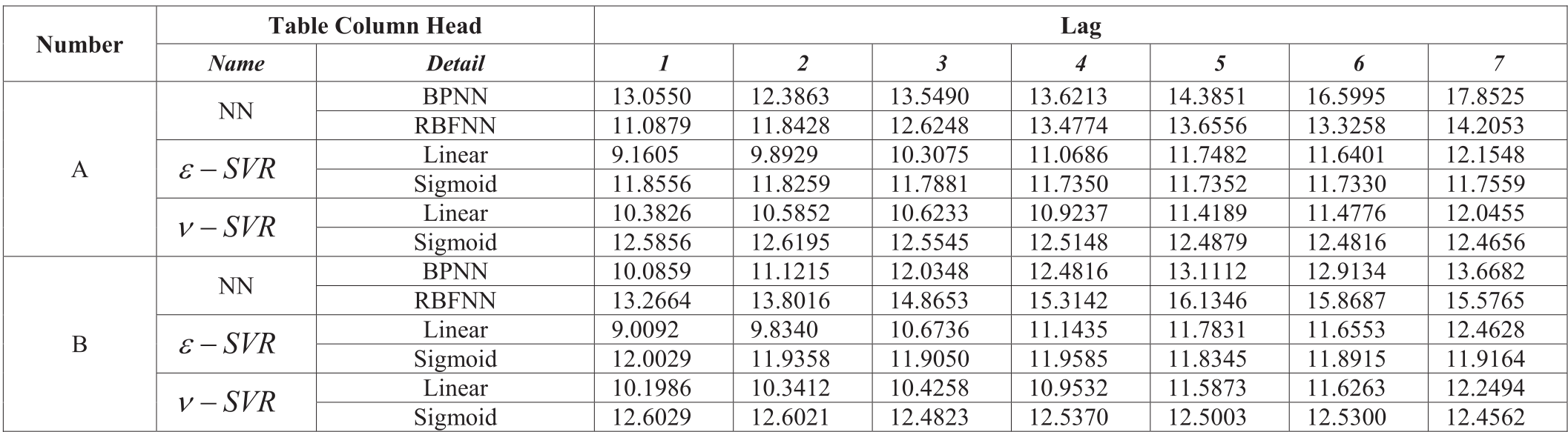
A critical contribution of this work is the analysis of Time Lag. Does a search today mean a sale today, or a sale next week? The framework tests various lags (1 to 7 days) to find the "window of hesitation."
Core Insights from Experiments
The study used real-world data from one of China's largest B2C platforms, focusing on 65 book categories over a four-month period.
1. SVR Outperforms Neural Networks
Contrary to the trend of using complex deep learning, the empirical evidence showed that ε-SVR with a Linear kernel provided the most stable and accurate results (lowest MAE and RMSE). While BPNN improved when behavioral data was added, RBFNN actually struggled with the extra features, likely due to overfitting on the noise.
2. The 48-Hour Window
The data revealed that for the vast majority of categories, the optimal lag is 1–2 days. This suggests that in the e-commerce environment, once a user starts searching for a specific product and clicks into the details, the decision to purchase is made rapidly. If you aren't using today's search data to predict tomorrow's sales, you are already behind.
3. Not All Categories React Equally
The "Enhancing Effect" varies by product type:
- High Sensitivity: "Finance" and "Exam" books showed the most significant performance boost when behavioral data was included. These are likely "high-involvement" purchases where users research heavily before buying.
- Low Sensitivity: Categories like "Cartoon" or "Art" were less influenced by search data, suggesting these might be more impulsive or driven by external discovery rather than internal search.
Critical Analysis & Conclusion
This paper validates the intuition that intent data beats historical data. By proving that a simple linear SVR can outperform complex NNs when fed the right behavioral features, the authors highlight the importance of feature engineering over model complexity in noisy e-commerce environments.
Limitations: The study is limited to the book category. Consumer behavior for high-ticket items (like electronics or furniture) likely involves a much longer lag than 1-2 days. Furthermore, the "Page View" metric is a blunt instrument; future models could benefit from "Time on Page" or "Add to Cart" actions.
Final Takeaway: For e-commerce platforms, the internal search bar is more than a navigation tool—it is a crystal ball. Integrating these behavioral streams into inventory systems can lead to a quantifiable reduction in stock-outs and overstock costs.