
Simple-Greedy: Optimizing Social Welfare in the Era of Autonomous Influencers
Online Welfare Maximization of Sponsored Viral Marketing with Stochastically Arriving Spreaders
This paper introduces a general framework for sponsored viral marketing that accounts for the stochastic arrival and autonomy of social media spreaders. It proposes the "Online Simple-Greedy" algorithm to maximize social welfare by allocating arriving spreaders to sponsors, achieving a competitive ratio compared to the offline optimum.
TL;DR
The classic Influence Maximization (IMP) problem is due for an upgrade. While traditional research treats "spreaders" (influencers) as static assets to be picked from a list, this paper recognizes them as autonomous agents who log in and out stochastically. By framing this as an Online Welfare Maximization problem, the authors prove that a straightforward Online Simple-Greedy algorithm is not just effective—it is theoretically optimal () for allocating arriving influencers to advertisers in real-time.
Probing the Motivation: The "Static" Fallacy
Most viral marketing research operates under a "god-view" assumption: an advertiser sees the whole network, picks seeds, and hits "go." In reality:
- Spreaders are autonomous: A celebrity might not be available or willing when you need them.
- Dynamics are online: Users arrive at the platform at unpredicted times.
- Multi-Sponsor Competition: Multiple brands are fighting for the same set of influential eyes simultaneously.
This paper shifts the focus from "Who should I pick?" to "How should the platform allocate an arriving spreader to the right sponsor?"
Methodology: The Online Greedy Allocation
The authors propose a framework involving three parties: Sponsors, the Platform, and Spreaders. The goal is to maximize Social Welfare (the sum of utilities of all parties).
1. Mathematical Intuition
The platform assumes that the influence function is submodular (exhibits diminishing marginal returns). To handle influencers who might be assigned to the same brand multiple times, they introduce Extension 1: This ensures that the more a spreader is used for the same sponsor, the less "extra" value they bring.
2. The Algorithm
The Online Simple-Greedy algorithm (Algorithm 1) is elegant:
- When a spreader arrives, calculate the potential marginal gain for every sponsor .
- Assign to the sponsor who maximizes .
- Update the state and repeat.
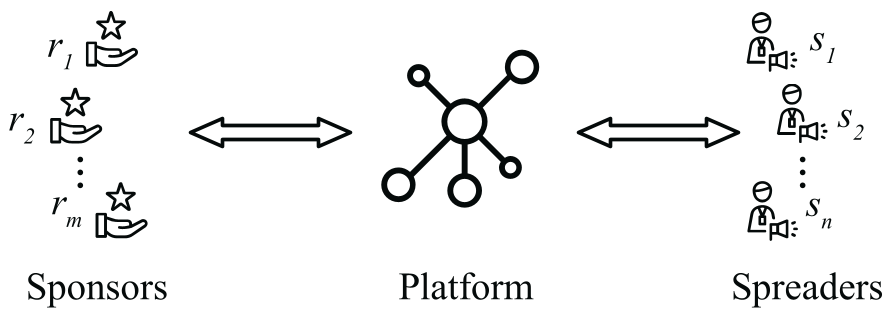
Theoretical Brilliance: Greedy is Optimal
One might think a greedy approach is "lazy," but the authors prove its dominance. By using a Linear Programming (LP) relaxation as an upper bound for the expected offline optimum (), they demonstrate:
The Performance Bound: The algorithm is competitive. This means that in a world of stochastic arrivals (i.i.d. model), the greedy choice captures at least ~63.2% of the value an omniscient offline scheduler could achieve. Furthermore, they cite complexity results to show that no polynomial-time algorithm can do better unless .
Experimental Evidence
The authors tested their theory on real-world graphs: Wiki-Vote and Slashdot.
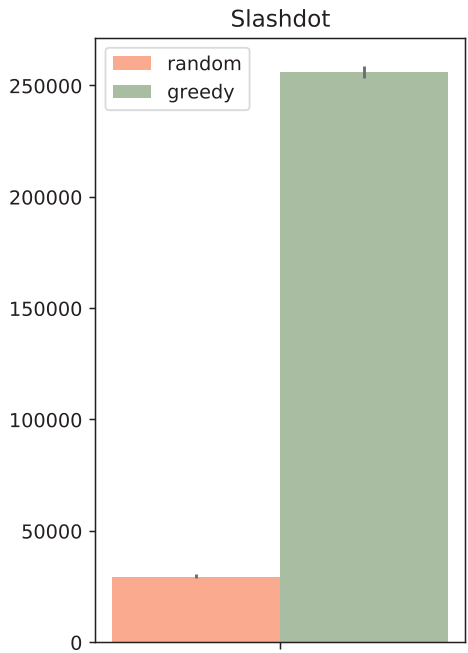
As shown in the comparison, the Online Simple-Greedy (green) consistently outperforms Random Allocation (red). Specifically, for larger networks like Slashdot, the efficiency of greedy selection becomes even more pronounced, validating the practical utility of the submodular framework.
Critical Analysis & Conclusion
Takeaway
This paper successfully bridges the gap between theoretical submodular maximization and the practical, messy reality of social media dynamics. It proves that platforms don't need hyper-complex forecasting models to manage influencers; a well-calibrated greedy marginal utility calculation is theoretically "as good as it gets."
Limitations
- I.I.D. Arrival Assumption: The model assumes we know the distribution of spreader arrivals from historical data. In highly volatile viral events, this distribution might shift rapidly.
- Strategic Behavior: While it considers spreader "discretion," it doesn't fully model spreaders acting strategically to manipulate their "price" or "availability" to get better contracts.
Future Outlook
The integration of Continuous-Time Diffusion is a promising next step mentioned by the authors. Future iterations could also explore "Spreader Fatigue" more deeply, where over-allocation leads to negative influence (backlash), moving beyond simple submodularity into non-monotone utility functions.