
OnlineCruise: Streamlining Social Connectivity in the Internet of Cars
OnlineCruise: An Online Social Grouping Strategy for Vehicular Social Networks
OnlineCruise is an online social grouping strategy designed for Vehicular Social Networks (VSNs) to facilitate user-oriented services through interest-based grouping. It utilizes an efficient and reliable Scoped Multicasting Service (SMS) within a publish/subscribe framework to form real-time vehicular social communities.
TL;DR
OnlineCruise is a novel strategy for Vehicular Social Networks (VSNs) that allows drivers to form social groups based on shared interests while on the road. By combining a Publish/Subscribe model with a deterministic Scoped Multicasting Service (SMS), it reduces network congestion (overhead) by up to 25% compared to traditional methods while maintaining high reliability in message delivery.
Background & Motivation: The Lonely Road
Despite being physically surrounded by hundreds of other vehicles, drivers often remain socially isolated. In the era of the "Internet of Cars," there is a growing demand for services that improve driving comfort—such as identifying common interests or coordinating platoons.
The technical challenge is not just "sending a message" but doing so without clogging the network (the infamous Broadcast Storm Problem). Prior works like SocialCast or RoadSpeak either failed to handle real-time updates or used non-deterministic routing that led to wasted bandwidth and missed opportunities for social "matches."
Methodology: Precision over Randomness
The genius of OnlineCruise lies in its deterministic scheduling. Instead of nodes waiting for a random interval to retransmit a message (which can lead to collisions or delays), OnlineCruise uses spatial awareness.
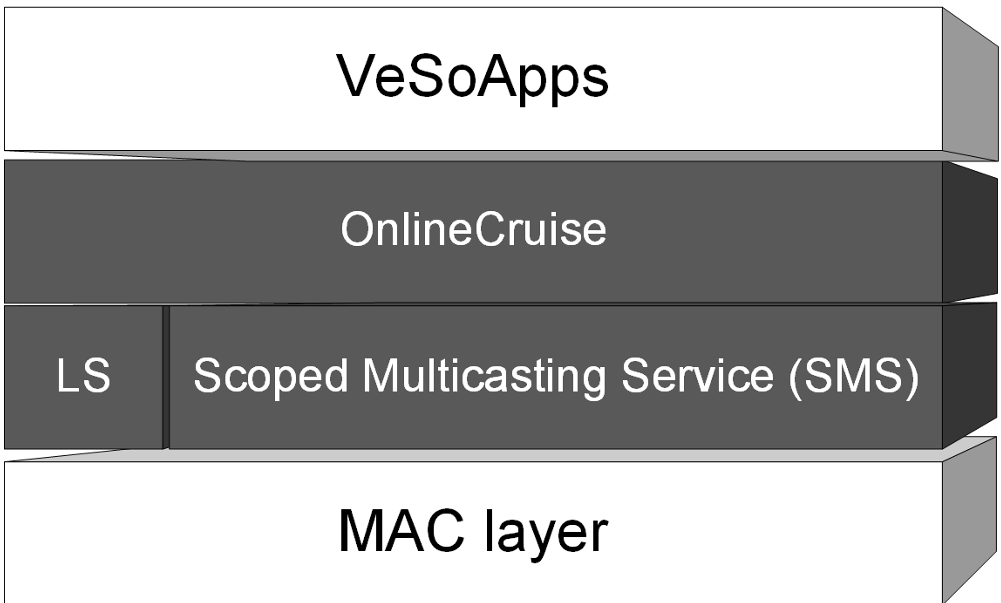
1. The Architecture
The system is built on a layered architecture integrating location sensors with the OnlineCruise layer.
2. Scoped Multicasting Service (SMS)
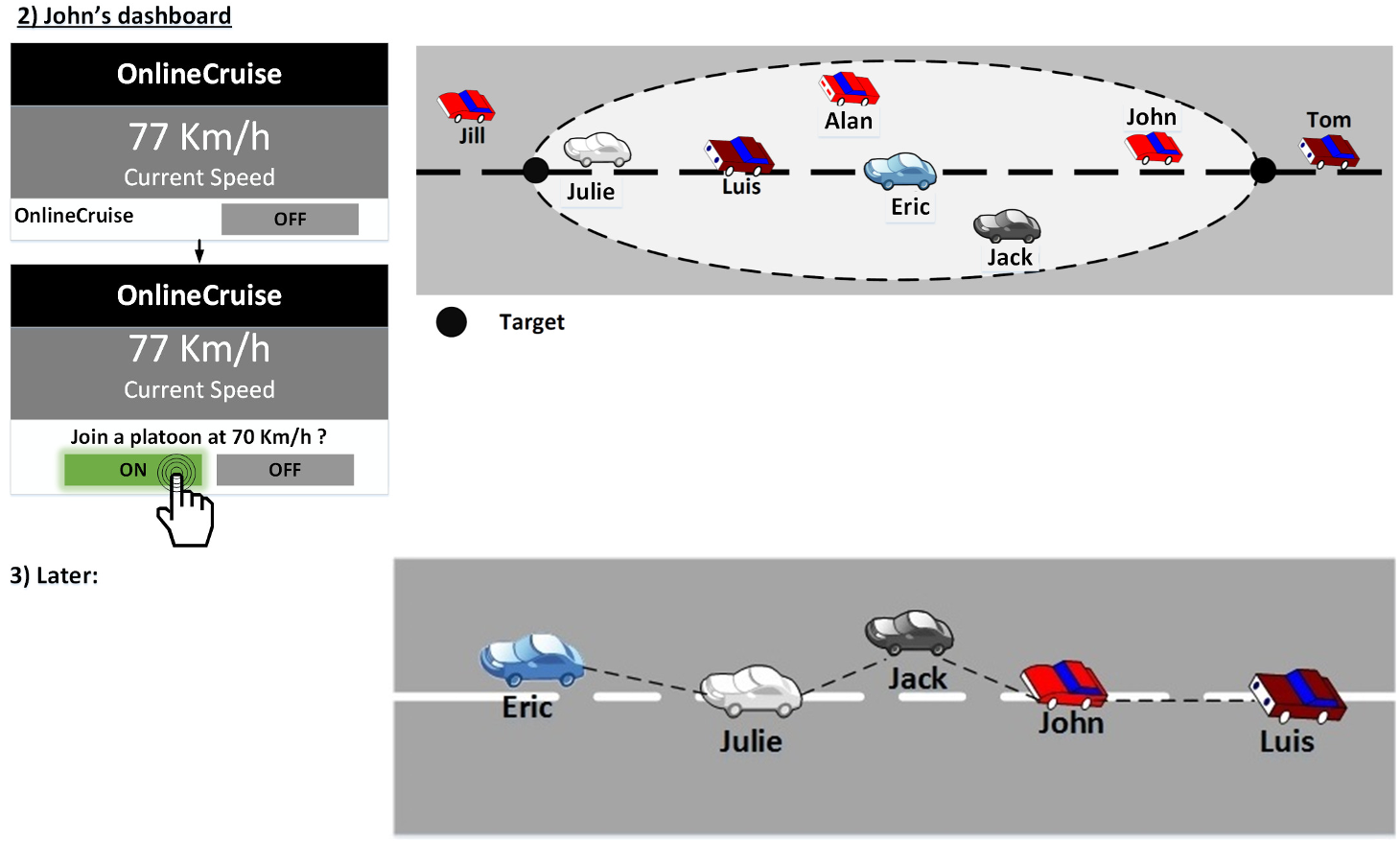
When a driver (e.g., "Eric") publishes an interest, the SMS identifies specific "targets" at the edge of his transmission range.
- Distance-Based Scheduling: Neighboring vehicles calculate a waiting time proportional to their distance from these targets.
- The Winner Forwards: Nodes closer to the target (the optimal path) time out first and retransmit, while nodes further away "mute" themselves upon hearing the retransmission.
- Dynamic Filtering: Subscribers check if their velocity and interests match the publisher's criteria in real-time.
Performance: Efficiency Meets Reliability
The researchers tested OnlineCruise using the Sinalgo simulator across varying vehicle densities on a 12km road.
- Message Load: In high-density environments, OnlineCruise beats the Counter-Based Scheme (CBS) by 24.9%.
- Scalability: While flooding techniques see an exponential rise in overhead, OnlineCruise maintains a significantly flatter growth curve due to its elective forwarding mechanism.
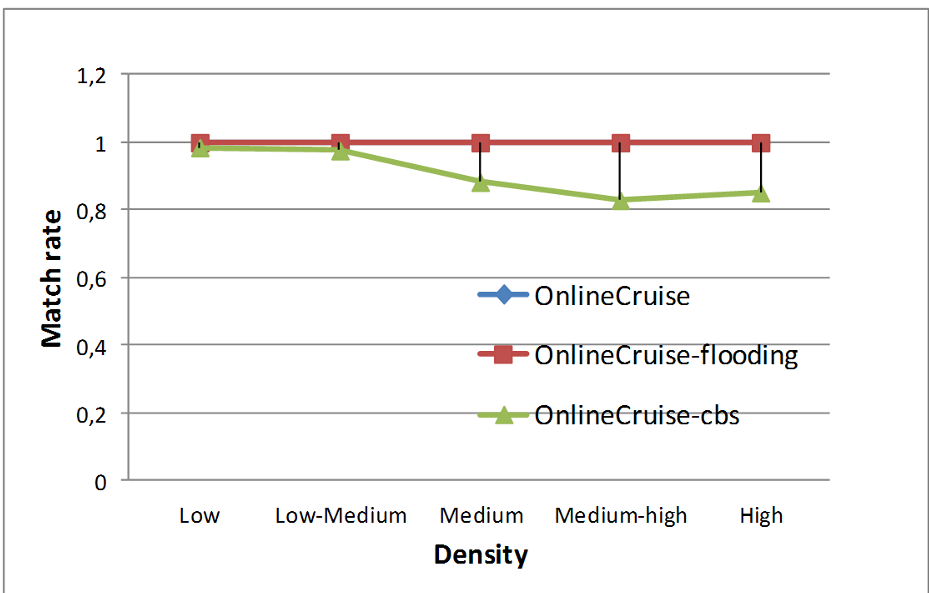
- Match Rate: Because messages travel faster and more reliably, more users successfully "match" and join social groups compared to legacy protocols.
Practical Implications & Future Work
The primary takeaway is that spatial determinism beats stochastic approaches in vehicular environments. By linking the network's routing layer directly to the physical location of the cars, OnlineCruise ensures that only the most "useful" nodes participate in data dissemination.
Limitations: The current study assumes a relatively uniform speed distribution (60-70 km/h). Future research should investigate how extreme speed differentials (e.g., highway vs. city) and physical obstacles (urban canyons) affect the Scoped Multicasting targets.
Conclusion
OnlineCruise moves us one step closer to a truly collaborative "Internet of Cars," where the network is not just a pipe for data, but a social facilitator that optimizes itself based on where we are and where we are going.