
ONSIDE: Breaking the Congestion Barrier in Socially-Driven Opportunistic Networks
ONSIDE: Socially-aware and Interest-based dissemination in opportunistic networks
This paper introduces ONSIDE (OpportuNistic Socially-aware and Interest-based DissEmination), a data dissemination algorithm for opportunistic networks (OppNets). By integrating online social connections, user interests, and contact history, ONSIDE achieves a high message hit rate while significantly reducing network congestion and delivery costs.
TL;DR
Opportunistic Networks (OppNets) thrive on human movement but suffer from communication "flooding" that chokes bandwidth. ONSIDE (OpportuNistic Socially-aware and Interest-based DissEmination) solves this by transforming mobile devices into "socially-intelligent" relays. By looking at who your friends are and what they like, ONSIDE achieves near-Epidemic hit rates while slashing data overhead by orders of magnitude (saving up to 32TB in large-scale simulations).
Problem & Motivation: The Flooding Dilemma
In an OppNet, there is no central server. Metadata must "hop" from one device to another via Bluetooth or Wi-Fi only when people physically meet. The classic solution, Epidemic Routing, simply copies everything to everyone.
Why this fails:
- Congestion: Buffers fill up with junk data, causing critical messages to be dropped.
- Selfishness: Some algorithms only download what the current user wants. If users don't have perfect overlap in paths, data gets stuck in "interest islands" and never reaches its target.
The authors' key Insight: Humans are social animals. We meet our friends predictably, and we tend to share interests with the crowds we hang out with. If we use these social "gravitational pulls," we can route data much more efficiently.
Methodology: The Exchange Function
ONSIDE moves away from simple flooding to a calculated weighted exchange. When two nodes (A and B) meet, node A won't just take everything from B. It evaluates a tripartite boolean function:
- Commonality: Do A and B share at least one interest? (If yes, they likely travel in the same circles).
- Altruism (Social): Even if A doesn't want the file, do A's Facebook/social friends want it?
- Predictive History: Has A encountered many people interested in this topic recently? If so, A is a good "bus" to carry that data.
 (The logical AND/OR structure of the ONSIDE exchange decision)
Experiments: Real-World Mobility
The researchers tested ONSIDE across three major mobility datasets: Infocom, Sigcomm, and UPB. These traces track real people moving through conferences and campus environments.
Results Highlights
- The Sigcomm Success: In the Sigcomm trace, ONSIDE outperformed ML-SOR and Limited Epidemic in almost every metric.
- Massive Efficiency: The delivery cost (the ratio of messages exchanged to messages delivered) was significantly lower. In a network of ~70 nodes, ONSIDE saved approximately 32 Terabytes of unnecessary transfers compared to Epidemic methods.
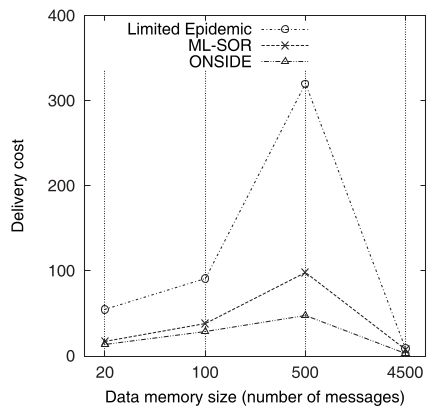 (Chart showing ONSIDE's superior delivery latency and hit rate balance)
Memory Scaling
A fascinating finding was that ONSIDE scales exceptionally well with modern hardware. While older algorithms like ML-SOR work okay on very small buffers (20 messages), ONSIDE dominates as soon as devices have realistic storage (1GB+). It reaches a "utility equilibrium" where it stops requesting data it knows it cannot efficiently deliver.
Critical Analysis & Conclusion
Takeaway: ONSIDE proves that "Context is King" in decentralized networks. By using social circles as a proxy for network topology, it creates a "Soft Infrastructure" that mimics human behavior.
Limitations:
- Interest Granularity: The algorithm struggled slightly with the UPB trace because the interests were too broad (only 5 categories). If everyone is "interested" in "Academic," everyone still talks to everyone, leading back toward flooding.
- Privacy: The paper assumes nodes are willing to share their friend lists and interests openly during contact—a hurdle for real-world deployment without robust encryption or anonymization.
Future Outlook: As we move toward a world of "Edge Computing" and IoT, ONSIDE’s approach of using social metadata to prune network traffic will be vital for keeping our wireless spectrum from becoming an unusable, congested mess.