
OnTac: Revolutionizing Crowdsourcing with Online Task Assignment and Real-Time Expertise Estimation
OnTac: Online task assignment for crowdsourcing
This paper introduces OnTac (Online Task Assignment for Crowdsourcing), an adaptive framework that jointly estimates worker reliability and task difficulty using an Online Expectation-Maximization (EM) algorithm. It achieves SOTA performance by dynamically assigning tasks to suitable annotators in real-time, significantly outperforming conventional GLAD and majority voting methods in both accuracy and budget efficiency.
Executive Summary
TL;DR: OnTac (Online Task Assignment for Crowdsourcing) is a novel framework designed to solve the inefficiency of traditional crowdsourcing. By utilizing an Online Expectation-Maximization (EM) algorithm, it estimates labeler expertise and task difficulty on-the-fly, allowing the system to assign the right questions to the right people.
Positioning: This work bridges the gap between passive label integration (like Majority Voting) and active task assignment. It moves away from "batch-processing" models towards a real-time, adaptive system that treats crowdsourcing as a dynamic resource allocation problem.
Problem & Motivation: The "Blind" Sampling Trap
Most crowdsourcing systems suffer from two main flaws:
- Heterogeneity Blindness: They treat all labelers as equally skilled and all tasks as equally difficult.
- The Budget Paradox: Requesters often pre-set a number of labels per task (e.g., 5 labels/task). This results in a waste of money for easy questions and insufficient data for hard ones.
The authors' insight is simple but powerful: If we can estimate a worker's "alpha" (ability) and a task's "beta" (difficulty) after just a few samples, we can stop asking easy questions and direct experts toward the "ambiguous" ones.
Methodology: The Online Inference Engine
OnTac is built on a probabilistic foundation where the probability of a correct label is modeled as a sigmoid function of the interaction between labeler ability and question difficulty :
The Two-Phase Loop
The system operates in a continuous loop:
- Assignment Phase: When a labeler arrives, the system ranks the question pool. It prioritizes tasks where the current posterior is near 0.5 (maximum uncertainty) and selects questions that match the worker's predicted expertise level.
- Inference Phase: Using Online EM, the system updates the global parameters immediately after receiving a label. Unlike standard EM, which re-scans the whole dataset, OnTac uses Sufficient Statistics () to interpolate past knowledge with new observations:
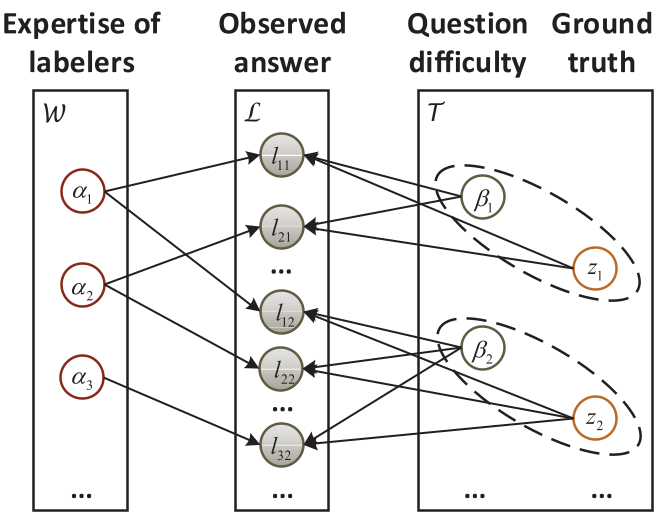 Fig 1: Plate representation of the probabilistic model showing the interaction between labelers (W) and tasks (T).
Experimental Breakthroughs
The authors validated OnTac through rigorous simulations against GLAD (Generative Model of Labels, Abilities, and Difficulties) and Majority Voting.
1. Superior Accuracy with Fewer Samples
Contrary to the intuition that online algorithms lose precision, OnTac actually converges faster to a higher accuracy level. As shown in the performance charts, once the number of labelers exceeds 20, OnTac's ability to "cherry-pick" tasks for specific workers allows it to surpass the offline GLAD baseline.
 Fig 2: OnTac outperforms GLAD and Majority Voting as the pool of labelers grows.
2. Massive Cost Savings
Perhaps the most significant result is the budget efficiency. Because OnTac stops labeling tasks once it reaches a high posterior confidence (Criterion 4), the cumulative cost (number of labels) is drastically reduced. At 70 labelers, OnTac achieved superior accuracy while spending only 68% of the budget required by the offline baseline.
 Fig 3: OnTac maintains high accuracy while the growth rate of total labels (cost) significantly slows down.
Critical Analysis & Takeaways
Key Contribution: OnTac successfully demonstrates that the trade-off between "exploring" a worker's ability and "exploiting" their skill for specific tasks can be managed online without expensive "gold standard" test questions.
Limitations:
- The model currently assumes binary labels. Extending this to multi-class or continuous tasks would require a more complex categorical distribution.
- It relies on a "cold start" where initial assignments might be random until the first few EM updates stabilize.
Future Outlook: In the era of Generative AI, where the most valuable data comes from RLHF (Reinforcement Learning from Human Feedback), the principles of OnTac are hyper-relevant. Efficiently routing difficult preference-ranking tasks to more "aligned" or expert human annotators could be the key to training better LLMs at a lower cost.