
OntoAugment: Boosting Semantic Alignment with Similarity of Similarities
OntoAugment: Ontology Matching through Weakly-Supervised Label Augmentation
OntoAugment is a weakly-supervised ontology matching system that enhances programmatic labeling by augmenting labeling function (LF) outcomes. It introduces a "similarity of similarities" mechanism to project labels from known concept pairs to similar unlabeled pairs, achieving up to 11 F1 points improvement over state-of-the-art weak supervision when few LFs are available.
TL;DR
Ontology matching is essential for IoT interoperability but suffers from a "labeling bottleneck." OntoAugment breaks this by using Reinforced Labeling to guess labels for unlabeled concept pairs based on their similarity to already-labeled ones. It significantly improves performance when you only have a few simple labeling rules, making "cheap" weak supervision much more effective.
The Problem: The Sparse Labeling Matrix
In the world of the Internet of Things (IoT), data models are notoriously heterogeneous. To make sense of them, we use Ontology Matching to find equivalent classes across different schemas.
While modern researchers have moved toward Weak Supervision (WS) (using rules called Labeling Functions or LFs to auto-label data), they hit a wall:
- High Effort: Writing complex LFs requires deep NLP and domain expertise.
- Low Coverage: Simple LFs (like "do the names match exactly?") only label a tiny fraction of the data, leaving the training matrix mostly empty (abstains).
- The Cold Start: Without enough LFs, the downstream machine learning model doesn't have enough data to generalize.
Methodology: The "Similarity of Similarities"
OntoAugment introduces a clever architectural layer between the labeling functions and the generative model. It asks: If Concept Pair A is a match, and Concept Pair B "looks" just like Pair A, shouldn't we label Pair B as a match too?
1. Feature Extraction
The system calculates a "similarity array" for every pair of concepts using three metrics:
- Levenshtein Distance: Basic string edit distance.
- SpaCy Similarity: Statistical word vectors.
- Universal Sentence Encoder (USE): Deep semantic embeddings for concept names.
2. The Gravitation Method
Instead of treating every data point in isolation, OntoAugment views them in a high-dimensional similarity space. A "gravitation effect" is applied where labeled points "attract" unlabeled points. If an unlabeled pair is sufficiently close to a group of labeled pairs, it "inherits" that label.
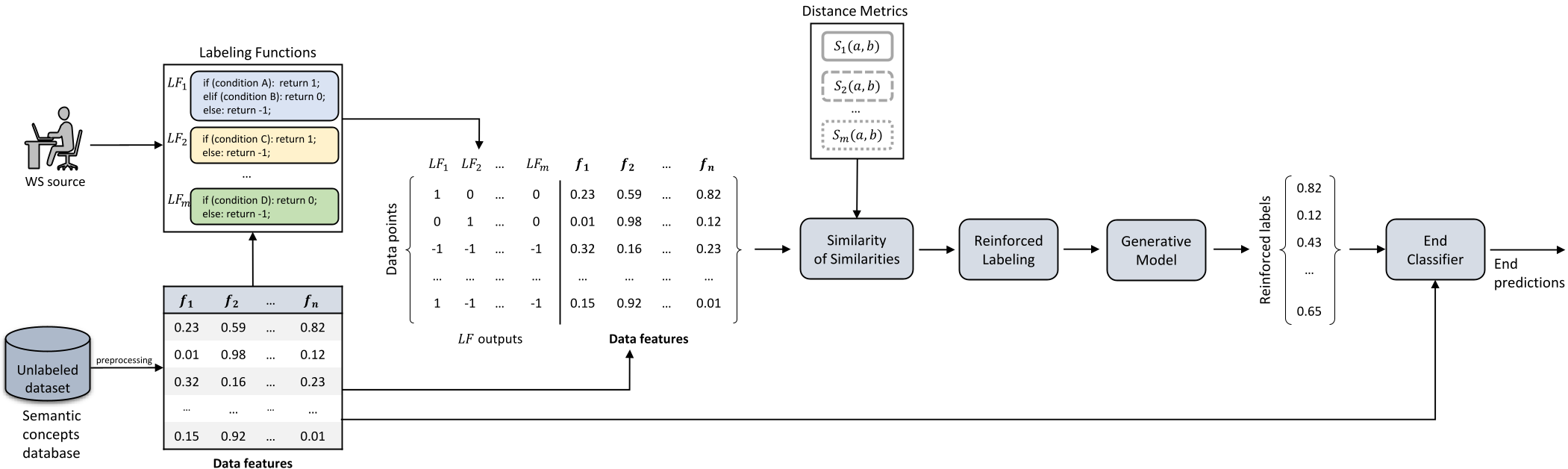 Figure 1: The OntoAugment pipeline, showing how the Similarity of Similarities module feeds into the Reinforced Labeling block.
Experimental Wins
The authors tested OntoAugment on the "Conference" dataset (7 ontologies).
- The "Few-Rule" Scenario: When excluding complex LFs (relying only on simpler ones), OntoAugment boosted the F1-score by 11 points (0.52 to 0.63).
- Density Increase: The labeling matrix density improved from 9.2% to 10.8%, providing the downstream Random Forest classifier with more positive samples to learn from.
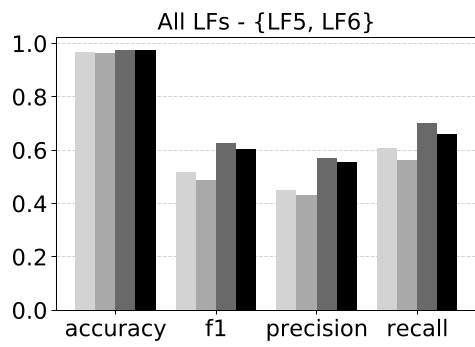 Figure 2: Performance comparison showing significant gains in F1-score for filtered and unfiltered cases.
Critical Insight & Conclusion
The brilliance of OntoAugment lies in its Inductive Bias. It assumes that the similarity metrics themselves are reliable neighbors for label propagation. While this could introduce noise if the similarity metrics are poorly chosen, the study shows that in high-imbalance tasks like ontology matching (where positive matches are rare), the benefit of finding more positive samples outweighs the risk of noise.
Future Outlook: While OntoAugment uses string and semantic similarities, future iterations could incorporate Structural Similarity (graph-based distances) to better handle complex hierarchical ontologies. For now, it offers a powerful toolkit for developers who want the benefits of AI-driven data integration without the soul-crushing task of manual labeling.