
OntoGen: Bridging the Gap Between Raw Data and Structured Knowledge
OntoGen: Semi-automatic Ontology Editor
OntoGen is a semi-automatic, data-driven ontology editor that integrates machine learning and text mining to assist users in building topic ontologies. It features unsupervised clustering and supervised active learning methods (SVM) to suggest concepts and relations, effectively lowering the entry barrier for non-expert users.
TL;DR
OntoGen is a semi-automatic ontology editor designed for domain experts rather than just ontology engineers. By combining unsupervised clustering (for discovery) and supervised active learning (for precision), it allows users to transform large document corpuses into structured topic ontologies with minimal manual effort and no required background in machine learning.
The "Expertise Gap" in Ontology Engineering
For years, the creation of ontologies—the backbone of the Semantic Web and advanced knowledge management—has been a bottleneck. Standard tools like Protégé are powerful but demand that the user be an "ontology engineer." Domain experts, who actually understand the data, often find these tools too complex.
The authors of OntoGen identified two critical failings in traditional workflows:
- Manual Labor: Building hierarchies from scratch is exhausting.
- Data Disconnect: Manual editing often ignores the underlying patterns present in the actual document corpus the ontology is meant to represent.
Methodology: The Best of Both Worlds
OntoGen's architecture revolves around a Semi-Automatic and Data-Driven philosophy. It doesn't replace the human; it augments them using two primary mechanisms:
1. Unsupervised Concept Suggestion (The Discovery Phase)
Using k-means clustering and Latent Semantic Indexing (LSI), the system analyzes the document corpus and suggests sub-concepts. This is ideal for "exploring" a new domain where the user might not yet know the optimal hierarchy.
2. Supervised Active Learning (The Refinement Phase)
When a user has a specific concept in mind, OntoGen uses SVM Active Learning. The system presents specific documents to the user, asking "Does this belong to the concept?" By answering a few "Yes/No" questions, the user trains an SVM classifier that automatically pulls in all related instances, creating a concept with surgical precision.
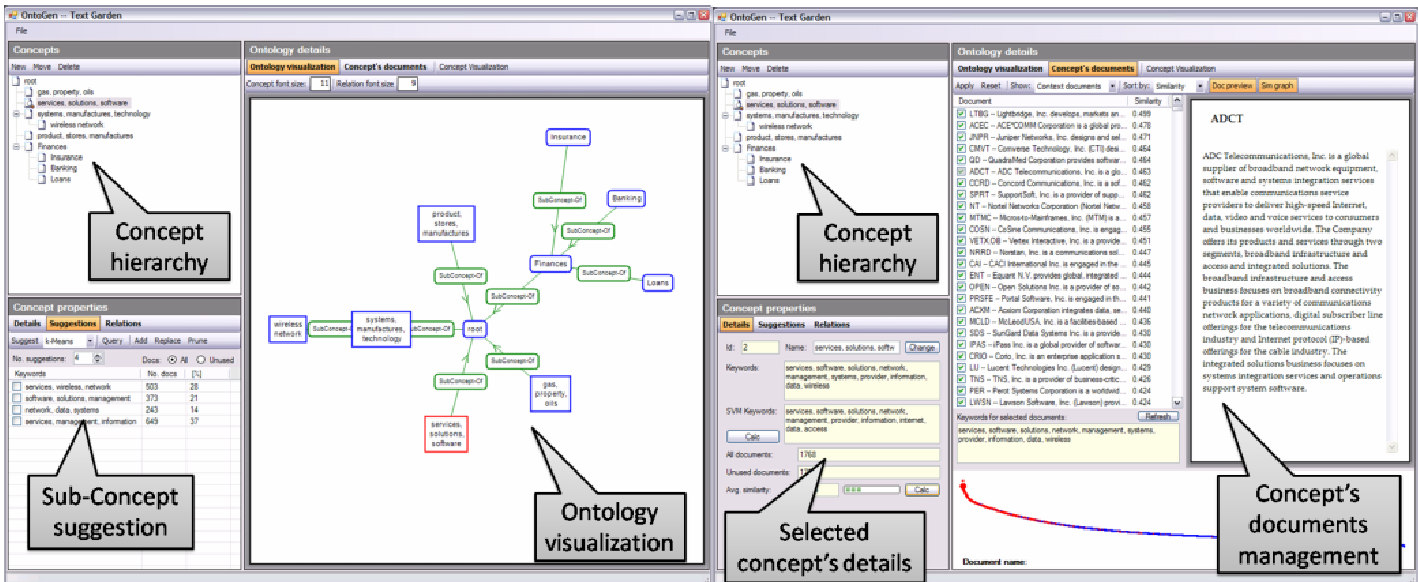 Figure 1: The standard layout showing the tree-view, document details, and the interactive learning interface.
Visualizing the Knowledge Space
One of OntoGen's most impressive features is the Topic Map. Using cosine similarity on TF-IDF vectors, the system projects documents onto a 2D plane.
- Closeness = Similarity: Documents that discuss similar topics appear as clusters.
- Density Mapping: Background textures indicate concentrated knowledge areas.
- Interactive Selection: Users can simply circle an area on the map to define a new concept, making ontology building as intuitive as drawing on a map.
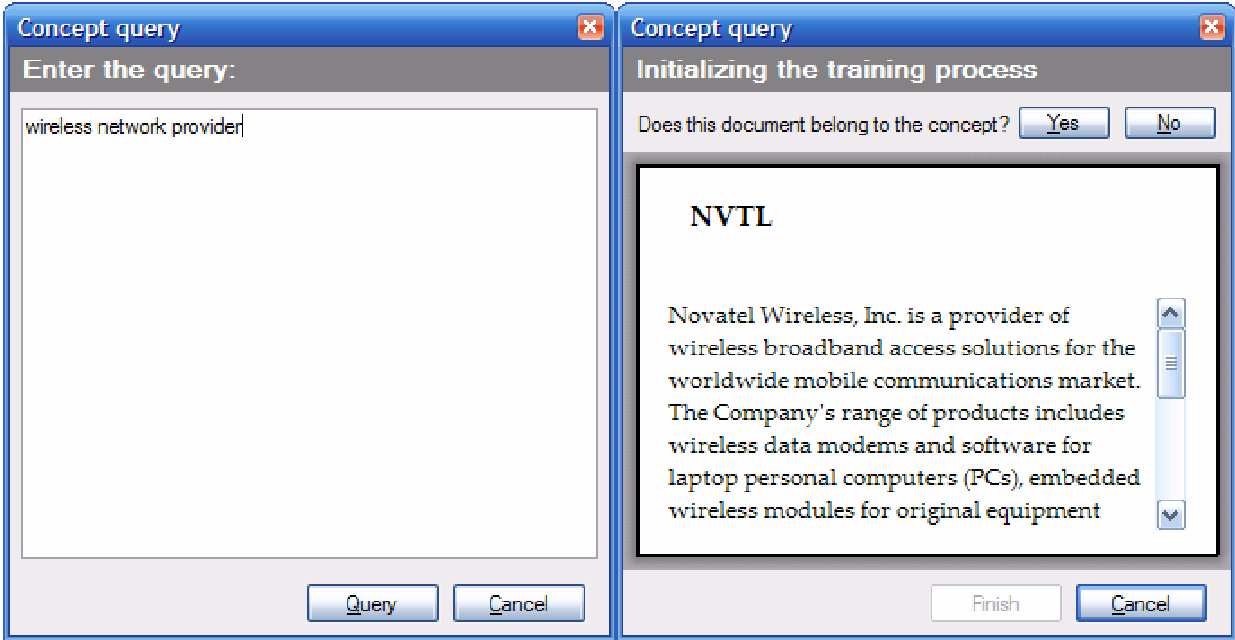 Figure 2: The visualization map where users can identify clusters and assign them to the ontology hierarchy.
Experimental Results: High Stakes User Trails
The system was put to the test with nearly 100 students across Computer Science and Psychology. The tasks were grueling: modeling 7,177 company descriptions and 5,000 news articles.
Key Findings:
- Efficiency: Overwhelmingly, users reported that the tool "saves time and effort" when managing large databases.
- Usability: Despite the complex math (SVMs, LSI), users with no technical background could successfully navigate the system.
- Visualization: The concept map was cited as a "great help," though users requested more vibrant aesthetics and larger displays (a classic 2000s constraint!).
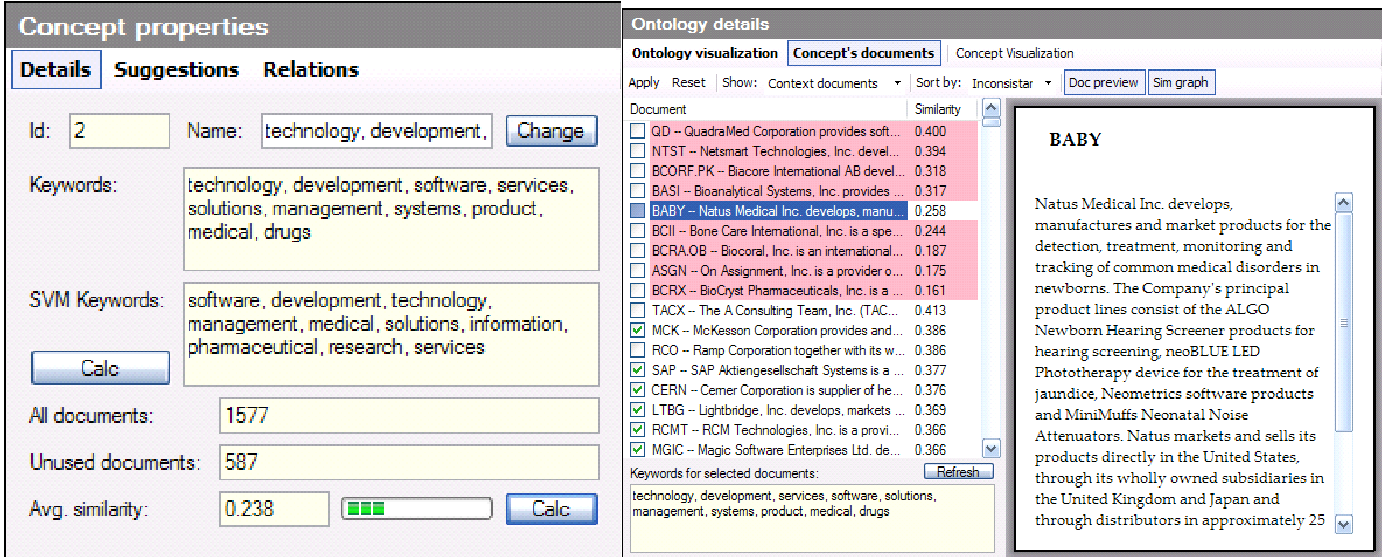 Figure 3: Keyword extraction methods (Standard vs SVM-based) provided to help users name concepts accurately.
Critical Insight & Conclusion
OntoGen represents a pivotal shift from Top-Down ontology design (where experts dictate structure) to Bottom-Up design (where data suggests structure).
Pros:
- Reduces "Modeling Fear" for non-engineers.
- Strong integration of Visualization and Machine Learning.
Limitations:
- The user interface, while functional, was noted as "unattractive" and "abstract" by some.
- The system is highly dependent on the quality of the initial document corpus.
Future Outlook: As we move into the era of LLMs, the principles of OntoGen—interactive, semi-automatic, and data-driven—remain more relevant than ever. Modern implementations would likely replace SVMs with embeddings, but the human-in-the-loop philosophy remains the gold standard for reliable knowledge engineering.