
Learning Ontology-Aware Classifiers: Bridging Prior Knowledge and Data-Driven Discovery
Learning ontology aware classifiers
The paper introduces a general framework for learning "Ontology-Aware Classifiers" from Attribute Value Taxonomies (AVTs) and data. It presents two specific instantiations, AVT-DTL (Decision Tree) and AVT-NBL (Naïve Bayes), which utilize hierarchical domain knowledge to handle partially specified data and achieve superior model compactness.
TL;DR
This research addresses a critical gap in machine learning: how to effectively use hierarchical domain knowledge (ontologies) during the training of classifiers. By introducing a general framework that searches for the optimal "abstraction level" (or Cut) within Attribute Value Taxonomies (AVTs), the authors demonstrate that algorithms like Decision Trees and Naïve Bayes can become more accurate, compact, and robust—especially when dealing with "partially specified" data where information is missing or abstract.
Background: The Hidden Structure of Data
In many scientific fields, data doesn't just exist as flat tables. Values have relationships; for example, in biological data, a specific protein might be categorized under broader functional hierarchies. Standard learners (like C4.5 or Naïve Bayes) ignore these relationships, treating every attribute value as a discrete, unrelated entity. This leads to two major issues:
- Data Fragmentation: Standard learners require instances to be specified at the most granular level.
- Model Complexity: Ignoring hierarchies often results in massive, "bushy" models that are hard to interpret.
The Core Insight: The "Cut" Refinement
The authors propose that the hypothesis space should not be fixed. Instead, it should be a collection of hypothesis classes, each corresponding to a different Global Cut across the taxonomies.
A Cut is essentially a horizontal slice through a tree-structured taxonomy. By starting with a highly abstract cut (the root of the taxonomy) and selectively refining it (moving down to more specific child nodes), the learner can find a "sweet spot" where the model is complex enough to be accurate but simple enough to generalize.
Methodology Evolution
The framework focuses on three pillars:
- Sufficient Statistics: Instead of simple counting, the algorithm propagates counts up and down the AVT trees. This handles cases where data is "partially specified" (e.g., we know a student is a "Graduate" but not if they are "Masters" or "Ph.D.").
- Hypothesis Refinement: A top-down search through the taxonomy.
- The Tradeoff: Using the Minimum Description Length (MDL) principle to penalize over-complicated cuts.
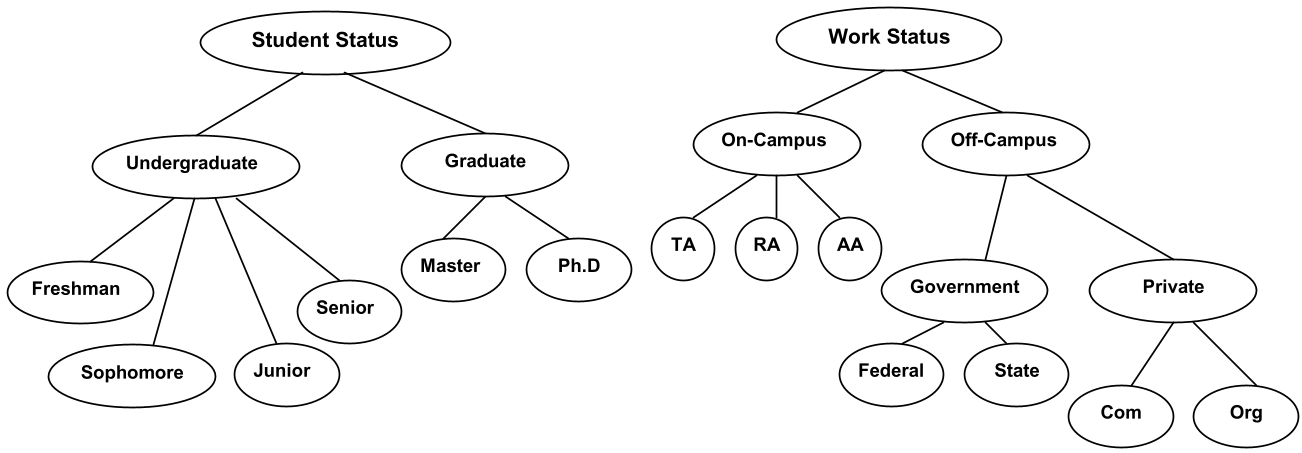 Figure 1: Example of Attribute Value Taxonomies (AVTs) and a sample dataset with mixed levels of abstraction.
Two Instantiations: AVT-NBL and AVT-DTL
The authors didn't just propose a theory; they implemented it on two classic learners:
- AVT-NBL (Naïve Bayes): This version optimizes the Conditional MDL (CMDL) score. It independently finds the best cut for each attribute, assuming they are independent given the class.
- AVT-DTL (Decision Tree): This integrates the cut refinement directly into the tree-growing process. It uses Information Gain to decide when to split a node vs. when to move deeper into the attribute hierarchy.
Experimental Proof: Better, Faster, Smaller
The experiments compared the new AVT-aware learners against standard versions and "Propositionalized" versions (which flatten the hierarchy into many binary flags).
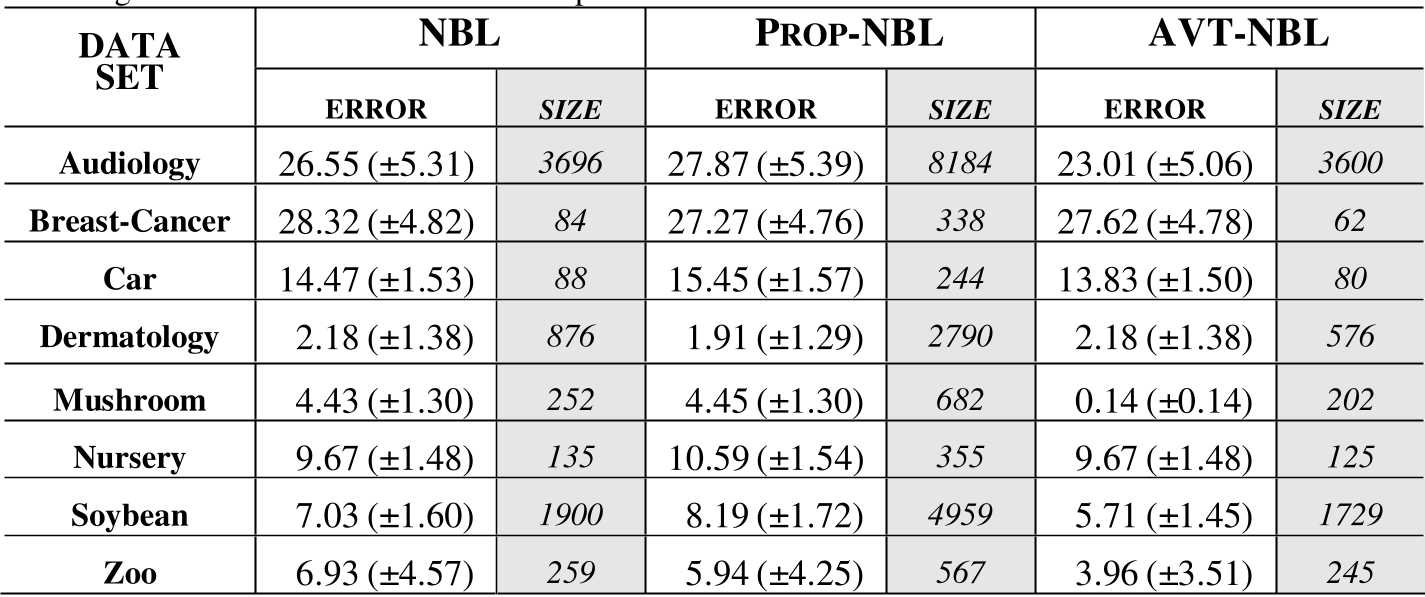 Table 1: Performance of AVT-NBL vs. Standard Naïve Bayes. Note the significant reduction in 'SIZE' (parameters) while improving error rates.
Key Findings:
- Robustness to Noise: On the Mushroom dataset, when 50% of the data was missing or abstract, AVT-NBL maintained an error rate of ~1.24%, while standard Naïve Bayes climbed to 6.63%.
- Compactness: The "Size" of the models (represented by parameters or tree nodes) was consistently smaller, sometimes by a factor of 2x or 3x, compared to propositionalized methods.
Critical Analysis & Future Outlook
The beauty of this work lies in its built-in regularization. By restricting the learner to navigate a hierarchy, the model is forced to find generalized patterns before diving into the noise of specific leaves.
Limitations:
- The current framework assumes tree-structured taxonomies. Future work is needed for Tangled Hierarchies (DAGs) where a concept might have multiple parents.
- It relies on high-quality, pre-defined ontologies. While the authors mention an "AVT-Learner" to generate these from data, the performance is naturally capped by the quality of the taxonomy.
Takeaway for the Industry
In domains like E-commerce (product hierarchies), Cybersecurity (threat taxonomies), or Medicine (disease ontologies), we shouldn't discard the domain knowledge we already have. This paper provides the mathematical and algorithmic foundation to treat ontologies as a first-class citizen in the machine learning pipeline.