
Beyond Keywords: Semantic Evolution in Social Network Advertising
Ontology-Based Advertisement Recommendation in Social Networks
The paper introduces a semantically-enhanced advertisement recommendation system designed for social networks. It utilizes OWL 2 ontologies to model user interests and ad profiles, achieving a high precision of 78% in matching users with relevant advertisements through a hybrid recommendation approach.
TL;DR
This research presents a framework that transforms how social networks handle advertising. By utilizing Semantic Web technologies and Ontologies, the system builds a bridge between what an advertisement is and what a user wants. It achieves a 78% average precision by dynamically evolving user profiles based on their social interactions, effectively solving the "cold-start" and "data sparsity" issues that plague traditional engines.
The Problem: The Noise of the Social Web
In the Web 2.0 era, we are drowning in data but starving for relevance. Traditional recommendation systems (Collaborative Filtering or simple Keyword Matching) face three critical walls:
- Cold-Start: New users provide no historical data to branch from.
- Sparsity: Most users only interact with a tiny fraction of available items.
- Volatility: User interests in social networks change rapidly from day to day.
The authors argue that simply "matching words" isn't enough; the system needs to "understand" the underlying concepts through a structured knowledge base.
Methodology: Bridging Profiles via Ontologies
The core of the system is the Interests Ontology, a 620-class taxonomy derived from the Curlie Web directory.
1. Vector Space Representation
Both ads and users are mapped into a multi-dimensional vector space where each dimension represents an ontological concept. Unlike simple TF-IDF, this system incorporates Semantic Distance. If a user is interested in "Laptops," the system understands a semantic proximity to "Hardware" even if the specific word isn't mentioned.
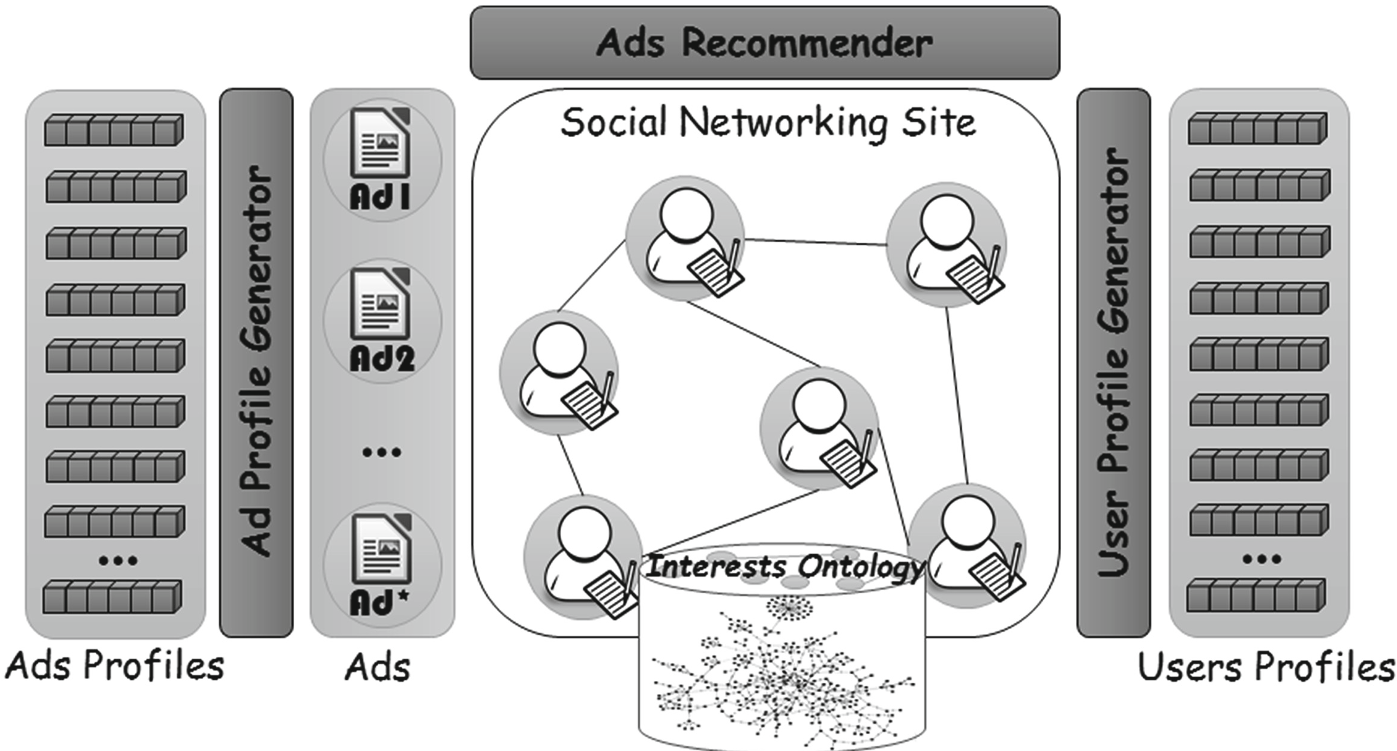
2. The Mutation Formula
The true "secret sauce" lies in how the user profile evolves. When a user creates a post or clicks an ad, their profile vector () is updated using a mutation rate:
- Post Mutation: Uses a decay factor to blend previous interests with new content extracted via NLP (GATE framework).
- Click Mutation: Directly shifts the user's vector toward the advertisement's vector, assuming an immediate intent.
Experiments: Precision and Scaling
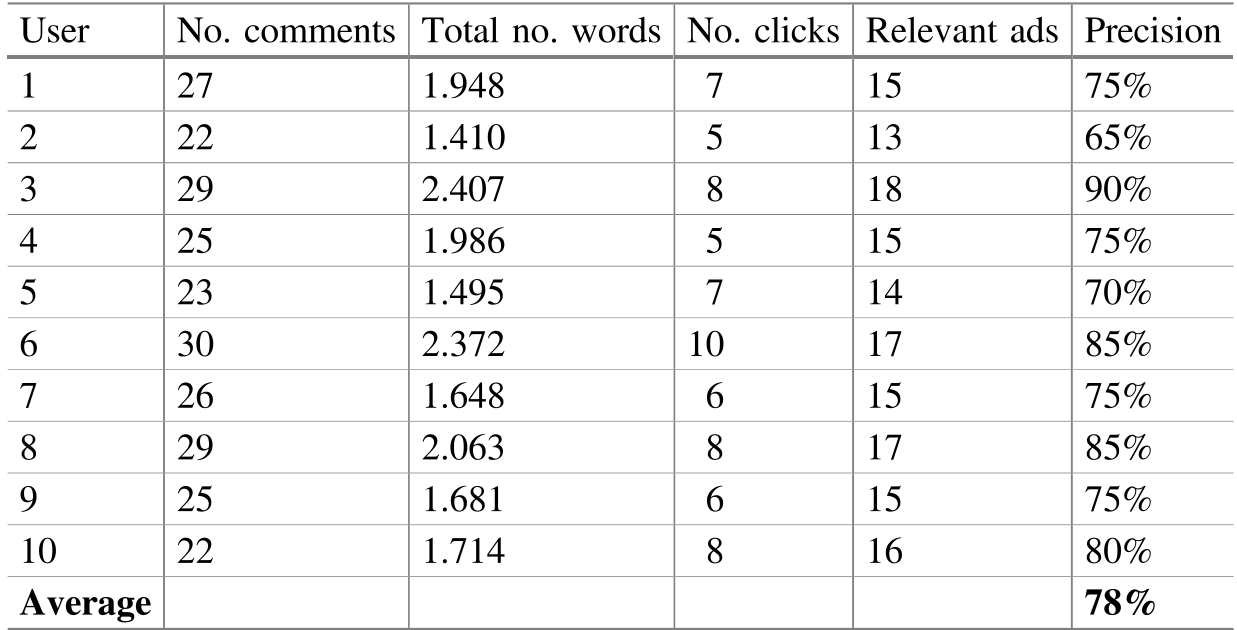
The validation involved a simulated environment where participants provided registration data and social contributions.
Key Findings:
- Precision Correlates with Engagement: Users with more comments and clicks saw precision scores as high as 90%.
- Hybrid Advantage: By combining content-based filtering with knowledge-based reasoning, the system maintained a high floor of 65% precision even for less active users.
Critical Insight: Why This Works
Most modern systems treat users as a "black box" of click patterns. This paper treats user interest as a dynamic semantic manifold. By anchoring recommendations in an ontology, the system introduces Inductive Bias that helps it reason about new items without historical click-through data. Furthermore, by selecting ads from the first quartile of similarity that have been "recommended the less," it tackles the Diversity and Serendipity problem—avoiding the echo-chamber effect where users see the same ads repeatedly.
Conclusion & Future Outlook
While the current framework relies heavily on textual data, the future of this tech lies in Multi-modal Analysis. Integrating image recognition and social graph relationships (who you follow) into the ontological vector would likely push precision past the 80% mark. For practitioners, the takeaway is clear: structured knowledge is the ultimate remedy for the "dirty data" of social media.
Academic Reference
García-Sánchez, F., et al. "Ontology-Based Advertisement Recommendation in Social Networks."