
Bridging the Semantic Gap: Ontology-Driven Object Recognition
Ontology based complex object recognition
This paper introduces an ontology-based framework for complex object recognition that bridges the gap between high-level expert knowledge and low-level image processing. By utilizing a "Visual Concept Ontology" (encompassing color, texture, and spatial relations) and hierarchical machine learning, the system enables semantic object categorization with enhanced explainability.
TL;DR
Researchers have developed a hybrid cognitive vision framework that combines the structured logic of Ontologies with the flexibility of Machine Learning. By creating an intermediate layer of "Visual Concepts," the system can transform expert domain knowledge into accurate image recognition, providing both high performance and human-readable explanations for its decisions.
Background: The Symbol Grounding Problem
In computer vision, a persistent challenge is the "Semantic Gap." An expert might describe a biological cell as having a "dark, circular nucleus," but an algorithm sees only a matrix of pixel intensities. Historically, systems were either:
- Purely Statistical: High performance but "black boxes" with no semantic reasoning.
- Purely Knowledge-Based: Transparent but brittle and hard to scale to varying image conditions.
The authors of this paper propose a middle ground—a system that "learns" what a symbol like "Dark" or "Circular" actually looks like in a specific context.
Methodology: The Visual Concept Ontology
The heart of the approach is a Visual Concept Ontology. It isn't tied to one specific task (like biology or vehicle tracking); instead, it provides a universal vocabulary for:
- Color: Hue, Brightness, Saturation (based on ISCC-NBS).
- Texture: Repetitiveness, Contrast, Granularity.
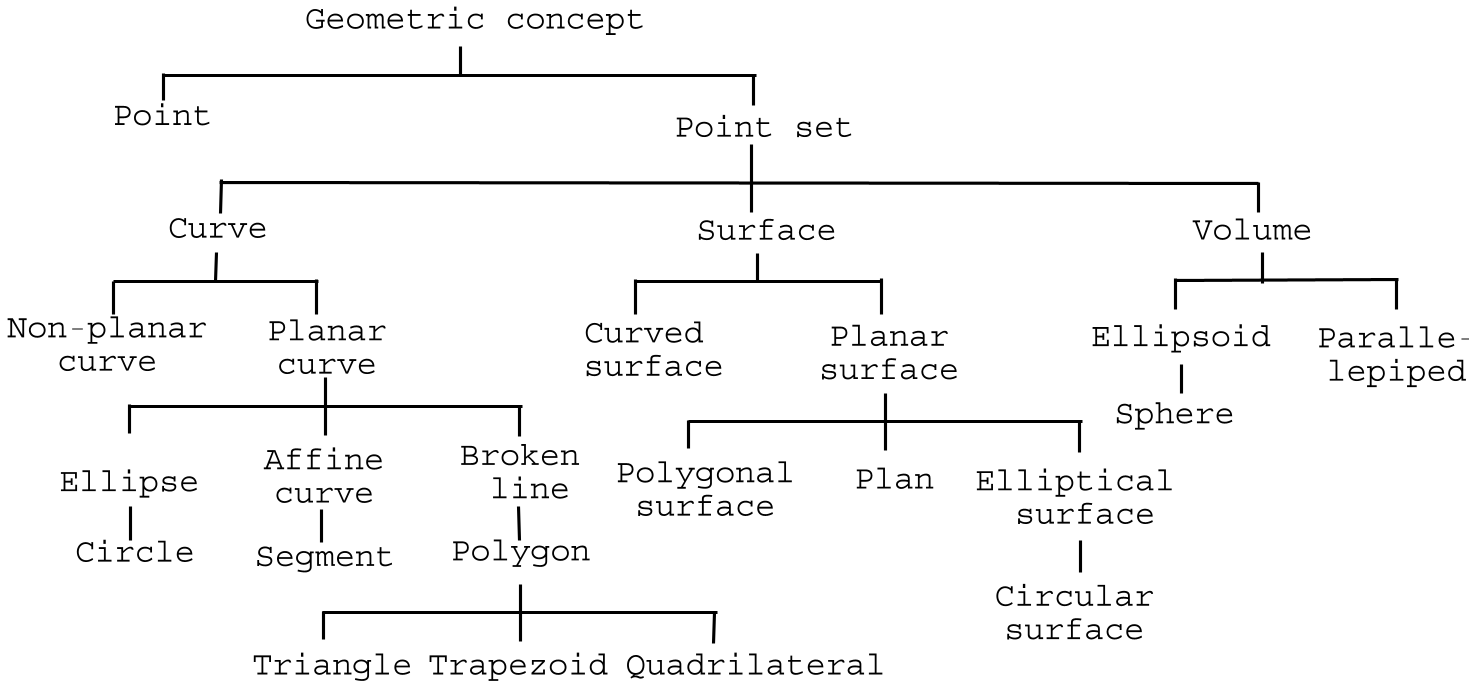
- Spatiality: Geometric shapes (Circular, Elliptical) and RCC-8 relations (Overlap, Disconnected).
System Architecture
The workflow is split into two phases: Knowledge Acquisition/Learning and Categorization.
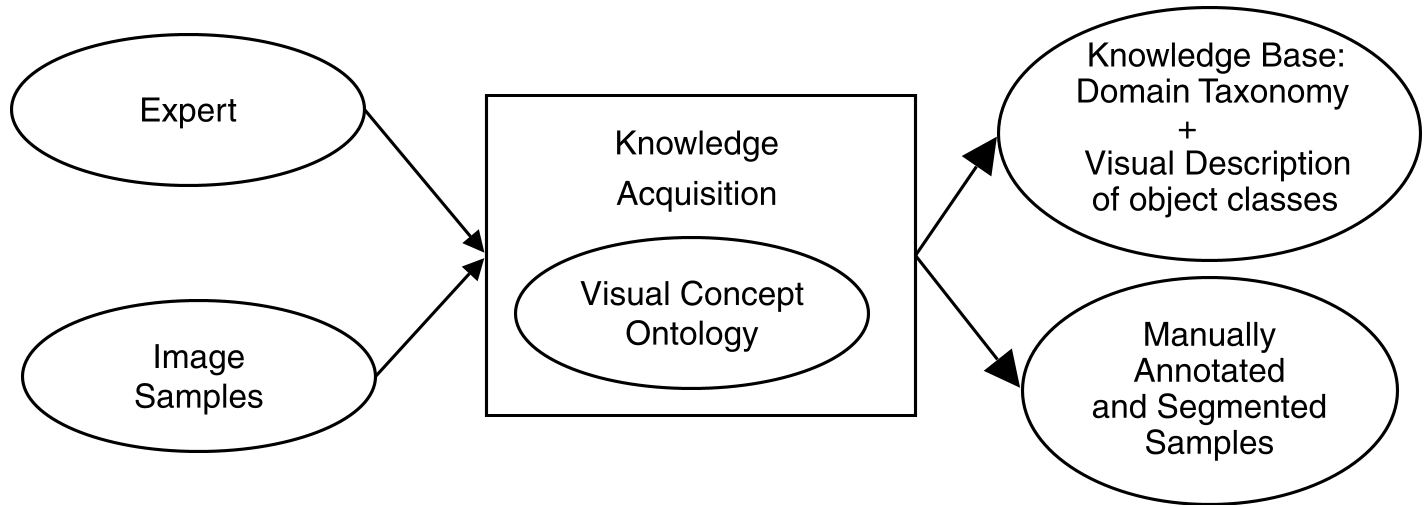
- Learning Phase: The expert provides images and labels them with ontological terms. The system then uses Sequential Forward Floating Selection (SFFS) to find the best numerical features (Gabor filters, Histograms) that correspond to those terms.
- Recognition Phase: When a new image arrives, the system extracts features, runs them through the trained classifiers to identify visual concepts, and then matches those concepts against the domain taxonomy to name the object.
Experiments and Insights
The authors tested the system on complex textures (Brodatz) and real-world vehicle indexing.
Key Result: Texture Grounding
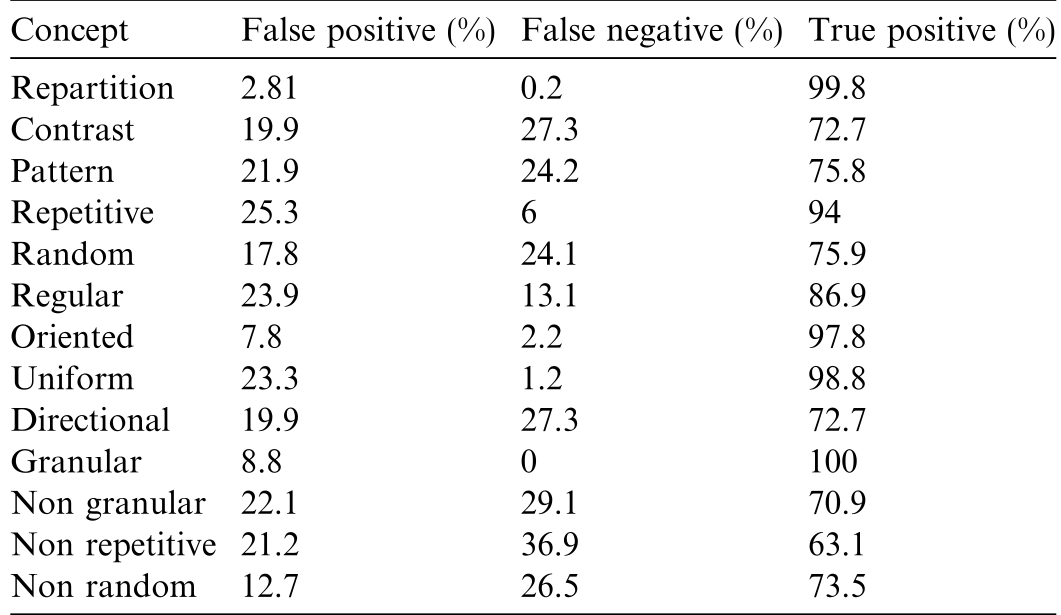
The system proved remarkably effective at learning abstract texture concepts. By reducing 127 initial features down to the 20 most relevant ones via the Bhattacharyya distance criterion, the system achieved near-perfect recognition for specific attributes:
- Granular Concepts: 100% True Positive Rate.
- Repartition: 99.8% True Positive Rate.
Critical Analysis & Conclusion
Why it Works
The brilliance of this approach lies in its modularity. Because the domain knowledge (what an object is) is separated from the visual description (what it looks like), the same system can be adapted from biology to satellite imagery simply by retraining the "Visual Concept" layer. It avoids the black-box pitfalls of modern Deep Learning by forcing the model to pass through a human-understandable symbolic bottleneck.
Limitations
- Segmentation Reliance: The system assumes regions of interest can be segmented. If segmentation fails, the ontology has nothing to analyze.
- Expert Burden: Building the initial domain knowledge base still requires significant human effort.
Future Outlook
The authors suggest that future work should focus on Unsupervised Learning to help experts build these ontologies automatically. As we move toward more "Transparent AI," the fusion of symbolic logic and statistical learning shown here remains a cornerstone policy for mission-critical vision tasks.
Takeaway: Real-world vision isn't just about pixels; it's about the language we use to describe them.