
Deciphering Sport Marketing: An Ontology-Based Data Mining Core for Adidas Taiwan
Ontology-based data mining approach implemented for sport marketing
This paper presents a hybrid data mining framework combining Ontology, the Apriori algorithm, and K-means clustering to extract customer knowledge for sport marketing. Applied to Taiwan Adidas, it identifies specific relationships between consumer profiles, media preferences, and celebrity endorsers to optimize product promotion.
Executive Summary
TL;DR: This research bridges the gap between Artificial Intelligence and Sport Management by introducing an Ontology-based Data Mining approach. By structuring knowledge through domain-specific ontologies and applying the Apriori algorithm and K-means clustering, the study provides Taiwan Adidas with a blueprint for matching specific consumer segments with the ideal media channels and celebrity endorsers.
Background: Within the broader field of CRM and market analytics, this work represents a transition from "blind marketing" to "data-driven intelligence," positioning ontology not just as a philosophical concept, but as a practical schema for relational databases.
Problem & Motivation: The "Semantic Gap" in Marketing
Prior sport marketing research often treated consumer data as isolated variables (age, income, gender). However, the "Why" behind a purchase often lies in the complex web of:
- Emotional Connection: Which athlete does the user admire?
- Media Consumption: Where does the user get their news (TV, Internet, or Magazines)?
- Product Perception: Is the product seen as "Performance" gear or "Heritage" fashion?
The authors realized that without a structured Ontology, data mining algorithms might find correlations but miss the contextual logic of the sports industry.
Methodology: Structuring Intelligence
The core of this paper is its three-tier methodology:
1. The Sport Marketing Ontology
Using Protégé, the researchers built a conceptual map of the Taiwan Adidas ecosystem. This ensured that every data point—be it a "Running Shoe" or "Beckham's endorsement"—was categorized with semantic accuracy.
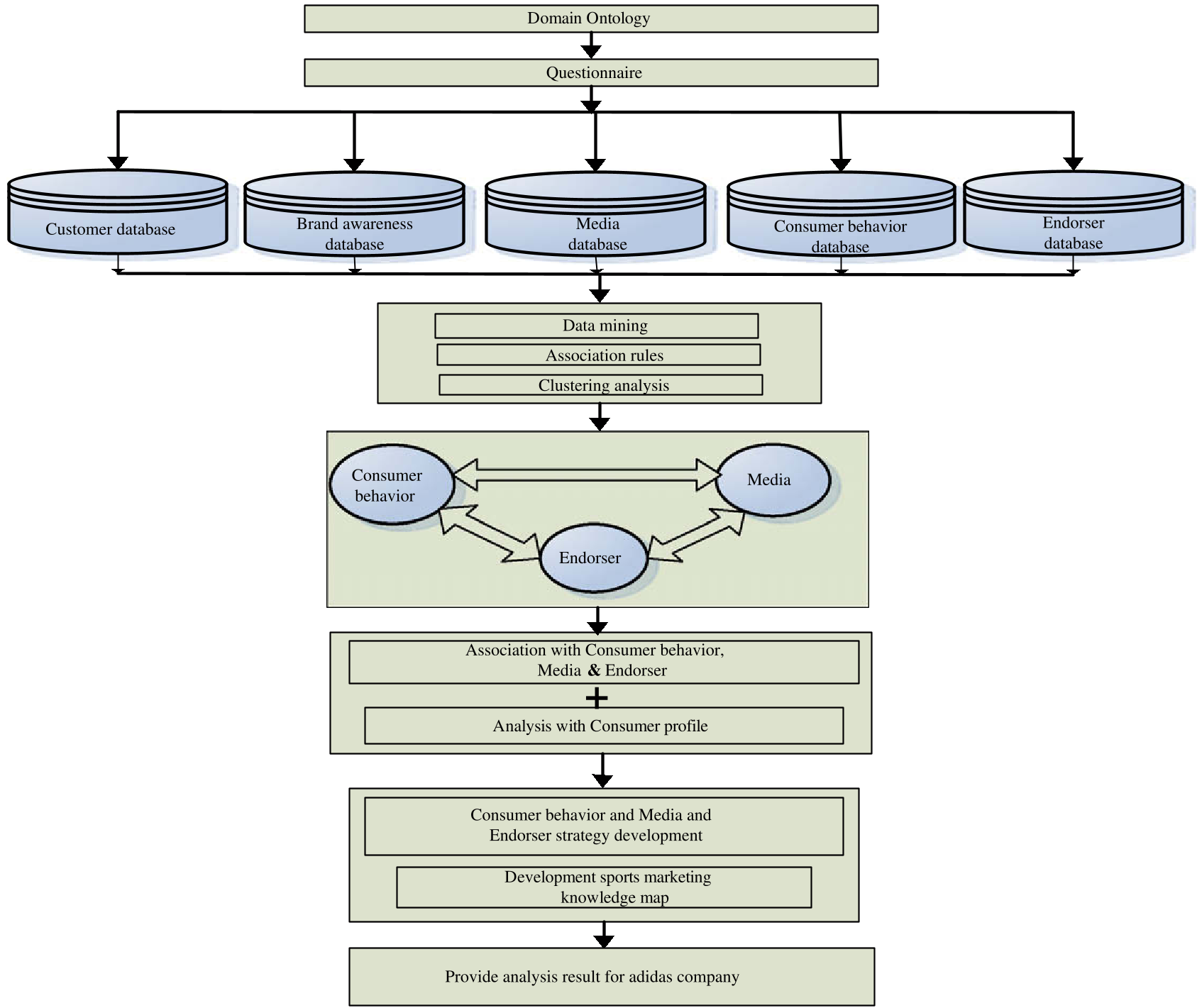 Figure: The ontological association between consumers, products, and endorsers sets the stage for data extraction.
2. Association & Clustering
The researchers utilized a two-step mining process in SPSS Clementine:
- K-means Clustering: Grouped the 800 respondents into distinct clusters based on income and age.
- Apriori Algorithm: Within those clusters, it identified "Rules." For example: If a customer is interested in NBA, they have an 80% confidence of following specific Taiwanese sports channels.
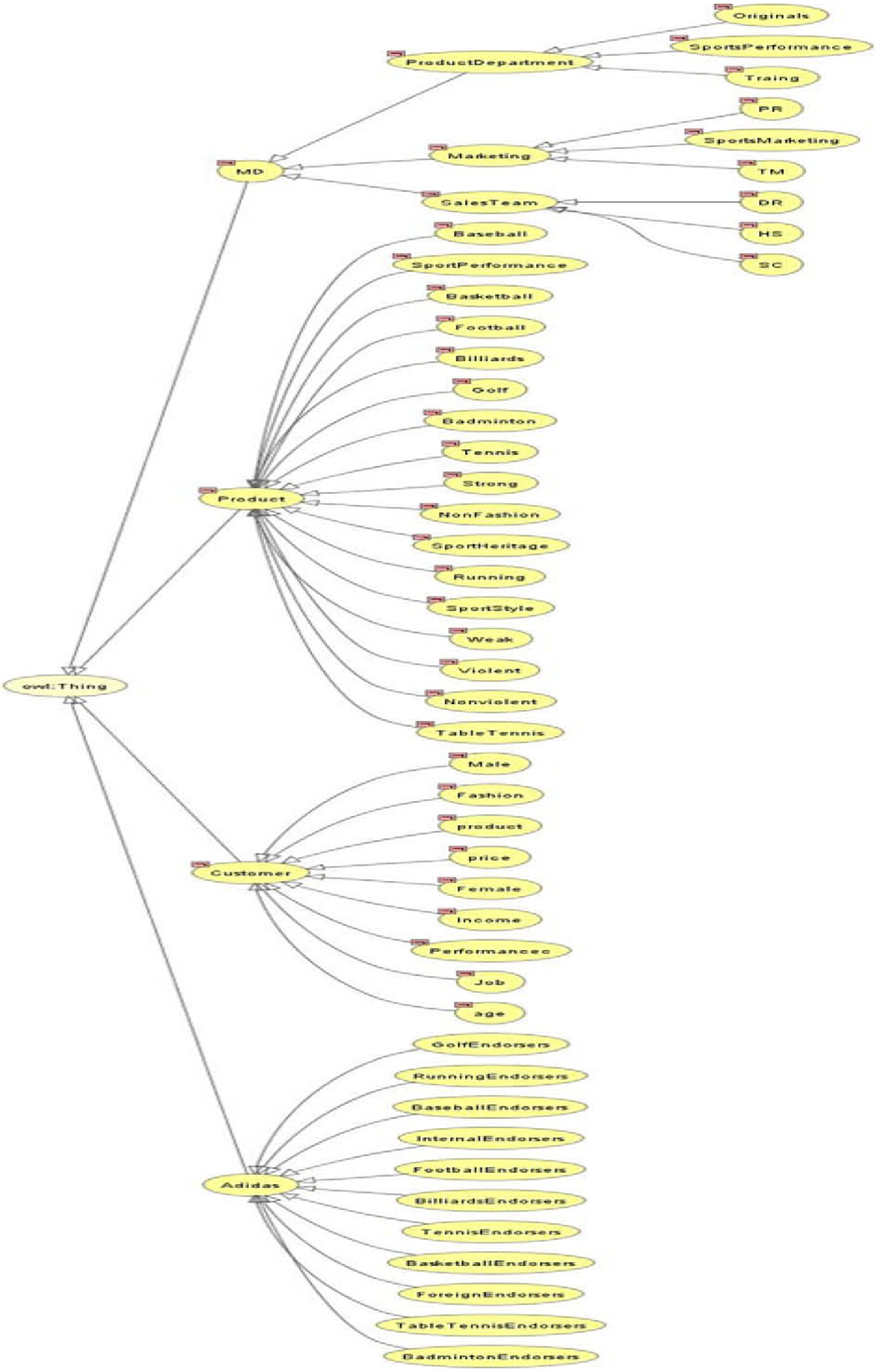 Figure: The integrated research framework from data collection to knowledge discovery.
Experimental Results: The Adidas Case Study
The study identified two primary "Personas" that represent the bulk of the Taiwan market:
Cluster 1: The Traditional Professional
- Media: Prefers United Daily and Apple Daily (Newspapers) and TV channels like ESPN.
- Endorsers: Highly influenced by professional athletes like Chien-Ming Wang (Baseball).
- Strategy: Focus on performance-driven narratives in traditional media.
Cluster 2: The Lifestyle Enthusiast
- Media: Devours BANG and GQ Magazines; high internet engagement (Yahoo Sports).
- Endorsers: Follows local stars like Tien Lei and global icons like Kobe Bryant.
- Strategy: Market "Heritage" and "Style" lines through digital and fashion-forward outlets.
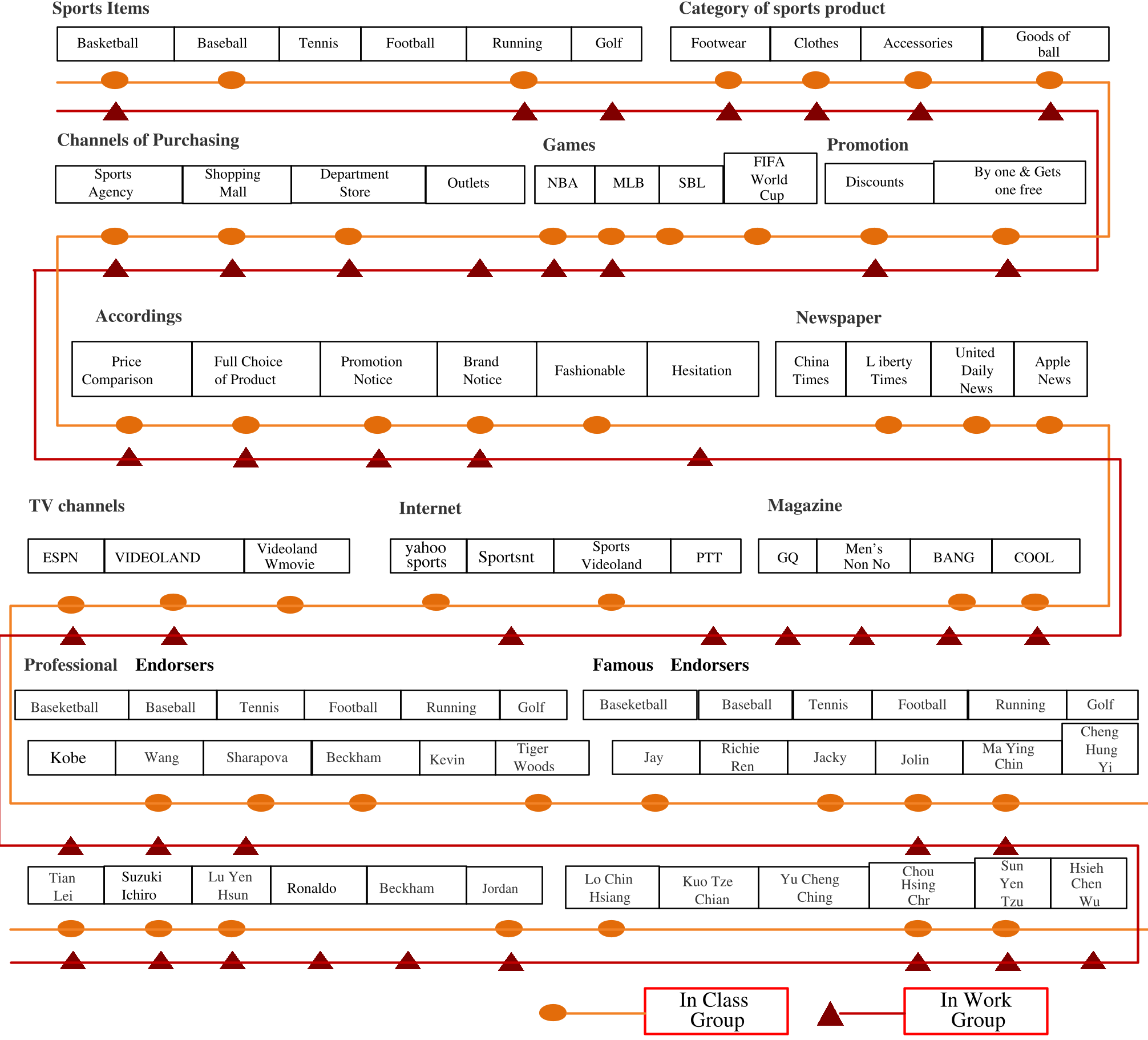 Figure: The resulting Knowledge Map serves as a strategic compass for Adidas marketers.
Critical Analysis & Conclusion
The Takeaway
The genius of this paper lies in its Semantic Schema. By forcing the data into a pre-defined ontology, the authors ensure that the resulting Association Rules are not just "statistically significant" but "commercially relevant." For Adidas, this means the difference between a wasted multi-million dollar endorsement and a pinpoint-accurate campaign.
Limitations & Future Work
While robust, the study relies on static questionnaire data. In the era of Web 3.0, the next frontier for this research is Real-Time Ontology Updates—streaming social media data (Twitter/Instagram) directly into the mining engine to capture 24-hour shifts in fan sentiment. Additionally, the shift toward "Micro-Influencers" over global celebrities like Beckham might require a more granular update to the "Endorser" branch of their ontology.
Conclusion
Liao et al. prove that data mining is not a "magic box." Its power is unlocked only when guided by a structured understanding (Ontology) of the human behavior it seeks to predict.