
ORBM: Bridging the Gap Between Domain Knowledge and Deep Learning in Health Social Networks
Ontology-based deep learning for human behavior prediction in health social networks
The paper introduces the Ontology-based Restricted Boltzmann Machine (ORBM), a novel deep learning framework for predicting human exercise behavior in health social networks. By integrating domain knowledge from the SMASH ontology with temporal social influence modeling, the ORBM achieves state-of-the-art accuracy (0.859) in predicting user activity levels.
Executive Summary
TL;DR: The Ontology-based Restricted Boltzmann Machine (ORBM) represents a paradigm shift in health informatics. By mapping deep learning architectures to the hierarchical structure of a domain ontology (SMASH), the researchers have created a model that doesn't just "see" numbers, but understands the relationship between biomarkers, social interactions, and exercise effort.
Positioning: This work is one of the earliest successful attempts to formalize "Semantic Deep Learning" in the health domain. It moves beyond the black-box nature of standard RBMs by using an ontology to guide representation learning, effectively setting a new SOTA for human behavior prediction in longitudinal social datasets.
The Problem: The "Flat-Data" Fallacy
In traditional machine learning for health social networks, a user is often represented as a flat feature vector. For example, BMI, number of steps, and number of received messages are treated as independent variables.
However, real-world health data is inherently structural:
- Hierarchical: "Wellness Score" is a high-level concept derived from "Biomarkers" and "Physical Activity."
- Interdependent: Social influences aren't just about the volume of messages; they are about the similarity of behavior between friends (homophily).
- Temporal: Motivation cycles—users might be active in early weeks due to novelty but need social support to sustain effort during the "middle week" slump.
Prior SOTA methods like the Socialized Gaussian Process (SGP) failed to capture these nuances, leading to performance degradation when user behavior became volatile.
Methodology: Infusing Semantics into RBMs
The core innovation of this paper is the ORBM architecture, which consists of two main phases:
1. The Bottom-Up Representation Learning
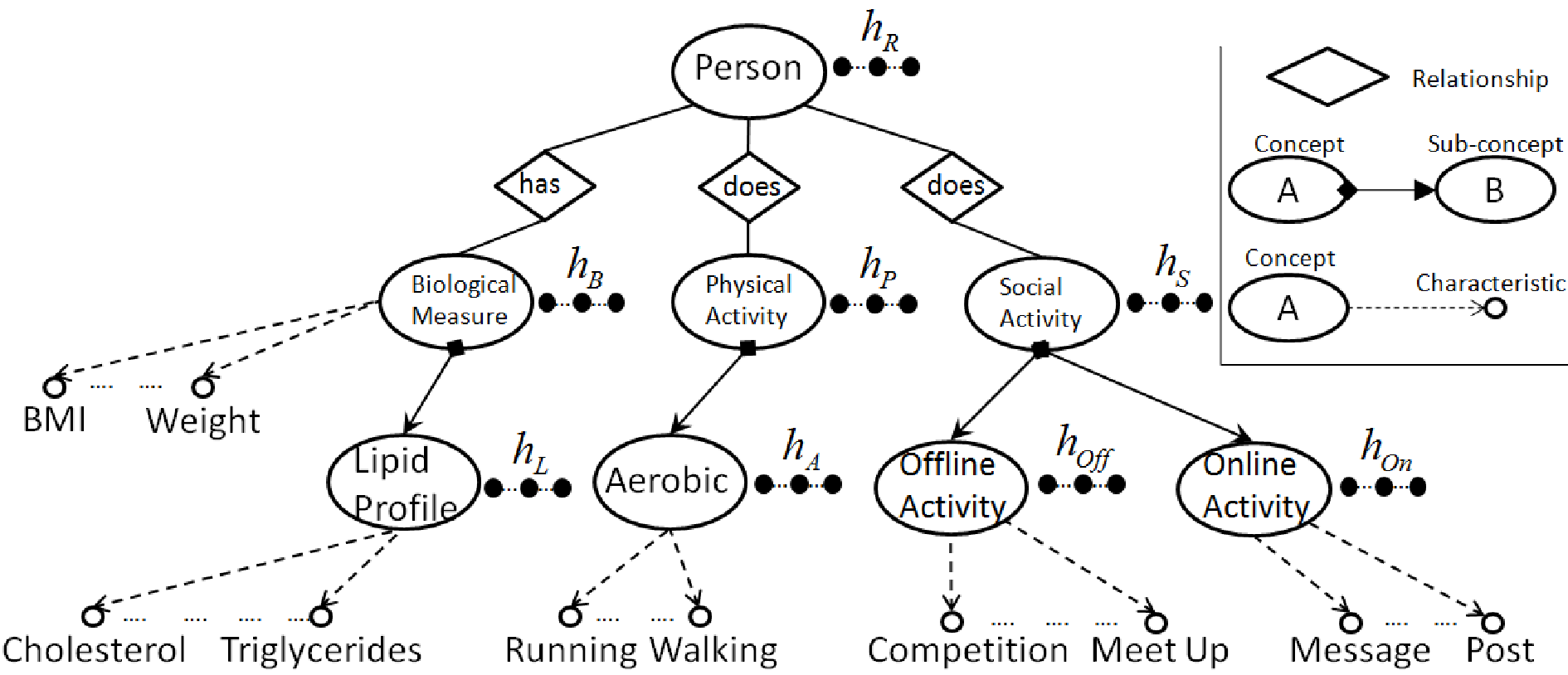
Instead of one massive RBM, the authors use the structure of the SMASH (Semantic Mining of Activity, Social, and Health data) ontology.
- The Logic: A representation of a "Person" is learned by aggregating representations of their "Biological Measures," "Social Activity," and "Physical Activity."
- The Mechanism: For every concept in the ontology, an RBM is trained where the visible units are the features (or hidden units of sub-concepts). This creates a "Concept Hierarchy" of latent variables.
2. Temporal and Social Modeling
Once the structured user representation is formed, it is fed into a temporal framework:
- Self-Motivation: Captured via autoregressive connections from historical variables (previous weeks).
- Social Influence (): The authors defined a specific metric using the Cumulative Distribution Function (CDF) of user similarity. This allows the model to "weigh" the influence of a friend based on how similar their behavior patterns are to the general population.
Experiments: Proving the Semantic Advantage
The authors tested ORBM against a variety of baselines using the YesiWell dataset, a real-world study involving 254 participants.
Key Performance Findings:
- Accuracy Boost: ORBM reached 85.9% accuracy, compared to the 67.7% achieved by Gaussian Processes.
- The Ontology Edge: Comparing ORBM to a standard Social RBM (which ignores the ontology) showed a 3% absolute improvement. This proves that the structure of the data matters as much as the data itself.
The "Middle Week" Resilience
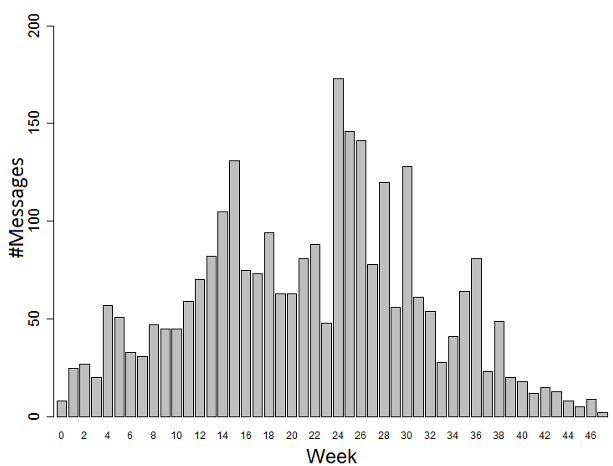
A fascinating observation in the study was the "dip" in performance for most models during the middle weeks of the study. This period coincided with a surge in active users—people who were previously sedentary suddenly becoming active. Traditional models saw this as "noise." ORBM, thanks to its environmental event modeling and social influence capture, remained stable and accurate during these transitions.
Critical Analysis & Conclusion
The Takeaway: ORBM proves that domain knowledge (ontologies) is not just a tool for data organization but a powerful inductive bias for deep learning. By constraining the latent space to follow clinical logic, we get models that generalize better with less data.
Limitations: The current approach requires a manually defined ontology (SMASH). In domains where ontologies aren't well-defined, the "bottom-up" algorithm would struggle. Furthermore, training independent models for every user (though fine-tuned) might face scalability issues in networks with millions of nodes.
Future Outlook: As we move toward Neuro-Symbolic AI, the ORBM serves as a blueprint for how we can combine the symbolic reasoning of ontologies with the statistical power of deep neural networks to tackle complex human-centric problems.