
Intelligent Sensing: An Ontology-Driven Architecture for Environmental Crisis Management
An ontology based approach to intelligent data mining for environmental virtual warehouses of sensor data
The paper introduces an intelligent Environmental Virtual Warehouse that combines OWL ontologies and rule-based reasoning (via the Drools ReteOO engine) to manage heterogeneous sensor data. By integrating M3Data for distribution and Protégé for semantic modeling, the system enables real-time decision support and early warning for environmental hazards like toxic gas contamination.
TL;DR
This research presents a sophisticated framework for environmental monitoring that moves beyond mere data collection. By integrating OWL (Web Ontology Language) with a Drools-based rule engine, the system transforms raw sensor streams from "Virtual Warehouses" into actionable intelligence—enabling localized toxicity alerts and predictive contamination modeling.
Problem & Motivation: The "Blindness" of Big Sensor Data
While sensor technology has advanced rapidly, our ability to synthesize the resulting data has lagged. We face two primary hurdles:
- Semantic Heterogeneity: Sensors from different manufacturers use varying units, nomenclature, and metadata, making fusion nearly impossible.
- Latency in Decision Making: In scenarios like bushfires or chemical leaks, moving data from legacy databases to a centralized warehouse (ETL) introduces delays that can cost lives.
The authors argue that we need a system that doesn't just store data, but understands the relationships between a wind vector and a toxicity sensor's location.
Methodology: The Core Architecture
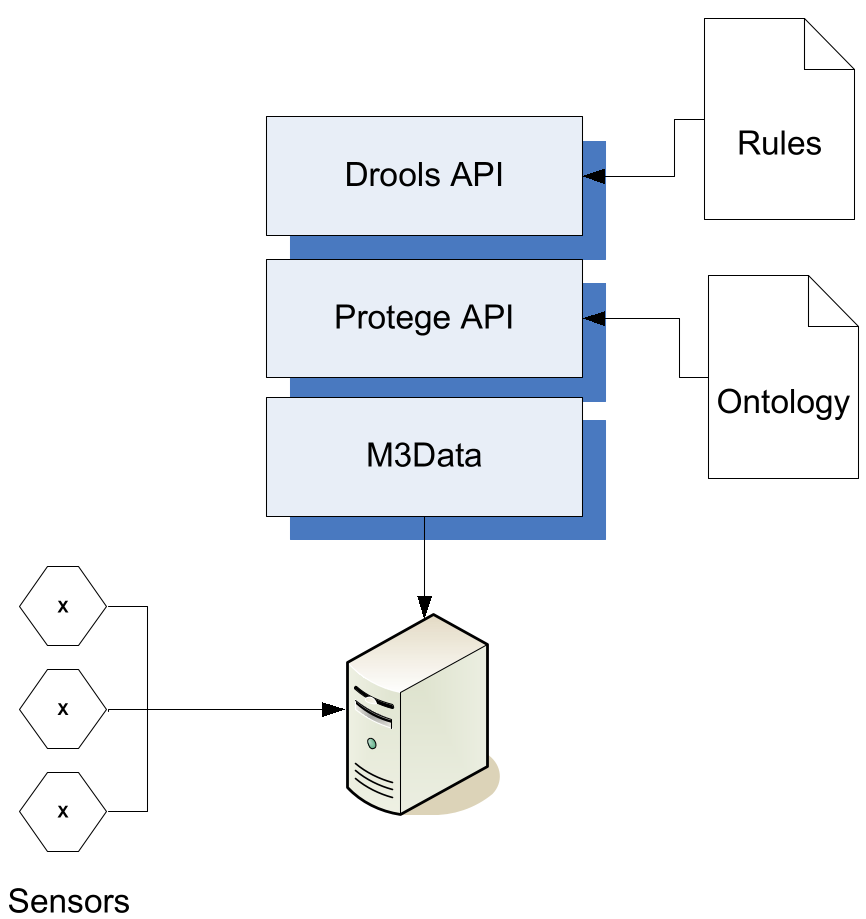
The proposed system relies on a three-tier design to bridge the gap between physical sensors and high-level decision support.
1. The Virtual Warehouse & M3Data
Unlike traditional warehouses, the Virtual Warehouse accesses operational data directly from source systems. This is managed by the M3Data platform, which acts as a grid of agents handling data transport, notification, and processing.
2. Semantic Modeling with OWL
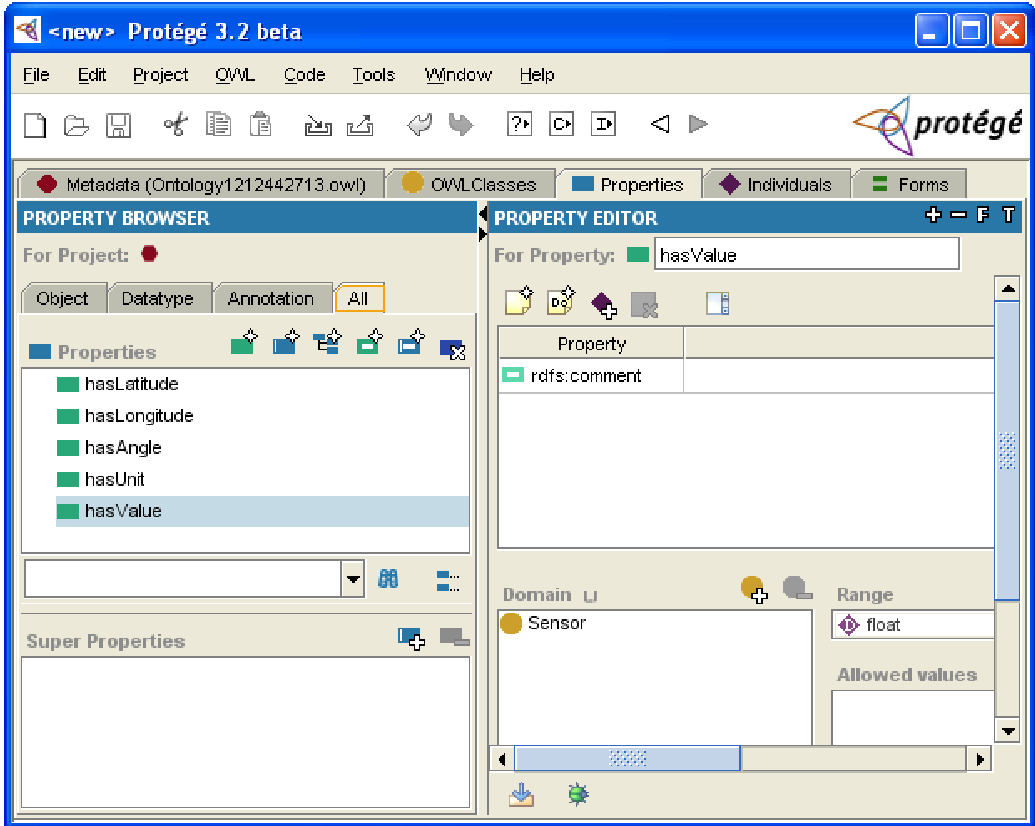
The system uses Protégé to define an ontology that captures:
- Sensor Specs: Toxicity, wind, temperature, and pressure.
- Spatial Context: Longitude and latitude (hasLongitude/hasLatitude).
- Vector Dynamics: Magnitude and angle (hasValue/hasAngle).
3. Rule-Based Reasoning (DROOLS)
The reasoning layer uses the RETE algorithm (ReteOO implementation) to process facts. It doesn't just look for thresholds; it infers new facts. For example, if a toxicity threshold is exceeded, a rule calculates the potential "downwind" contamination area based on current wind speed and direction.
Experiments & Results
The prototype focused on toxic gas dispersion. The system successfully demonstrated "Level-Two" data fusion (Situation Refinement).
- Inference Capability: When toxicity was detected at "Location 1," the rule-based engine automatically calculated the time-of-arrival for a contamination alarm at "Location 2" by factoring in distance and wind speed.
- Real-world Application: The researchers visualized these results using GIS data from the Taranto region in Italy, showcasing a CO (Carbon Monoxide) warning system that dynamically updates based on sensor inputs.
Critical Insight & Conclusion
The real value of this paper lies in its Inductive Bias—the assumption that environmental hazards are inherently spatial and sequential. By using an ontology, the system provides a "universal translator" for sensors.
Limitations: While the virtual warehouse offers speed, it may face performance bottlenecks during massive data consolidation since it lacks a local optimized index. However, for real-time disaster response, the trade-off of "freshness over throughput" is technically sound.
Future Outlook: This paradigm paves the way for "Self-Organizing Environmental Clouds," where sensors can join a network and immediately contribute their data to a global reasoning engine without manual recalibration.