
OIWMA: Revolutionizing Taiwan Travel Discovery via Swarm Intelligence and Ontologies
Ontology-Based Intelligent Web Mining Agent for Taiwan Travel
The paper introduces OIWMA, an Ontology-based Intelligent Web Mining Agent designed to automate the collection of Taiwan travel information. It integrates a domain-specific ontology with hybrid optimization techniques, specifically Ant Colony Optimization (ACO) and Particle Swarm Optimization (PSO), to perform semantic analysis on web data.
TL;DR
The Ontology-based Intelligent Web Mining Agent (OIWMA) is a sophisticated framework designed to sift through the noise of the internet to find hyper-relevant travel information for Taiwan. By leveraging a structured domain ontology and a potent mix of Ant Colony Optimization (ACO) and Particle Swarm Optimization (PSO), it transforms the web into a quantifiable 3D semantic space, ensuring tourists get exactly what they need—from "Taroko National Park" to local "Gourmet" delicacies.
Problem & Motivation: The Failure of Keyword Search
Standard search engines operate on a "surface-level" understanding. When you search for "Tainan gourmet," a legacy search engine might prioritize a page because of its keyword density or SEO manipulation rather than its actual geographic and cultural relevance.
The authors identify a critical gap: the lack of semantic query awareness. This leads to:
- Information Overload: Too many irrelevant results.
- Credibility Issues: Search ranking manipulation by third parties.
- Efficiency Loss: Travel agencies and tourists spend hours manually verifying data.
The motivation here is to build an agent that actually understands the relationship between a location (e.g., Kaohsiung) and its attributes (e.g., Night Markets) using a "Computational Model of the World"—an Ontology.
Methodology: The Core Engine
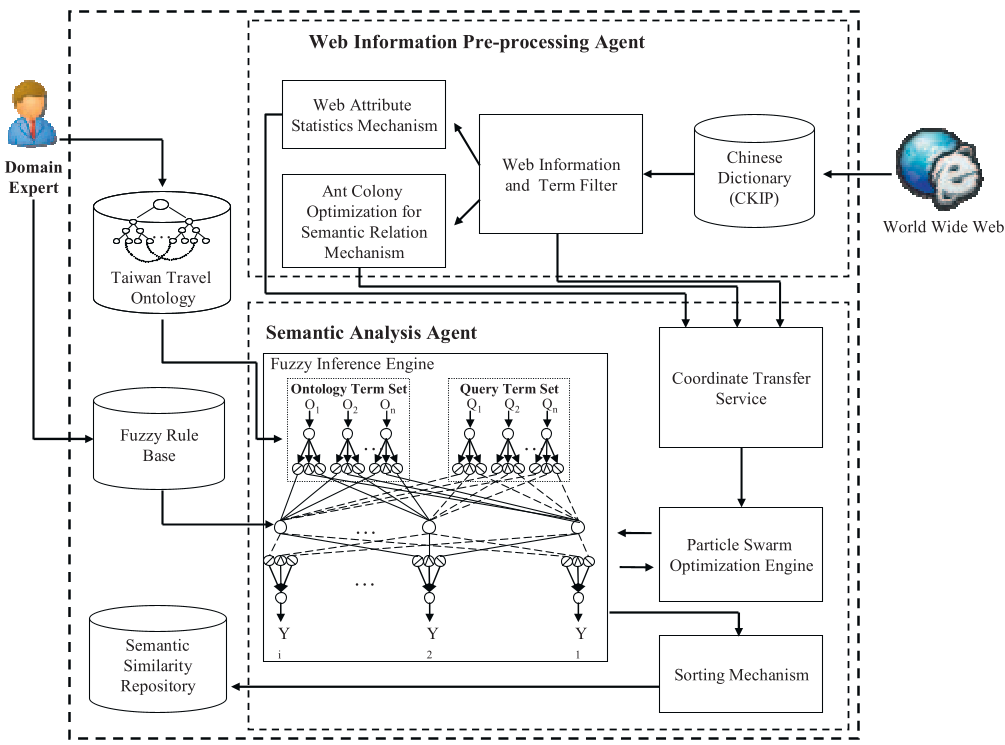
The OIWMA architecture is split into two specialized sub-agents:
1. Web Information Pre-process Agent
This agent uses the CKIP (Chinese Knowledge Information Processing) system to filter meaningful terms. It calculates the Context Information Strength (CIS). More importantly, it uses Ant Colony Optimization to discover paths between concepts, determining the Semantic Relation Similarity (SRS).
2. Semantic Analysis Agent (The 3D Mapper)
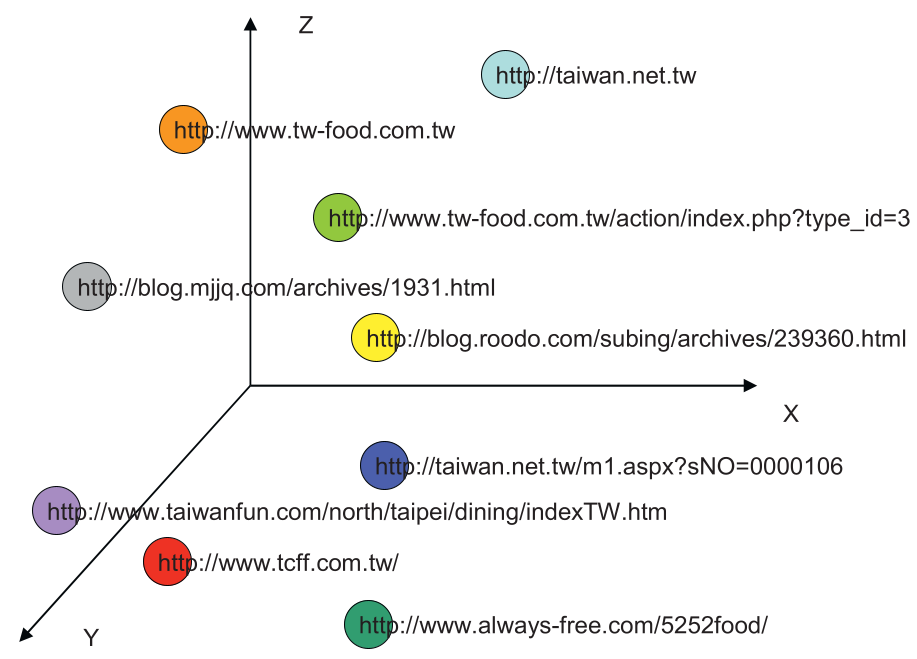
This is where the magic happens. The agent converts every webpage into a coordinate in a 3D Space:
- X-axis: Semantic Relation (calculated via ACO).
- Y-axis: Context Relation (hyperlink and HTML tag frequency).
- Z-axis: Context Information (term frequency).
3. Optimization via PSO and Fuzzy Logic
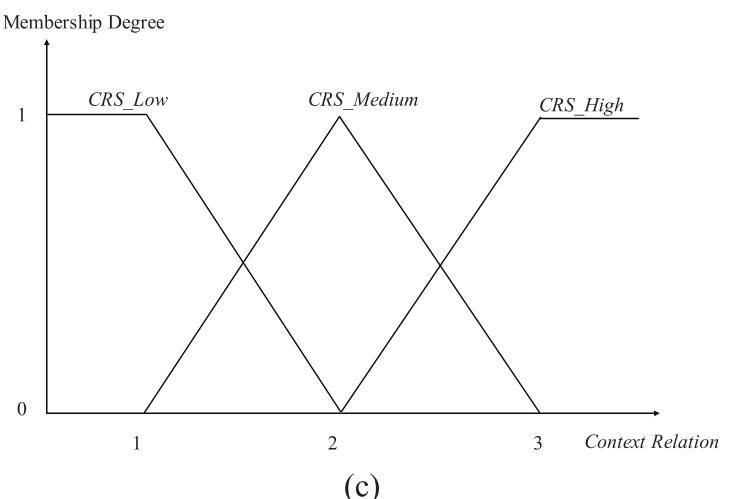
Instead of a simple linear ranking, the authors use Particle Swarm Optimization. Each "particle" (potential solution) moves through the search space to find the optimal webpage. The "fitness" of these particles is determined by a Fuzzy Inference Engine, which uses 25 rules (e.g., If SRS is Very High and CRS is High, then Similarity is Very High) to mimic human expert judgment.
Experiments & Results
The paper demonstrates the construction of a robust Taiwan Travel Ontology, categorizing regions like Taipei, Taichung, and Hualien with specific relations like "Locate" and "Part of Gourmet."
By applying the membership functions (visualized below), the system can handle the "fuzziness" of natural language. A website doesn't just "match" or "not match"; it has a degree of relevance.
The result is a sorted repository of travel information that is significantly more accurate than raw search engine output, specifically tailored to the nuances of Taiwan's geography and culture.
Critical Analysis & Conclusion
Takeaway
OIWMA proves that semantic web mining is not just about "finding words," but about "understanding relationships." By using swarm intelligence, the system avoids getting stuck in local optima during search, leading to higher quality recommendations.
Limitations & Future Work
While powerful, the system currently relies on expert-defined fuzzy rules, which can be subjective. The authors suggest that future iterations could incorporate Neural Networks or Genetic Algorithms to learn these rules automatically from data, making the system more adaptive to changing travel trends.
Ultimately, this work lays the foundation for "Semantic Travel," where the agent doesn't just find links, but understands the soul of a destination.