
From Statutes to Social Sentiment: Ontology-Based Law Discovery
Ontology Based Law Discovery
This paper presents a framework for Ontology Induction applied to specific legal domains, specifically analyzing the Italian "Legge Bassanini." It combines Log Odds Ratio (LOR) and Random Indexing (RI) to automatically extract concept clouds and linguistic relations from heterogeneous web corpora including news and social media.
TL;DR
This research moves beyond traditional, static legal models to propose a dynamic method for "Law Discovery." By mining the web using statistical NLP techniques like Log Odds Ratio (LOR) and Random Indexing (RI), the authors demonstrate how to extract "concept clouds" that reveal the stark difference between a law's official intent and its public perception among citizens.
The Gap Between "Black Letter Law" and Public Reality
Most legal ontologies are designed by experts to represent the internal logic of a statute. However, these models ignore a vital data source: the Web. The authors argue that a law like Italy's Bassanini Law (aimed at administrative simplification) lives two lives. In official news, it is a tool for "federalism" and "reform." On forums and blogs, it is a world of "stamps," "photocopies," and "bureaucratic delays."
The technical challenge lies in the unstructured nature of web data. How do we filter out "noise" (like forum signatures and off-topic chatter) while maintaining the nuanced linguistic relations that define a domain?
Methodology: The Hybrid Discovery Engine
The study utilizes a multi-stage pipeline to transform raw web search results into a structured semantic representation.
1. Automated Corpus Harvesting
The researchers used Google search services to gather 1,567 documents categorized by genre:
- Groups/Forums: Spontaneous, often subjective discourse.
- News: Controlled, descriptive information.
- Blogs: A middle ground of opinionated commentary.
2. Term Specificity via Weighted LOR
To find words that define the "Bassanini" domain, the authors used a weighted Log Odds Ratio. This compares term frequency in the domain corpus against a general background corpus.

3. Semantic Clustering with Random Indexing (RI)
While LOR identifies what words are important, RI identifies how they relate. By using high-dimensional vector spaces and "random signatures" for contexts, RI clusters terms that appear in similar environments.
Key Insights: Divergent Perspectives
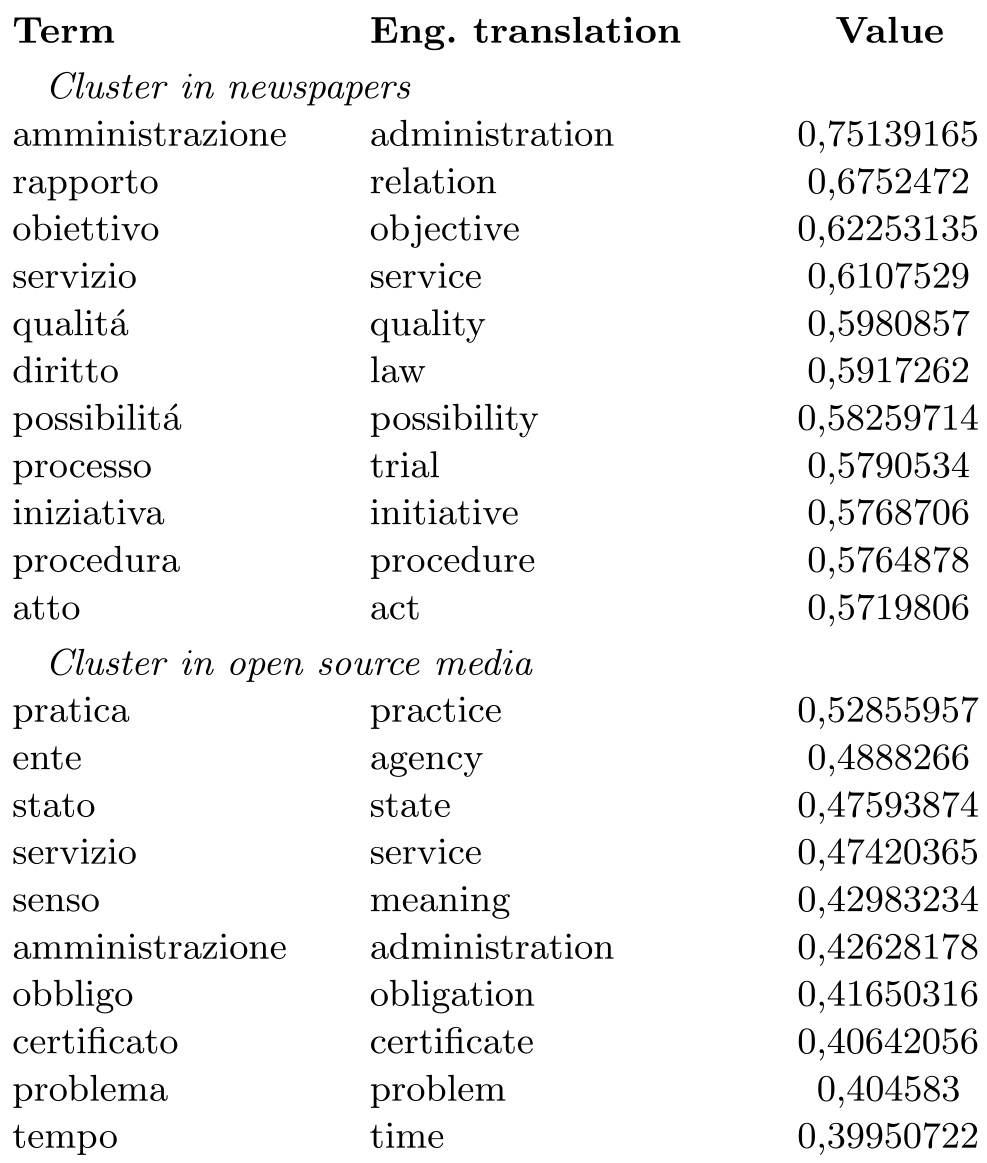
The most striking result of the study is the minimal overlap (36%) between the concept clusters found in newspapers versus those found in open-source media (forums).
- The "Professional" View (News): Associated with terms like quality, rights, services, and administrative relationships.
- The "Citizen" View (Blogs/Groups): Associated with problems, obligations, dossiers, and time.
Prototypical Relations
The system didn't just find nouns; it found predicates. For example, the term "documento" (document) was statistically linked to verbs like "allegare" (enclose), "firmare" (sign), and "richiedere" (require). This reveals the actions citizens must perform, effectively mapping out a "User Experience" of the law.
Critical Analysis & Future Outlook
Contribution: The paper successfully demonstrates that ontology learning is not just for building databases; it's a tool for sociological analysis. It provides a "bootstrap" for legal experts to see which parts of a law are actually impacting the public.
Limitations: The current method provides an "informal ontology"—a concept cloud rather than a rigid hierarchy. It also struggles with multi-word units (chunks); for instance, it might treat "abolition" and "prefect" separately rather than recognizing the specific legal event "abolition of the prefect."
Future Directions: The next frontier involves integrating these "linguistically induced" models with formal frameworks like Jur-WordNet or LOIS. By bridging the gap between raw web sentiment and formal logic, we can create legal systems that are both legally sound and socially aware.
Takeaway: The "perception" of a law is just as important as its "text." NLP allows us to bridge that gap at scale.