
Bridging the Gap: Integrating Distributed Databases and Data Mining via Ontological Frameworks
An Ontology-Based Method to Link Database Integration and Data Mining within a Biomedical Distributed KDD
This paper introduces an ontology-based distributed Knowledge Discovery in Databases (KDD) framework that bridges the gap between database integration and data mining. Using "Virtual Schemas" (VS) and "Preprocessing Ontologies" (PO), the method enables seamless querying and automated data cleaning across heterogeneous biomedical data sources without centralization.
TL;DR
In the era of collaborative science, the traditional centralized data warehouse is becoming a bottleneck. This paper proposes a decentralized KDD (Knowledge Discovery in Databases) model that uses Virtual Schemas and Preprocessing Ontologies to link database integration with data mining. By resolving structural and semantic heterogeneities on-the-fly, the method enables researchers to treat multiple distributed databases as a single, clean, and unified resource.
Background: The Centralization Crisis
Standard KDD workflows typically follow a "Gather-Clean-Store-Analyze" pipeline. In fields like biomedicine, where data is siloed across various institutions, this approach fails due to:
- Data Redundancy: Storing multiple copies of massive datasets.
- Latency: Central warehouses lack real-time synchronization with evolving source data.
- Heterogeneity: Structural differences (schema) and data format variations (instances) make merging datasets a manual, error-prone nightmare.
The authors argue that the "missing link" is a unified method that handles both Schema Integration and Data Preprocessing within a distributed environment.
Methodology: The Architecture of Intelligence
The core innovation lies in the two-step ontological approach that replaces the traditional ETL (Extract, Transform, Load) process.
1. Virtual Schemas (VS) for Schema Unity
Instead of physically moving data, the system creates a "Virtual Schema." Each local database is mapped to a domain ontology. These VSs are then unified into a Unified Virtual Schema (UVS). Users query the UVS using high-level concepts (e.g., "Malignant Tumor") without needing to know the specific table names or SQL dialects of the underlying physical databases.
2. Preprocessing Ontologies (PO) for Instance Integrity
Schema mapping is only half the battle. Data instances often have different scales (cm vs. inches) or synonyms ("Malignant" vs. "Type-C"). The Preprocessing Ontology (PO) acts as a framework to store these transformation rules. When data is retrieved, it is automatically transformed based on the PO before being fed into data mining algorithms.
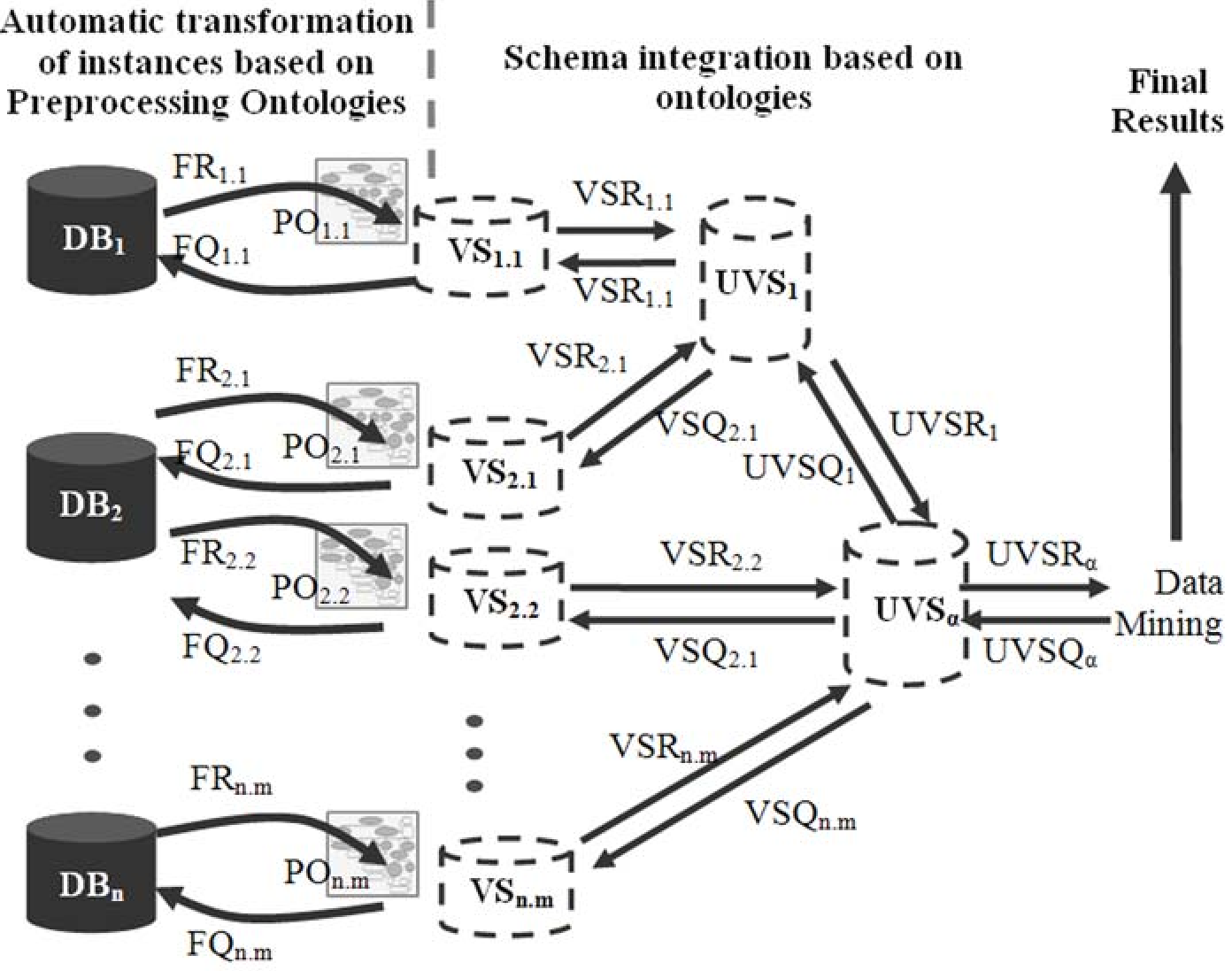 Figure 1: The proposed method showing how queries travel through Virtual Schemas and results are cleaned by Preprocessing Ontologies.
Experiments & SOTA Comparison
The researchers tested their framework against two major biomedical datasets, including the SEER database. They compared their solution against established tools like SEMEDA, KAON Reverse, and Weka.
Key findings included:
- Performance Boost: By enabling access to more distributed sources, the volume of training data increased, leading to more robust machine learning models.
- Functional Superiority: As shown in the comparison table below, the proposed solution is the only one to offer a complete stack: distributed approach, ontology-based schema integration, instance integration, and automated inconsistency detection.
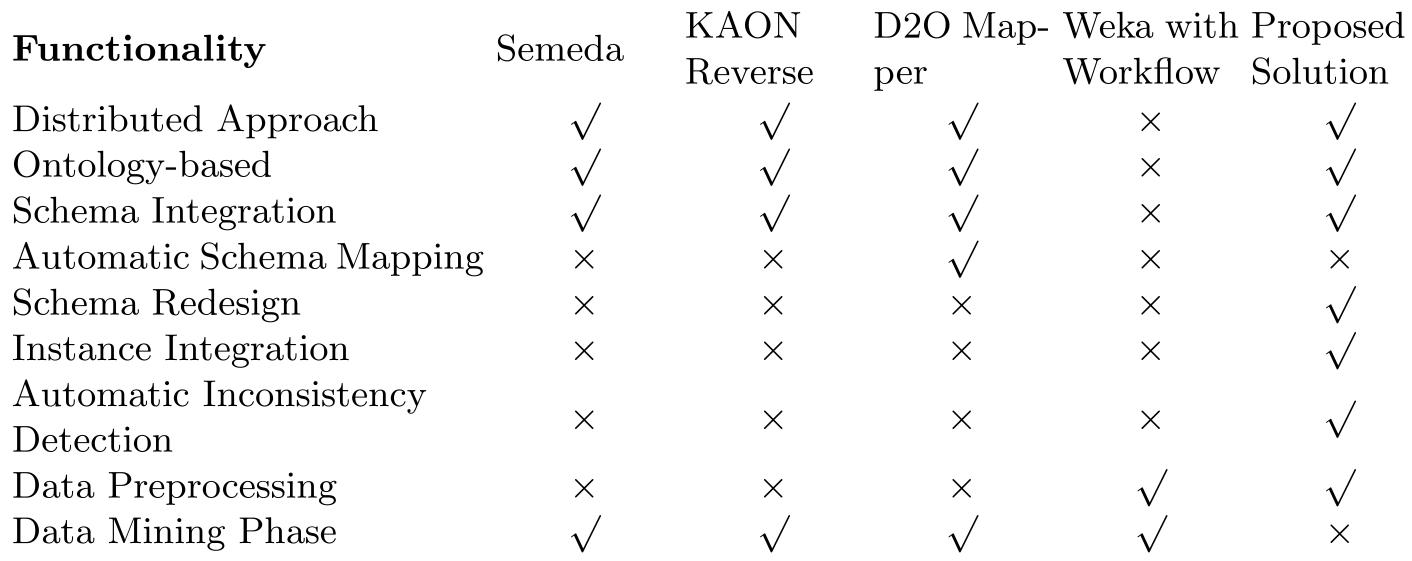 Table 1: Comparison of functionalities across different database integration and data mining frameworks.
Critical Analysis & Conclusion
The Takeaway
The true value of this work is the decoupling of the data's physical location from its semantic meaning. By treating preprocessing as an ontological task rather than a hard-coded script, the system gains enormous flexibility and reusability.
Limitations & Future Work
While the framework is powerful, the authors acknowledge that Schema Mapping is still a semi-manual task which can be labor-intensive for hundreds of sources. Future research aims to:
- Automate Mapping: Using machine learning to suggest links between physical schemas and ontologies.
- Grid Integration: Scaling the system to "Grid" environments for high-performance resource planning.
In conclusion, this ontology-based method provides a scalable blueprint for future biomedical research, ensuring that "big data" doesn't necessarily mean "centralized data."