
Bridging the Gap: How Ontologies and Data Mining Revolutionize KPI Analysis
Toward an Ontology-Based Model of Key Performance Indicators for Business Process Improvement
This paper introduces a hybrid semantic-analytical framework for Business Process (BP) improvement, combining an OWL-based ontology with data mining. It specifically addresses the integration of quantitative execution metrics (from jBPM) and qualitative patient experience data (via questionnaires) into a unified Key Performance Indicator (KPI) model.
TL;DR
To truly improve business processes, measuring "how long" is not enough—we must understand "why" and "how" different metrics affect one another. This paper proposes a dual-engine framework: an OWL Ontology to map semantic relationships between tasks and KPIs, and Association Rule Mining to uncover hidden patterns between quantitative data and qualitative user satisfaction in a healthcare environment.
The "Blind Spot" in Modern BPM
Most organizations manage their Key Performance Indicators (KPIs) through static dashboards. While these tools show what is happening (e.g., "The waiting time is too long"), they fail to provide the semantic context. They ignore the intricate web of dependencies: Does a delay in activity A directly cause a drop in patient satisfaction B? Current Business Process Management (BPM) systems often treat quantitative logs and qualitative feedback as separate silos, leaving decision-makers to manually "connect the dots" between raw numbers and human experience.
Methodology: Semantics Meets Analytics
The authors propose a structured workflow that transitions from raw logs to actionable knowledge.
1. Data Fusion
The system captures data from two distinct sources:
- Quantitative: Execution logs from jBPM (an open-source BPMS), tracking durations and throughput.
- Qualitative: Patient questionnaires capturing satisfaction levels on a 5-point Likert scale.
2. The Semantic Layer (Ontology)
Using Protégé, the researchers built a formal ontology. This isn't just a list of terms; it includes Object Properties like related_with and Depend_quantitative. This allows the system to "understand" that a specific KPI is not a standalone figure but is intrinsically tied to a specific process task (e.g., "Consultation").
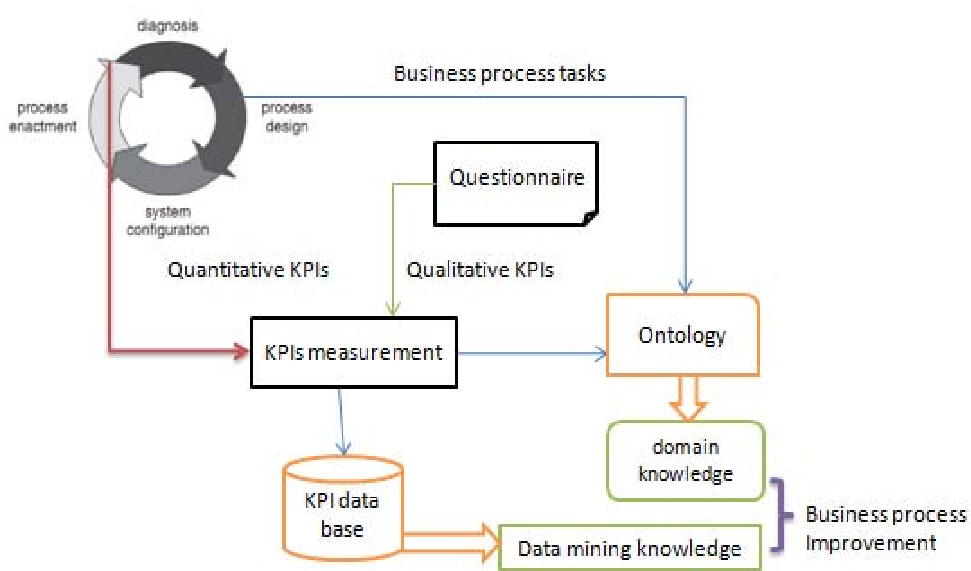 Fig 1: Overview of the proposed solution, merging BPM lifecycles with ontological modeling and rule discovery.
3. Rule Discovery (Data Mining)
To validate the ontology and discover new links, the authors used the Apriori algorithm. By analyzing 100 patient instances, they could generate rules such as:
- If (Quality of Medical Care = Not OK) AND (Clarity of Information = Not OK) THEN (Attention by Medical Staff = Not OK).
Experimental Insights from Healthcare
The methodology was tested in an Emergency Department (ED). The researchers focused on "Basic KPIs" rather than aggregate ones to maintain granular visibility into individual patient experiences.
Key Findings:
- Information Clarity is King: Association rules showed a high confidence (71.4%) linking "Clarity of Information" to "Medical Staff Attention." This suggests that psychological factors and communication are as critical as clinical speed.
- Semantic Querying: Using SPARQL, the authors developed a Java-based interface that allows managers to click a process activity and instantly see all related KPIs and their interdependencies.
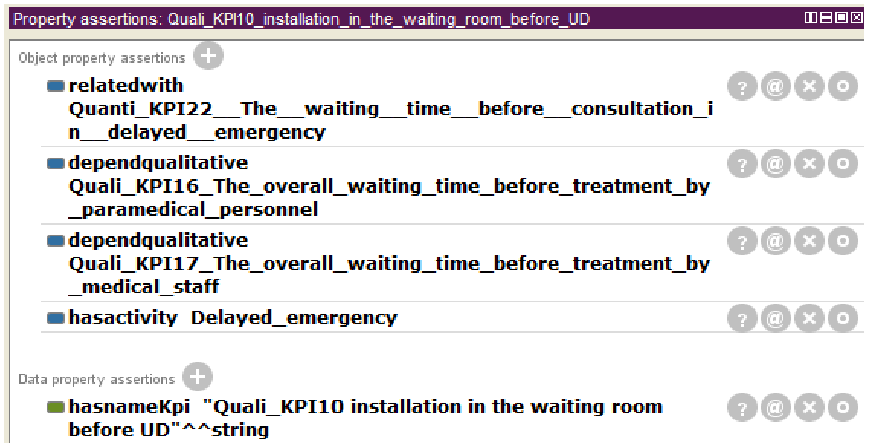 Fig 2: The ontology's class structure, defining how Process Tasks, Managers, and KPIs interact.
Critical Perspective: Beyond the Numbers
The true value of this work lies in its Inductive Bias. It assumes that process data alone is "mute" until it is situated within a domain-specific knowledge structure. While many AI approaches aim for "black-box" predictions, this paper champions Explainable BPM.
Limitations & Future Work
- Scalability: The study utilized 100 instances. While statistically significant for a pilot, real-world hospital data involves thousands of daily events, which might require more robust mining algorithms like PrefixSpan.
- Dynamic Adaptation: Currently, the ontology is static. Future iterations could benefit from a "Self-Evolving Ontology" that updates based on newly discovered association rules.
Summary Takeaway
This paper serves as a blueprint for organizations moving beyond simple reporting. By combining the logic of Ontologies with the pattern-finding power of Data Mining, we can transform raw process logs into a strategic roadmap for continuous improvement.