
Beyond Algorithms: How Ontologies and ML are Revolutionizing Academic Advising
Ontology-based Recommender System in Higher Education
This paper introduces an ontology-based recommender system enhanced with machine learning to assist high school students in selecting academic majors and universities. It integrates Semantic Web technologies to model domain knowledge (students, institutions, employment) with ML algorithms to analyze the successful career paths of alumni.
TL;DR
Choosing a college major is a high-anxiety decision where 75% of students feel lost. This paper presents a sophisticated hybrid recommender system that moves beyond simple "people who liked this major also liked..." logic. By combining Ontologies (to understand the "meaning" of subjects) and Machine Learning (to learn from alumni success), the authors provide a framework for personalized, data-driven academic orientation.
The "Undecided" Crisis in Higher Education
The stakes of academic advising are massive. Statistics show that roughly half of all students change their major at least once, leading to increased debt and delayed graduation. In some systems, like in France, students are often assigned to majors via rigid algorithms that ignore personal passion, leading to high dropout rates.
The fundamental challenge is Information Overload mixed with a Cold Start problem: a high school student has no history of "purchasing" or "rating" university courses, making traditional recommendation engines (like Netflix's) ineffective.
Methodology: The Semantic Bridge
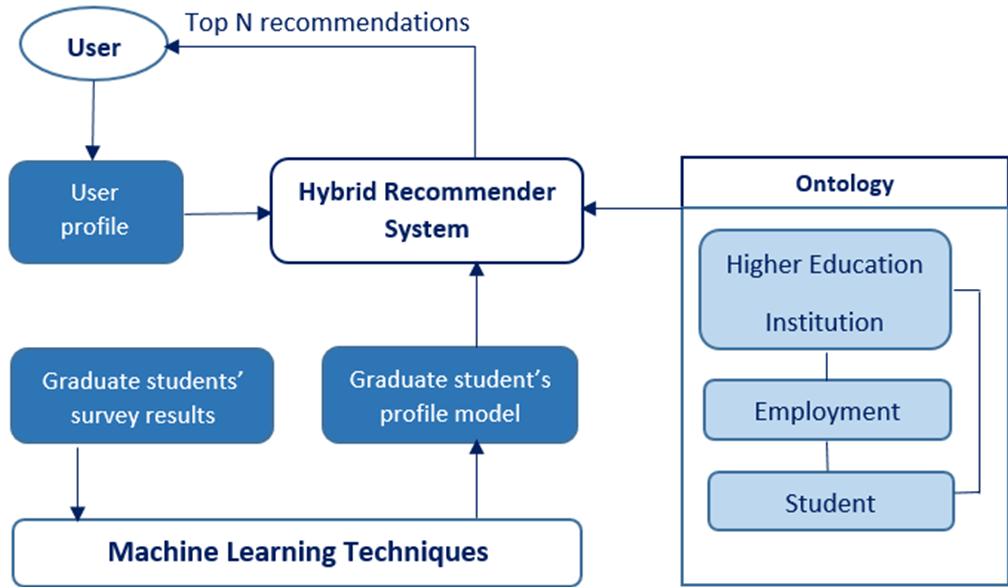
The authors propose a multi-layered architecture that treats education as a "knowledge domain" rather than just a dataset.
1. The Ontology Backbone
Using the Semantic Web philosophy, the system uses three primary ontologies:
- Student Ontology: Captures skills, interests, and vocational strengths.
- Institutional Ontology: Details university rankings, costs, and specific major requirements.
- Employment Ontology: Connects majors to real-world outcomes like salary and employment rates.
2. Machine Learning Enhancement
The innovation lies in how the system "learns." Instead of just matching keywords, it analyzes the paths of graduate alumni. By clustering the profiles of successful professionals, the system can say: "Students with your specific mix of interest in Humanities and Fine Arts typically found success in Major X at University Y."
How it Works: Data Collection & Processing
The system utilizes a dual-mode data collection strategy:
- Explicit: Profile building where students input preferences.
- Implicit: Surveying graduates to find "hidden" patterns between high school hobbies and professional success.
By using algorithms like K-means and Self-Organizing Maps (SOM), the system categorizes these diverse paths into "Frequent Models." When a new student arrives, the Hybrid Recommendation Engine maps the student's profile to the most successful historical cluster.
Critical Insight: Why This Matters
Most recommender systems prioritize "engagement" or "clicks." In education, the priority is long-term alignment. This paper's approach is superior to standard SOTA methods in this specific niche because:
- Interpretability: Because it uses an ontology, the system can explain why it recommended a major (e.g., "Because your skill in 'Logic' maps to the 'Computer Science' prerequisite").
- Accuracy: It accounts for the changing landscape of the job market via the Employment Ontology.
Conclusion & Future Outlook
While the paper focuses on the framework, the future of this work lies in scaling the data collection. The authors acknowledge that building these ontologies is a long-term effort. However, as we move into the era of AI-driven career coaching, this "Semantic + ML" hybrid provides a much-needed foundation of structured truth that LLMs currently lack.
Takeaway: The next generation of student support won't just be a chatbot; it will be a semantic engine that understands the deep relationships between human potential and academic pathways.