
Semantic Intelligence in Vehicle Sales: An Ontology-Based Recommender System
An Ontology-Based Recommender System Architecture for Semantic Searches in Vehicles Sales Portals
The paper proposes a hierarchical, ontology-based recommender system architecture designed for the automotive sales market. By integrating a "Vehicle Advertisements Ontology" (VAO) with semantic search techniques, the system aggregates data from multiple web portals to provide "best buy" recommendations based on contextual criteria like depreciation and insurance costs.
TL;DR
This research addresses the "Information Overload" in online car shopping by introducing a hybrid recommender system that uses Ontologies to understand the semantic context of a "best buy." By aggregating data across multiple portals and considering factors like depreciation and insurance, the system achieves an impressive 86.66% precision in identifying optimal vehicle deals.
Background & Motivation: Beyond Keyword Matching
When a user searches for a "Sedan" on a typical portal, the engine simply filters a database for that keyword. However, a true "best buy" involves understanding the market average (reference), the vehicle's quality (benchmark), and the best available price across the entire web, not just one site.
The authors argue that traditional systems suffer from:
- Data Silos: They only search their own internal databases.
- Flat Metadata: They ignore hidden costs like insurance and depreciation.
- Lack of Intent: They don't recognize the semantic relationship between a "Budget" and a "Value Opportunity."
Methodology: The Four-Layer Semantic Framework
To solve this, the paper introduces a hierarchical architecture that separates the knowledge (Ontology) from the logic (Recommendation).
1. The Vehicle Advertisements Ontology (VAO)
The backbone of the system is the VAO, which reuses industrial standards like GoodRelations and Schema.org. This allows the system to understand that a "Vehicle" isn't just a string of text, but an entity with attributes like vao:depreciationIndex and vso:insurancePrice.
2. Hierarchical Architecture
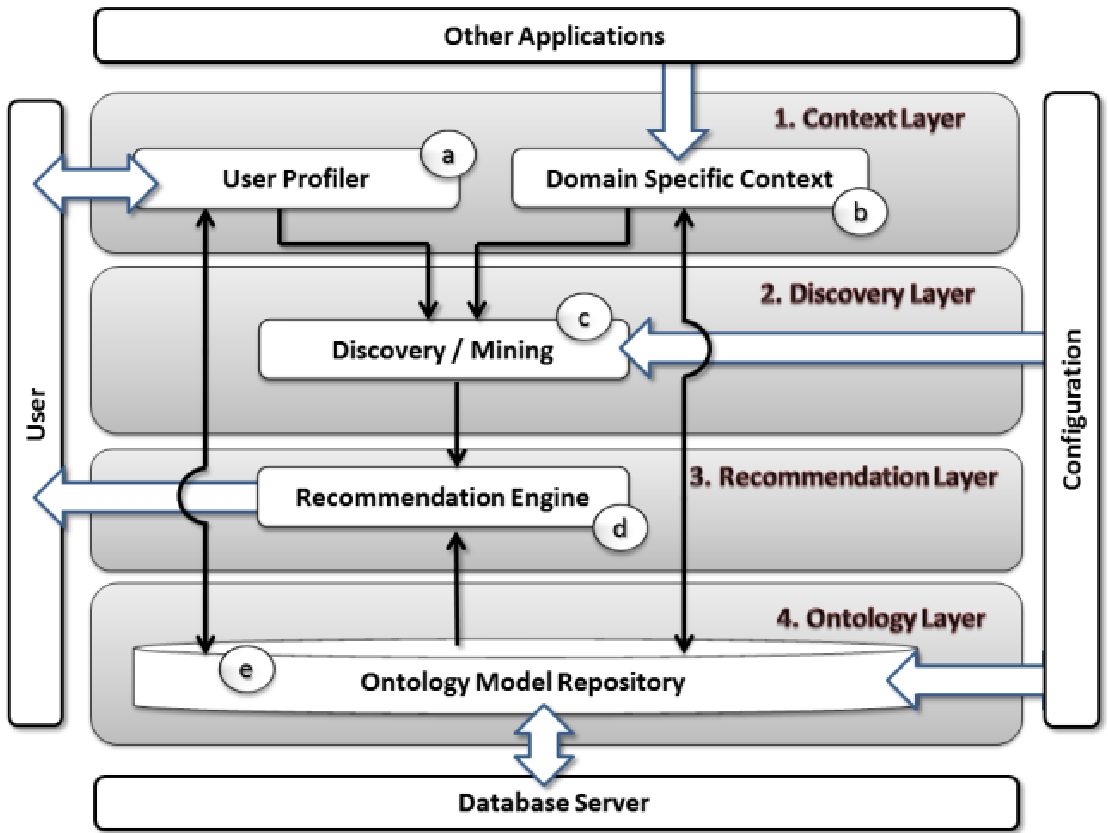 The architecture organizes the process into Context (User), Discovery (Mining), Recommendation (Engine), and Ontology (Storage) layers.
3. The Recommendation Logic
The system utilizes a custom algorithm that:
- Fetches Benchmarks to find the "best in class" model.
- Identifies Reference Prices (e.g., via FIPE) to establish a market average.
- Aggregates Advertisements via web robots.
- Ranks offers based on their proximity to the "Reference Price" within the user's budget.
Experimental Analysis: Precision vs. Recall
The authors tested the prototype against traditional Brazilian portals (WebMotors, OLX, MeuCarango).
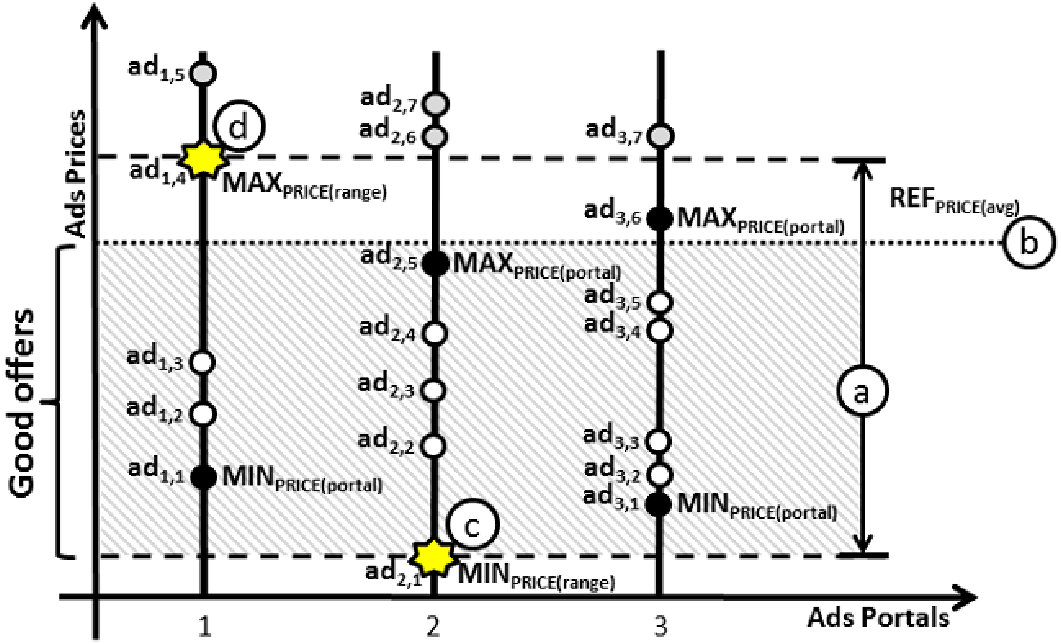 The visualization shows how the system filters advertisements (dots) relative to the Average Price (Ref) and the User's Range, effectively narrowing down "Good Offers" (Gray Area).
Key Metrics:
- Precision (86.66%): High accuracy in ensuring recommended cars were actually relevant opportunities.
- Recall (68.42%): A solid ability to find a majority of relevant deals across disparate sources.
- Feature Superiority: Unlike competitors, this prototype was the only one capable of "Best Buy" categorization and cross-portal acquisition.
Critical Insight & Future Outlook
The primary strength of this work lies in Ontology Reuse. By not building from scratch, the system maintains interoperability with the wider Semantic Web.
Limitations: The reliance on "on-the-fly" web robots can be fragile if external portals change their HTML structure. Future iterations could benefit from Machine Learning to handle unstructured layout changes and LLMs to parse natural language queries into the formal SPARQL/Logic queries required by the ontology.
Conclusion
This paper serves as a blueprint for specialized e-commerce platforms. By moving from "Search" to "Semantic Recommendation," we can transform the car-buying experience from a tedious manual comparison into an intelligent, value-driven service.