
Mingle: Bridging Physical Spaces and Social Digitalized Contexts via Ontologies
An ontology-based repository for a spontaneous social network
The paper introduces Mingle, a spontaneous social network architecture based on Ubiquitous Computing. It proposes a specialized ontology-based repository to manage location-dependent interactions in physical "Cells" (e.g., malls or parks), achieving a 77.66% lexical compatibility with standard domain ontologies.
TL;DR
The Mingle project reimagines social networking by grounding it in Ubiquitous Computing. Unlike stationary platforms like Facebook, Mingle creates "spontaneous" networks based on a user's physical presence in a specific location, or "Cell". At its heart lies a sophisticated ontology-based repository that manages identity, services, and location-based rules with high semantic precision.
Background & Motivation: Moving Beyond "Ad-Hoc" Models
Most social networks treat "location" as a static metadata field. However, in a truly ubiquitous environment (as envisioned by Mark Weiser), the network itself should emerge from the environment. The authors argue that current ad-hoc data representations are too rigid to handle the fluidity of spontaneous interactions—such as a student entering a campus (a "Private Cell") and immediately gaining access to local services while maintaining a specific degree of anonymity.
Methodology: The Mingle Ontology-Based Server
The core innovation is the use of Ontologies to define the social domain. Instead of a standard relational schema, the authors define a formal specification of terms and relations.
1. The Architecture
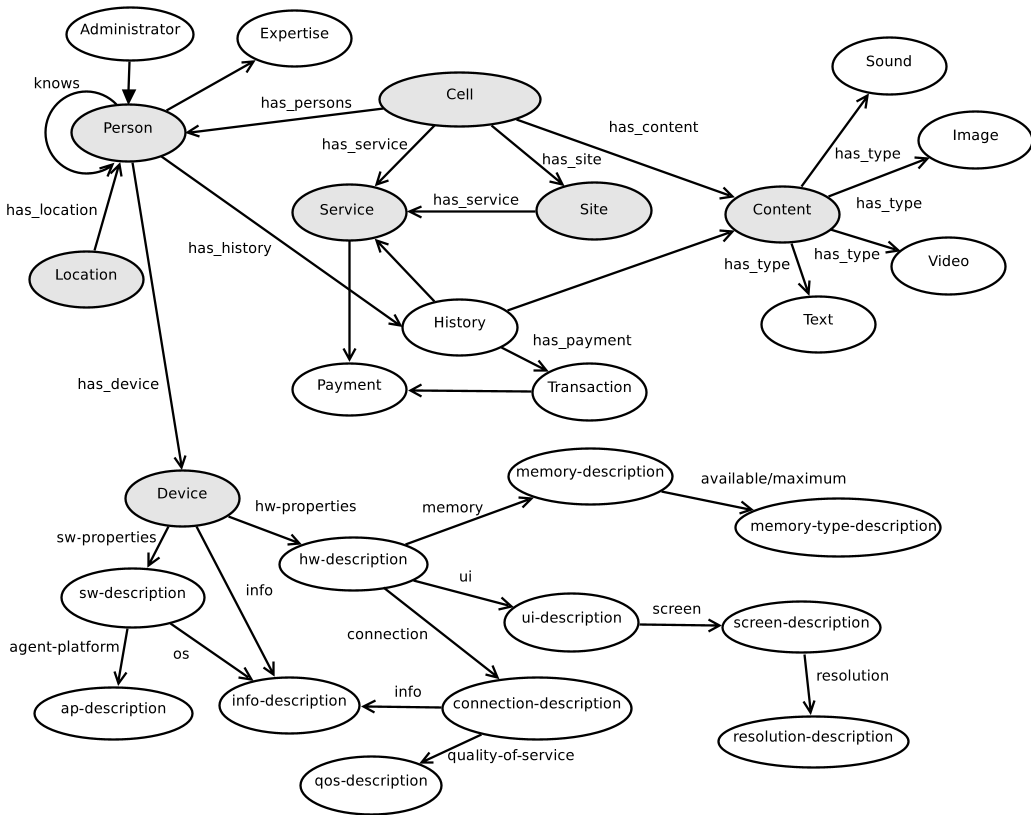
The system follows a wireless infrastructure where mobile devices communicate with a MingleServer. The server utilizes a "Mapping" layer to bridge the gap between high-level ontological classes and low-level database tables.
2. Semantic Intersection
The Mingle ontology isn't built from scratch. It strategically reuses three major standards:
- FOAF (Friend-of-a-friend): For personal profiles and relationships.
- FIPA Device: For managing the technical capabilities of mobile hardware.
- Finance Ontology: To handle transactions and service trades within the Cell.
3. Implementation Patterns
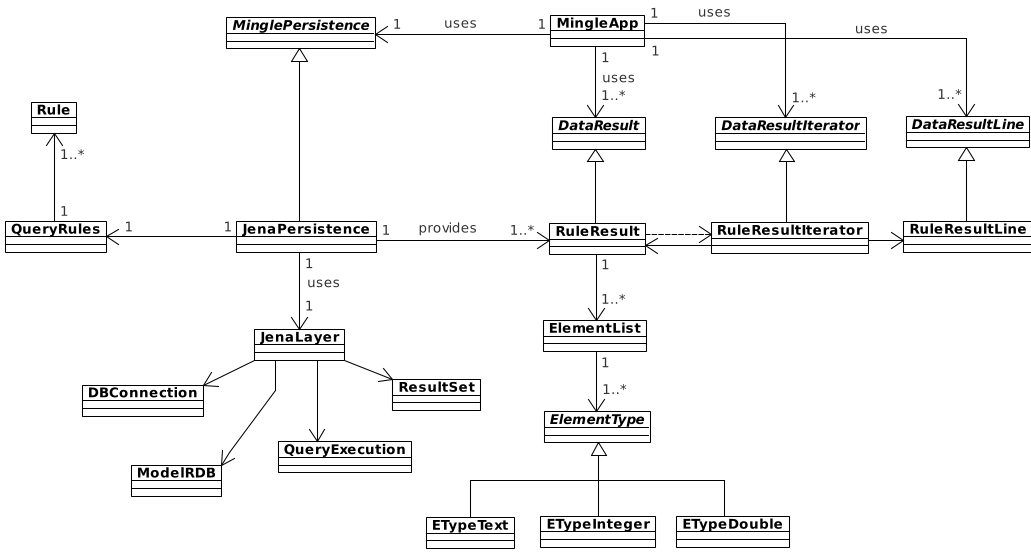
To handle the complexity of the Jena Library (the Java framework used to manipulate ontologies), the team employed several design patterns:
- Abstract Factory: Decouples persistence from the server logic.
- Façade: Simplifies interaction with the Jena SPARQL engine.
- Adapter: Converts ontological types (Integer, Text) into application-level types.
Evaluation: Efficiency and Completeness
The researchers evaluated Mingle through two lenses: Lexical Similarity and Functional Completeness.
Using the Levenshtein edit distance, they proved that Mingle's vocabulary effectively covers the domain of its source ontologies. Specifically, it showed a 52.83% overlap with FIPA Device, indicating a strong focus on mobile hardware integration.
| Ontology Source | Similarity (SM) |
|---|---|
| FOAF | 39.2% |
| FIPA Device | 52.83% |
| Finance | 47.15% |
| Combined Union | 77.66% |
At the Application Level, the prototype successfully executed all ten core requirements, from searching for products in a "Site" (a sub-unit of a Cell, like a store in a mall) to updating a user's position in real-time.
Critical Insight: The Power of Social Inference
The brilliance of using ontologies here is not just data storage, but inference. By using SPARQL queries, the system can dynamically determine if a user should have access to a service based on their location, identity status (anonymous vs. identified), and the Cell's security policies (public vs. private).
Conclusion & Future Outlook
While the current prototype has limitations (such as the inability to handle duplicate "use-service" events without timestamps), it provides a robust blueprint for the future of Context-Aware Computing.
Future Work involves extending the ontology to include "reputation" systems (rankings) and "tips." As we move toward a world of "Invisible Computing," the Mingle project proves that semantic technologies are the vital link between our physical locations and our digital lives.