
Beyond Clusters of Words: Leveraging Ontologies for Human-Centric Data Mining
Performance of Ontology-Based Semantic Similarities in Clustering
This paper investigates the integration of ontology-based semantic similarity measures into classical clustering algorithms. It specifically proposes a mixed distance function for Ward’s clustering that combines numerical, categorical, and semantic features using WordNet, achieving superior cluster interpretability and alignment with human reasoning via the Super-Concept based Distance (SCD) method.
TL;DR
Clustering is no longer just for numbers. This research demonstrates that by embedding WordNet-based semantic similarities into classical algorithms like Ward’s Method, we can create data partitions that actually make sense to humans. The "Super-Concept based Distance" emerges as a superior metric, outperforming traditional path-length calculations by considering the broader taxonomic context of concepts.
Background Positioning
In the landscape of data mining, this work bridges the gap between unstructured textual information and structured statistical clustering. It moves beyond the "Bag-of-Words" limitation by treating language as a network of concepts rather than a set of discrete labels.
The "Meaning" Gap in Clustering
Standard clustering algorithms are mathematically elegant but semantically "blind." If you cluster cities based on the text label "Language," a standard algorithm sees "Spanish" and "Portuguese" as equally different as "Spanish" and "Mandarin."
The authors argue that this lack of Inductive Bias regarding linguistic meaning results in clusters that are technically optimal but conceptually fragmented. Their insight is simple yet powerful: The hierarchical structure of human knowledge (Ontologies) should dictate the distance between data points.
Methodology: The Mixed Distance Framework
The core contribution is a hybrid distance function that balances three distinct data types:
- Numerical (): Population, land area (Euclidean).
- Categorical (): Continent, city ranking (Chi-square).
- Semantic (): Geographical interest, major attractions (Ontological).
The Evolution of Semantic Distance
The paper compares several ways to calculate using the WordNet taxonomy:
- Path Length: Calculating the shortest number of edges between two nodes. (Limited context).
- Wu & Palmer (WP) & Leacock-Chodorow (LC): Incorporating the depth of the tree to normalize the distance.
- Super-Concept Based Distance (SCD): This is the "hero" of the study. It looks at the overlap of "ancestor" concepts.

In this formula, the distance is derived from the ratio of non-common ancestors to total ancestors, capturing the "semantic weight" of the concepts.
Experiments & Results
The authors tested their hypothesis on a dataset of 23 world cities. They compared their algorithmic results against partitions made by four human subjects.
Performance Metrics
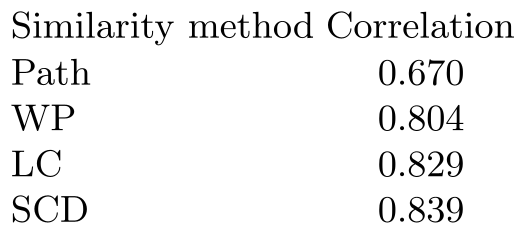
The superiority of the SCD method is evident in both benchmark correlation and partition accuracy:
| Similarity Method | Correlation (Miller & Charles) | Distance to Human Partition |
|---|---|---|
| Path Length | 0.670 | 0.560 |
| Wu & Palmer (WP) | 0.804 | 0.456 |
| SCD | 0.839 | 0.320 |
Interpretability Win
While the Path Length method mistakenly grouped "Chamonix" (a ski resort) with "Santa Cruz de Tenerife" (a beach destination), the SCD method successfully identified distinct semantic groups such as "European ski mountains," "Capital cities of Latin culture," and "English-speaking coastal cities."
Critical Analysis & Conclusion
Takeaway: This paper proves that semantic benchmark performance (how well a metric identifies word pairs) is a direct proxy for clustering performance. If a metric understands that a "Cat" is like a "Dog," it will also understand how to group complex entities like "Cities" or "Medical Profiles."
Limitations:
- The study relies heavily on WordNet, which is a general-purpose ontology. For specialized fields (e.g., legal or technical data), the method's efficacy would depend on the availability of high-quality domain-specific ontologies.
- The computational cost of calculating ancestor sets for every pair in a large dataset could become a bottleneck.
Future Outlook: As we move toward more "Explainable AI," integrating structured knowledge (Ontologies) with unsupervised learning (Clustering) remains a vital path for creating AI systems that categorize the world the way humans do.