
UPDL: Breaking the Silos of Personalized Services with Semantic Ontologies
Ontology-Based User Preference Modeling for Enhancing Interoperability in Personalized Services
This paper introduces the User Preference Description Language (UPDL), an OWL-based framework that leverages domain ontologies to create a standardized user preference model. It achieves high interoperability across heterogeneous personalized services, allowing user profiles to be shared and reused.
Executive Summary
TL;DR: This paper tackles the "Islands of Information" problem in personalized services. By introducing User Preference Description Language (UPDL), an OWL-based modeling framework, the authors enable different services to understand and share a user's preferences through a common semantic language tied to domain-specific ontologies.
Background Positioning: This work bridges the gap between traditional recommendation systems and the Semantic Web. It moves from simple keyword-matching to hierarchical semantic reasoning, positioning itself as a robust solution for interoperability in ubiquitous computing environments.
Problem & Motivation: The Interoperability Gap
We live in a world of fragmented personalization. Your favorite news app knows you love "Quantum Physics," but your e-learning platform remains oblivious to this fact.
The authors identify two critical pain points:
- Lack of a Generic Model: There is no universal standard to describe what a user likes across different domains.
- Data Silos: User profiles are trapped within specific service providers, making it impossible to provide a "warm start" for a user in a new service environment.
The Insight here is profound: If we map user preferences to a standardized hierarchy (an ontology), a system doesn't need to know the exact service-specific tag; it only needs to know the semantic concept the tag represents.
Methodology: The Core of UPDL
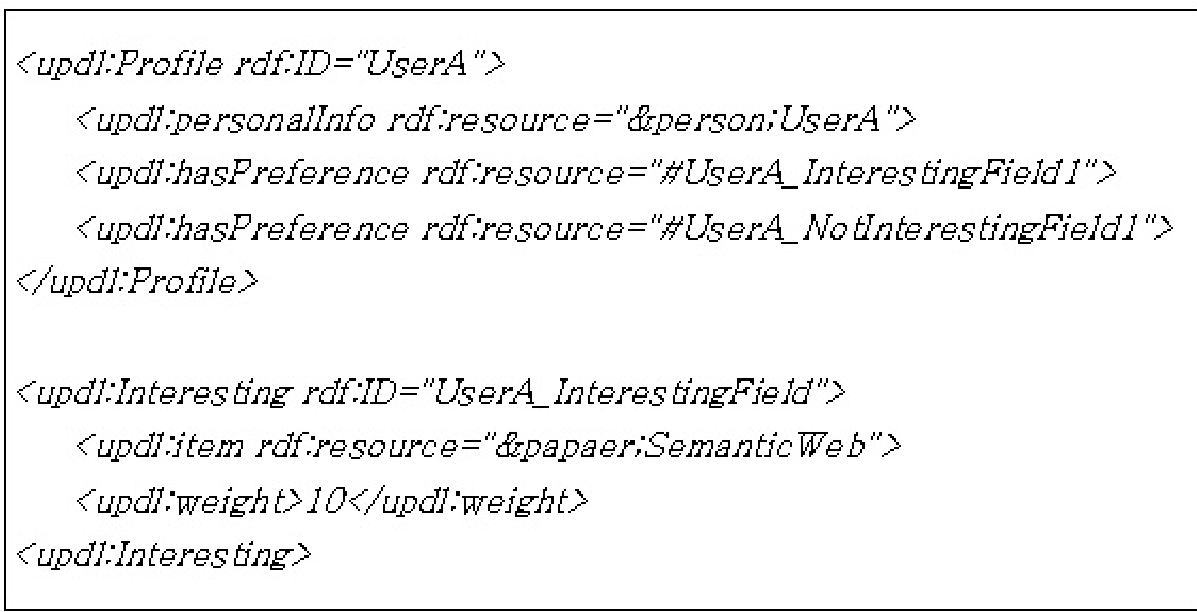
The heart of the solution is the User Preference Description Language (UPDL). Built on top of OWL (Web Ontology Language), UPDL allows for a structured description of "Interesting" vs "Not Interesting" items.
1. Hierarchical Weighting
The method doesn't just assign a static score. It uses a recursive weight assignment:
- Focus Item: Assigned a weight of 10.
- Parent Class: Receives 50% of the child's weight (e.g., 5).
- Root Propagation: This continues until the root, ensuring that if you like "Deep Learning," the system infers a general interest in "Artificial Intelligence."
2. Architecture
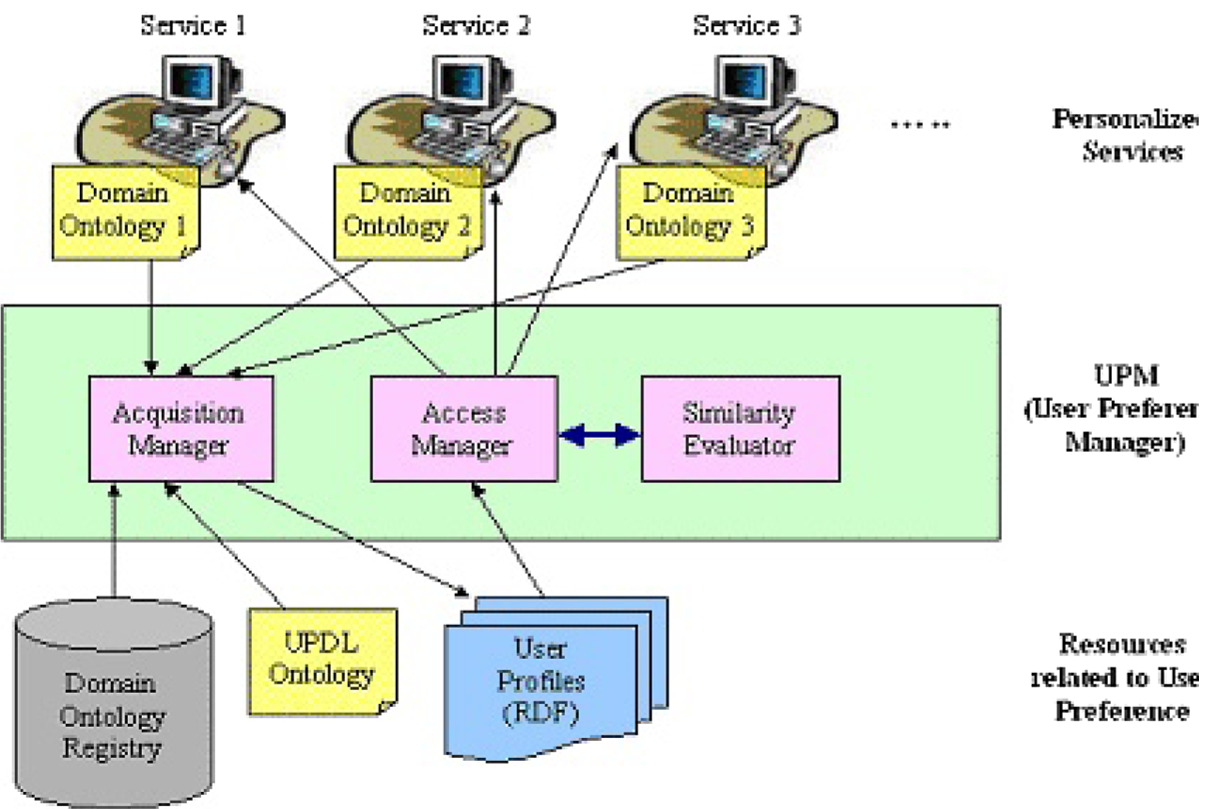
The proposed User Preference Manager (UPM) acts as the orchestrator, handling acquisition, access, and similarity evaluation.
The use of URIs is the "secret sauce"—it allows the UPDL to point to any domain ontology (like SUMO or MILO) globally, ensuring that "preferences" are not just strings, but linked data.
Experiments & Results: Semantic Synergy
The authors validated the model by demonstrating a cross-service scenario involving a Paper Search Service and an E-Learning Service.
- Key Finding: Even when the E-Learning service didn't have the specific term "Semantic Web" in its database, the Similarity Evaluation Module traced the UPDL profile back to a shared higher-level concept in the domain ontology.
- Implementation: By utilizing the Jena framework and RDQL queries, the system successfully retrieved relevant content across disparate domains.
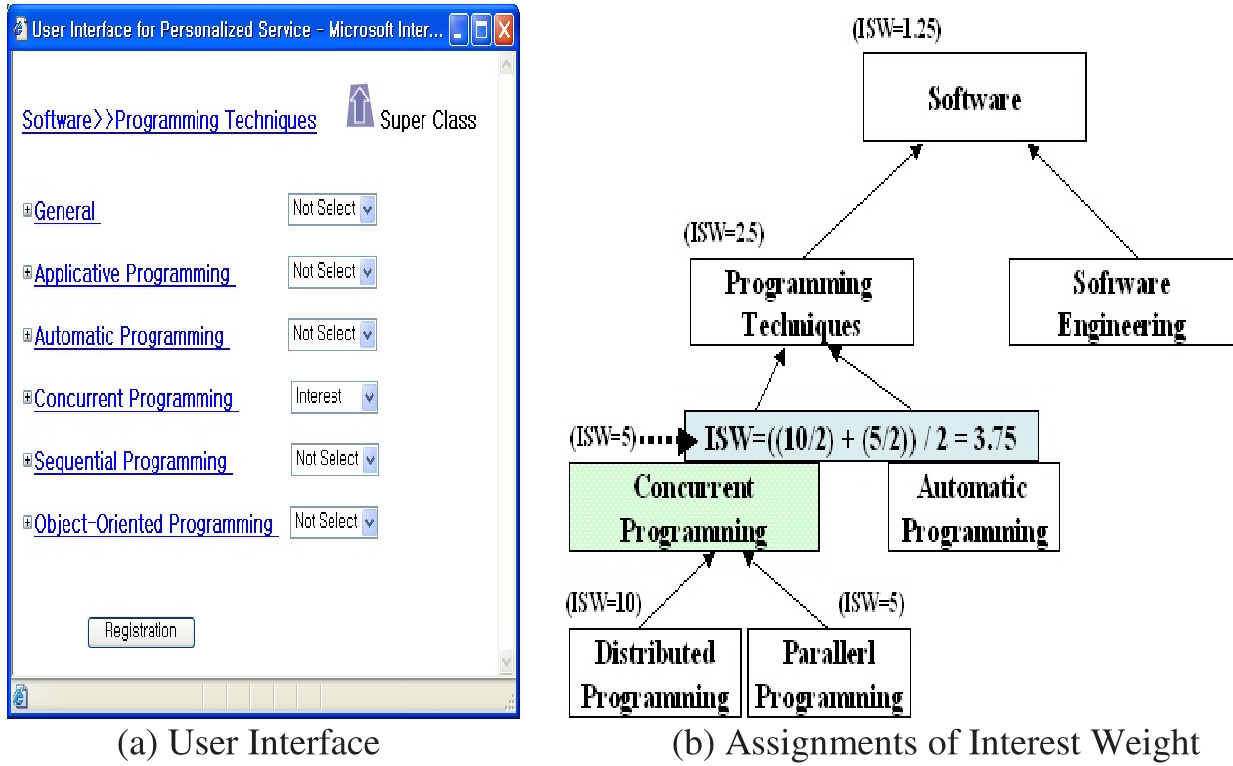
The acquisition module ensures that as a user navigates the hierarchy, the system captures the "granularity" of their interest, solving the ambiguity inherent in multi-level preference systems.
Critical Analysis & Conclusion
Takeaway
UPDL provides a blueprint for a shared "User Interest Layer" for the internet. Its strength lies in its flexibility; as new domains emerge, you don't need to rewrite the code—you only need to plug in a new domain ontology.
Limitations
- Ontology Maintenance: The system's effectiveness is heavily dependent on the quality and availability of domain-specific ontologies.
- Computational Overhead: Real-time similarity reasoning across massive, deep ontologies can be resource-intensive compared to simple vector-based lookups.
Future Outlook
The logical next step for this research is the integration of Large Language Models (LLMs) to automatically map user behaviors to ontological nodes, reducing the friction of manual registration and making UPDL truly "invisible" yet powerful.