
Decoding Preferences: A Semantic Approach to Ontology-Based User Profiling
Ontology-based user profile learning
The paper introduces a novel approach for learning context-enriched user profiles by integrating data mining (Association Rules, Bayesian Networks) and Ontologies. The core method, evaluated in e-learning scenarios, maps behavioral patterns to ontological segments to dynamically adapt a personal agent's assistance.
TL;DR
Most personal agents treat user interests as a flat list of keywords. This paper introduces a framework that uses Ontology Segmentation and Bayesian Networks to discover why a user performs an action. By enriching raw data mining results with semantic structures, the authors achieved a 14% boost in precision for personalized recommendations.
The Motivation: Why Keyword-Based Profiles Fail
Imagine three users reading football news. One likes the "Sports" section, another follows "Lionel Messi" wherever he is mentioned, and the third only reads a specific columnist. To a traditional agent, they all just like "Football."
The problem is Context Heterogeneity. Static profiles defined at design-time cannot capture the nuance of which attribute (author, section, or keyword) actually triggers the user's interest. The authors argue that a user profile must be an active, evolving component capable of learning high-level context from low-level interaction logs.
Methodology: From Raw Logs to Semantic Segments
The proposed system moves through three distinct phases to bridge the gap between "data" and "meaning."
1. Association Rule Mining (The Pattern Finder)
The system tracks user actions (read, save, comment) and uses the Apriori algorithm to find frequent itemsets.
- Input: User transaction logs.
- Output: Rules like
If Section=Sports AND Topic=Transfers THEN Action=Read.
2. Bayesian Network Creation (The Relation Mapper)
Association rules are often too specific. To find the "common thread" between rules, the authors map attributes to concepts in a domain ontology. They use the K2 algorithm to build Bayesian Networks that determine the probability of specific ontological relations (e.g., hasWritingStyle or hasPrerequisite) being relevant to the user's current behavior.
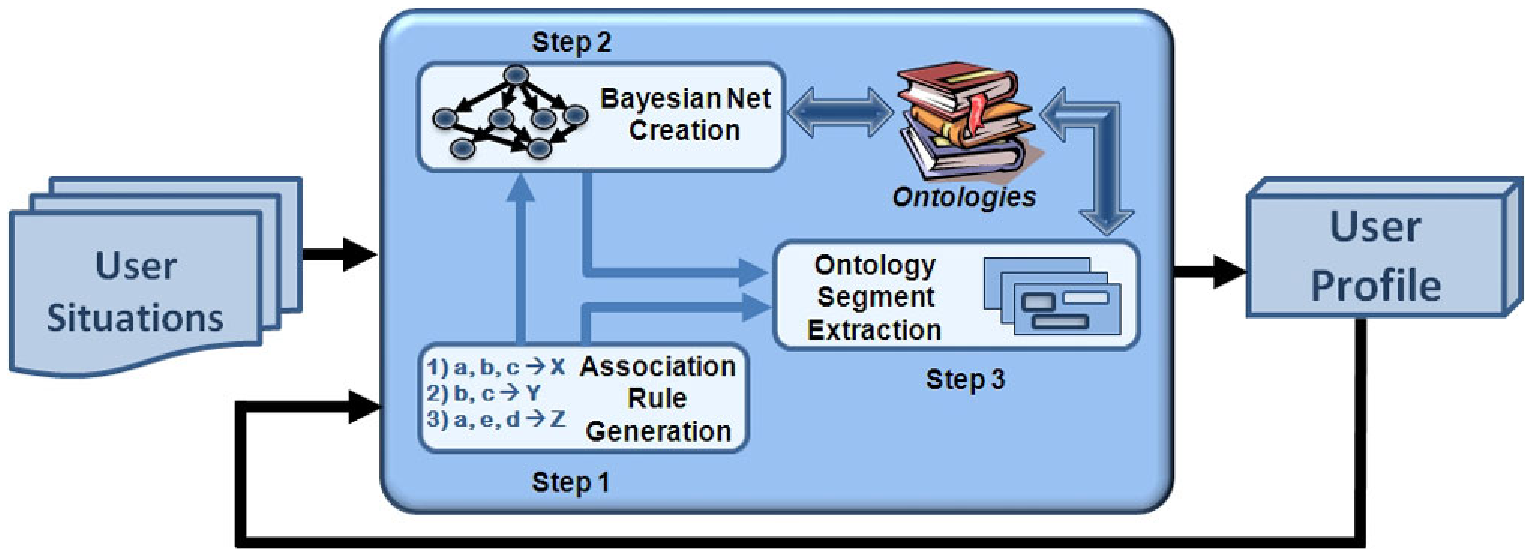 Figure: The data mining and ontology integration architecture.
3. Spreading Activation (The Segment Extractor)
The final step uses Spreading Activation. The relevance scores from the association rules are "injected" into the ontology and allowed to flow through the relations. The "flow rate" is governed by the probabilities learned in the Bayesian step.
- The concepts that accumulate the most "relevance" form an Ontology Segment—a mini-ontology that represents the user's specific context.
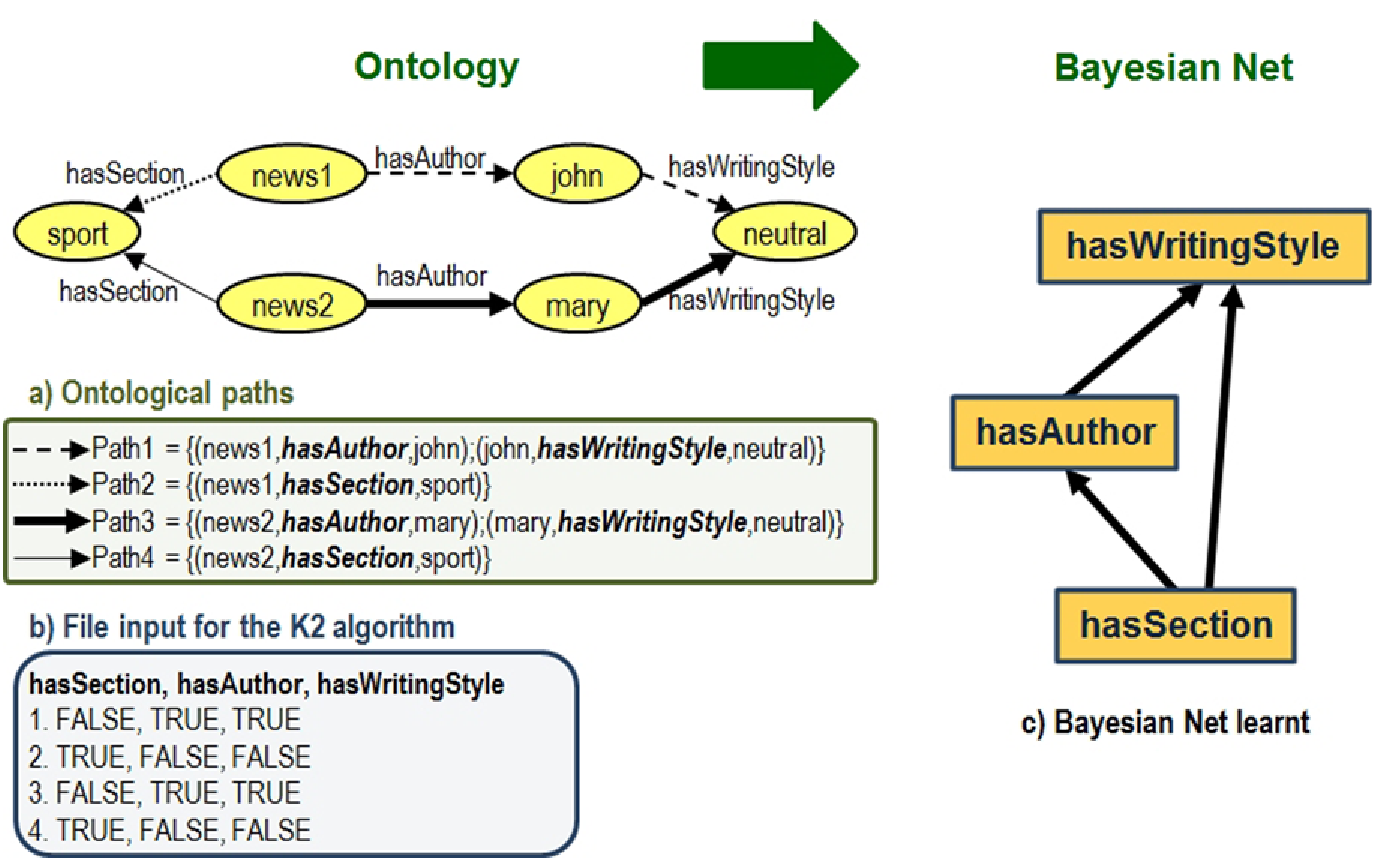
Experimental Validation: E-Learning Case Study
The authors tested this in SAVER, an e-learning platform. They tracked 52 students over 1,877 learning situations.
Performance Gains
The semantic profile consistently outperformed traditional rule-based profiles:
- Precision: Jumped from 0.52 to 0.66 (14% absolute gain).
- Recall: Reached a high of 0.95, ensuring almost all interesting content was retrieved.
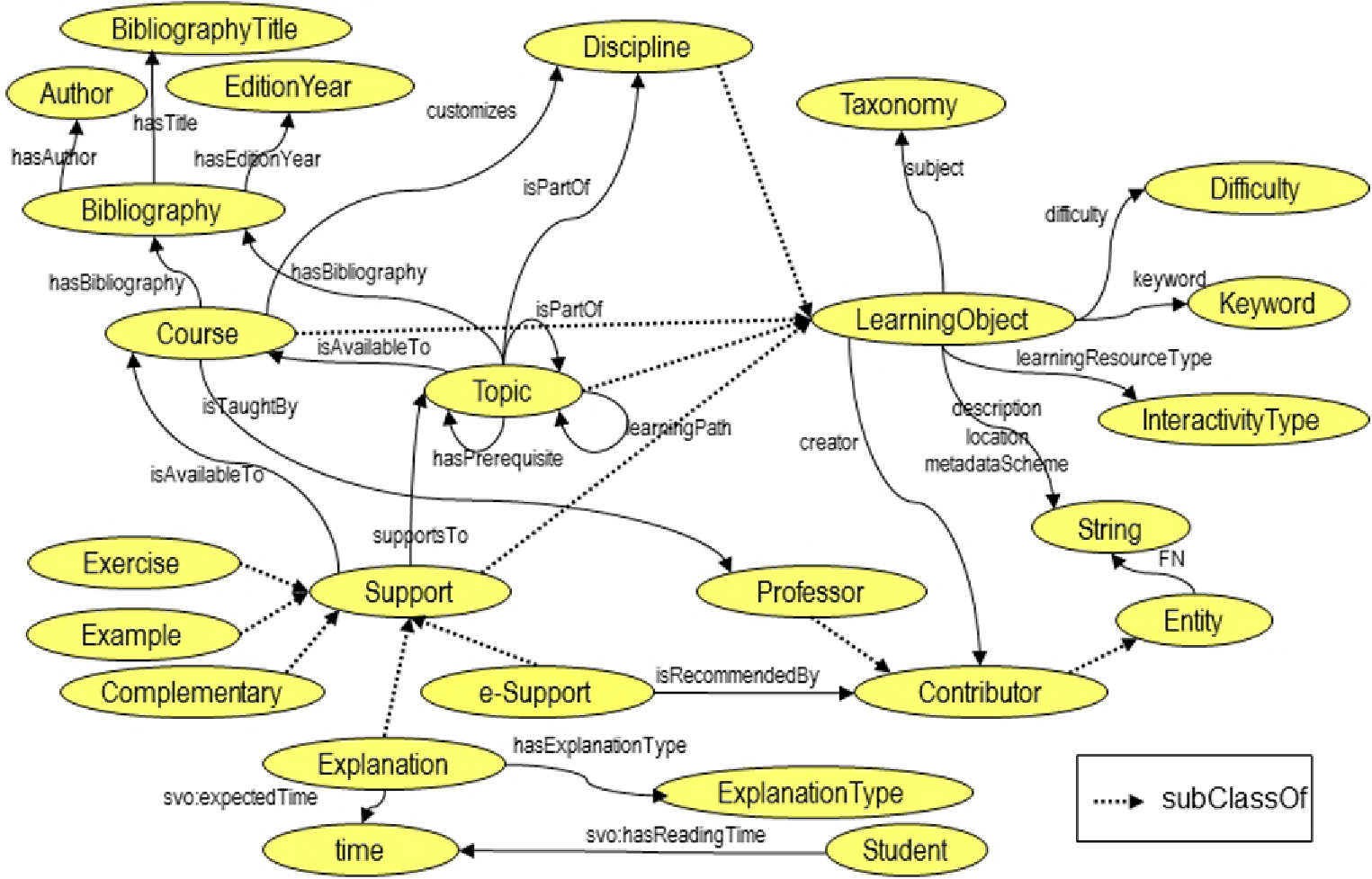
Adaptation to Change
Crucially, the model was tested on its ability to handle Preference Drift. When a student switched from "Association Rules" (easy) to "Bayesian Networks" (complex), the Spreading Activation algorithm gradually shifted its "relevance mass" to the new concepts. The use of a "memory" factor prevented the profile from changing too erratically due to one-off actions.
Critical Analysis & Conclusion
Takeaway: This work demonstrates that ontologies shouldn't just be static lookup tables; they are dynamic canvases onto which we can project probabilistic behavior.
Limitations:
- Ontology Scalability: The precision gains were modest partly because the domain ontology was small. In massive, web-scale domains, the computational cost of spreading activation across millions of nodes could be prohibitive.
- Cold Start: The system still requires initial "User Situations" to trigger the mining process.
Future Outlook: In the age of Neural Networks, this symbolic-probabilistic hybrid approach offers a path toward Explainable AI (XAI). Unlike black-box embeddings, an "Ontology Segment" is human-readable, allowing users to inspect and even manually tune their own profiles.