
O-VSM: Bridging the Semantic Gap in Web 2.0 with Ontology-Derived Vector Spaces
Applying Ontology Based Vector Space Model to Web 2.0
This paper introduces the Ontology-Based Vector Space Model (O-VSM), a logic-driven information retrieval framework designed for Web 2.0 social networks. By integrating domain ontologies and fuzzy inference, the model transforms decentralized RSS feeds into semantic feature vectors to improve the precision of user-oriented information matching.
TL;DR
The paper proposes a transition from keyword-centric retrieval to sentiment-aware semantic retrieval via the Ontology-Based Vector Space Model (O-VSM). By treating RSS feeds as "knowledge fragments" and using fuzzy logic to measure their distance within a domain ontology, the authors provide a mechanism to match users with content even when they use entirely different vocabularies.
Motivation: The Failure of Keywords
In the era of Web 2.0, information is scattered across RSS feeds, blogs, and wikis. Traditional Vector Space Models (VSM) serve as the backbone for most search engines but suffer from a fatal flaw: they treat terms as independent dimensions. If a job seeker searches for "Java" and a recruiter posts a listing for "Object-Oriented Programming," a standard VSM might find zero correlation.
The authors argue that we need a "semantic bridge"—a way for machines to understand that these terms are geographically close within the landscape of human knowledge.
Methodology: From Graphs to Fuzzy Vectors
The core innovation of O-VSM lies in how it quantifies meaning. The process follows three sophisticated steps:
1. The Ontology as a Coordinate System
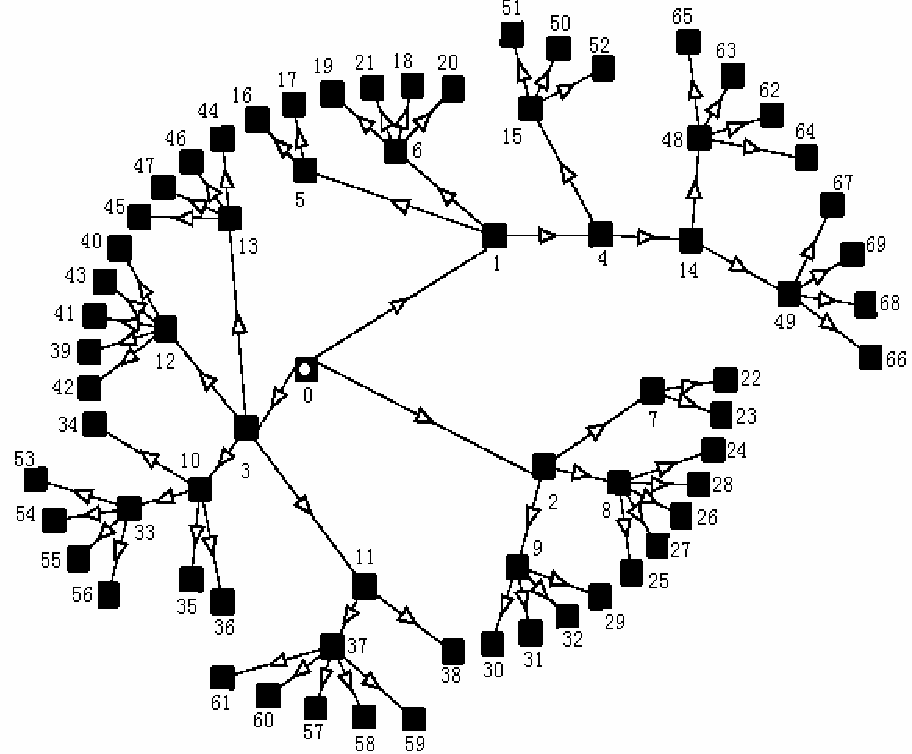
Instead of an N-dimensional space where N is the number of arbitrary words, O-VSM uses a Domain Ontology.
- Nodes: Represent concepts (e.g., "Software", "Driver", "C").
- Edges: Represent "IS-A" relationships.
- Distance: The semantic correlation is inversely proportional to the shortest path between two nodes in the graph.
2. Knowledge Fragment Reconstruction
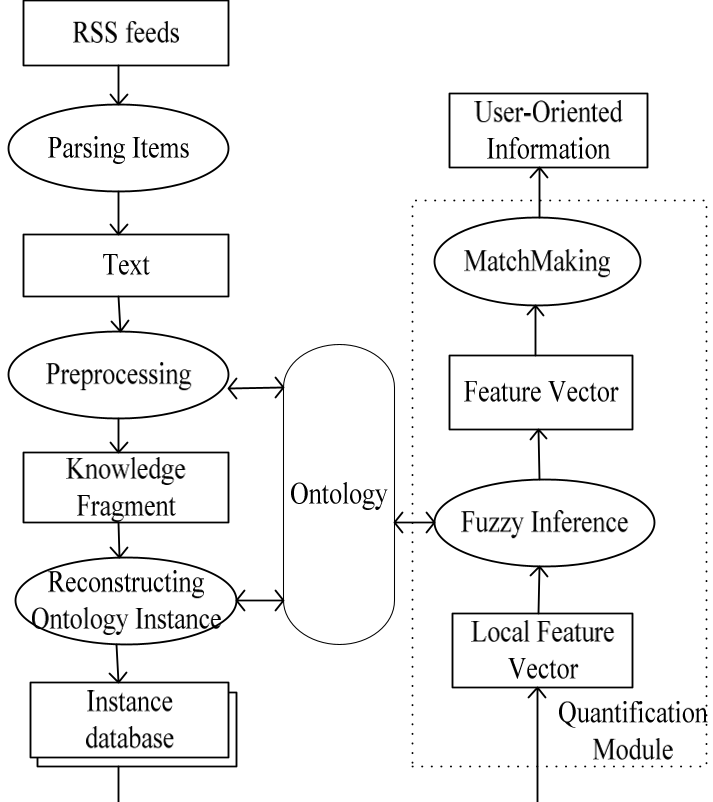
When an RSS feed is ingested, it is parsed and reconstructed into a "Local Knowledge Fragment." This is essentially a subgraph of the main ontology. The weight of a term in this vector isn't based on frequency (TF-IDF), but on its depth and relation to the root of the specific information item.
3. Fuzzy Inference for Global Mapping
To compare two different users' vectors, the model applies Fuzzy Inference. It uses a max-min composition to "spread" the influence of a term to its neighbors. If a document mentions "C," the fuzzy logic ensures the vector also contains a "shadow" weight for "Software Engineering," effectively smoothing the search space.
Experimental Results
The authors tested O-VSM using a DVR (Digital Video Recorder) R&D domain ontology. They simulated a job-matching scenario where decentralized RSS feeds carried job descriptions.
The performance is governed by the Vigilance Parameter ():
- : Strict identity (Hard keyword matching).
- : Broad conceptual matching.
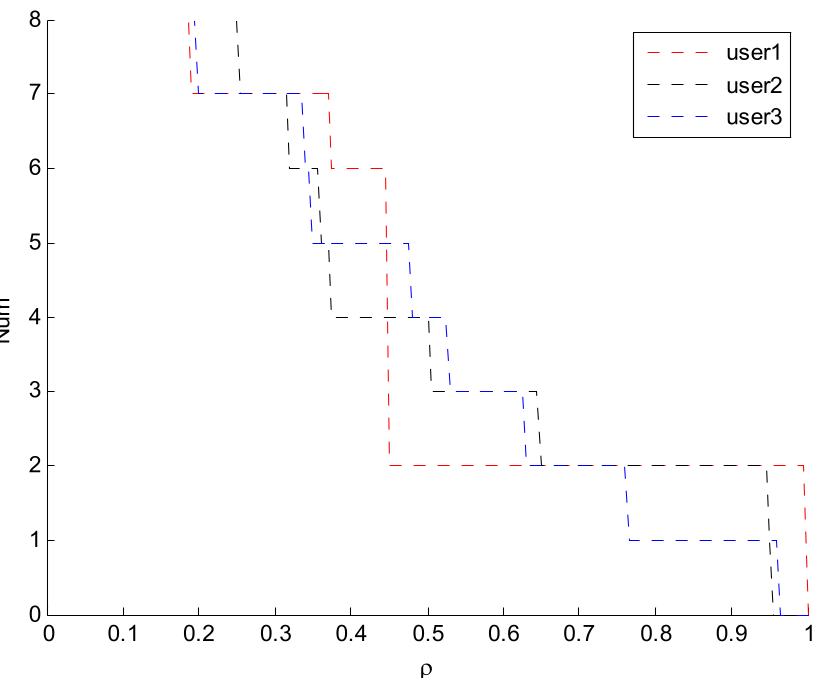
The results showed that as decreased, the system could successfully retrieve semantically relevant job posts that a traditional VSM would have ignored.
Critical Insight & Conclusion
O-VSM represents a shift from statistical importance to structural importance. By anchoring vectors in a pre-defined ontology, the model bypasses the "black box" nature of Latent Semantic Indexing (LSI) and provides an interpretable, deterministic way to handle semantic ambiguity.
Future Outlook: While the model is powerful, its reliance on a manually constructed ontology is a bottleneck. In today's context, integrating LLMs to dynamically generate these ontologies could make O-VSM a highly scalable solution for modern decentralized web protocols.