
Structuring Patient Voices: An Ontology-Based Approach to Health Forum Mining
Ontology-Based Visualization of Healthcare Data Mined from Online Healthcare Forums
The paper introduces a "Healthcare Forum Mining Ontology" designed to structure and visualize data extracted from online health communities like Medications.com and SteadyHealth.com. It employs a text-mining framework to convert unstructured forum posts into a semantic knowledge base, enabling researchers to analyze patient profiles and drug-disease-symptom associations.
Executive Summary
TL;DR
This paper presents a framework to transform the "chaos" of online healthcare forum discussions into a structured, semantic knowledge base. By developing a dedicated Healthcare Forum Mining Ontology, the researchers provide a way to store extracted patient profiles and medical associations (drugs, diseases, symptoms) in a machine-readable format. The tool then visualizes this data, allowing clinical researchers to spot trends like side effects and disease symptoms without needing access to private hospital records.
Background Positioning
In the landscape of Medical Informatics, this work acts as a bridge between unstructured Social Media Mining and Formal Medical Knowledge Representation. It addresses the "Semantic Gap" between how patients talk about health online versus how clinical systems (like SNOMED-CT) record it.
Problem & Motivation: The Data Privacy Wall
Clinical researchers face a paradox: they need massive amounts of patient data to find new treatment patterns, but strict privacy laws and fragmented Electronic Health Records (EHRs) make this data nearly inaccessible.
The authors identify an alternative: Online Healthcare Forums. In these spaces, users freely disclose demographics, symptoms, and treatment outcomes. However:
- Lack of Structure: Posts are raw text with no inherent hierarchy.
- Terminology Mismatch: Patients use lay language, not clinical coding.
- Scalability: Humans cannot manually process millions of posts to find "Why does Drug X cause Side-Effect Y in males over 50?"
Methodology: The Core Framework
The researchers built a comprehensive pipeline to solve the "structure" and "semantics" problem simultaneously.
1. The Healthcare Forum Mining Ontology
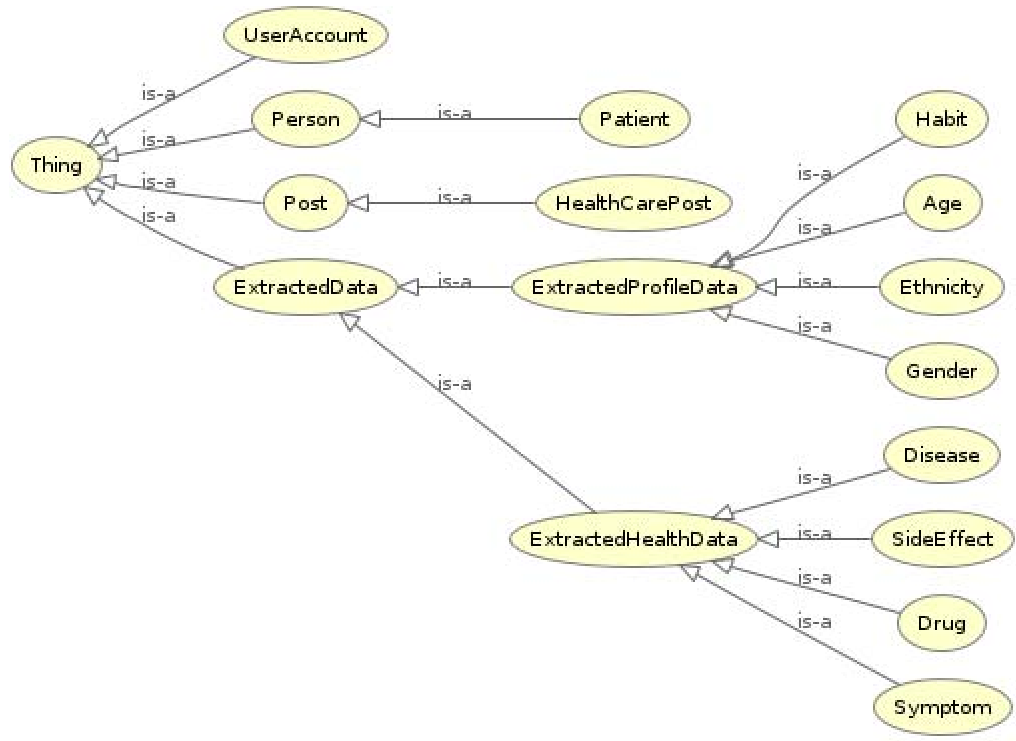
The heart of the paper is the ontology (built with Protégé and OWL). It creates a formal hierarchy where a "Patient" is a subclass of "Person" who has relationships like hasBeenPrescribed a Drug.
2. System Architecture
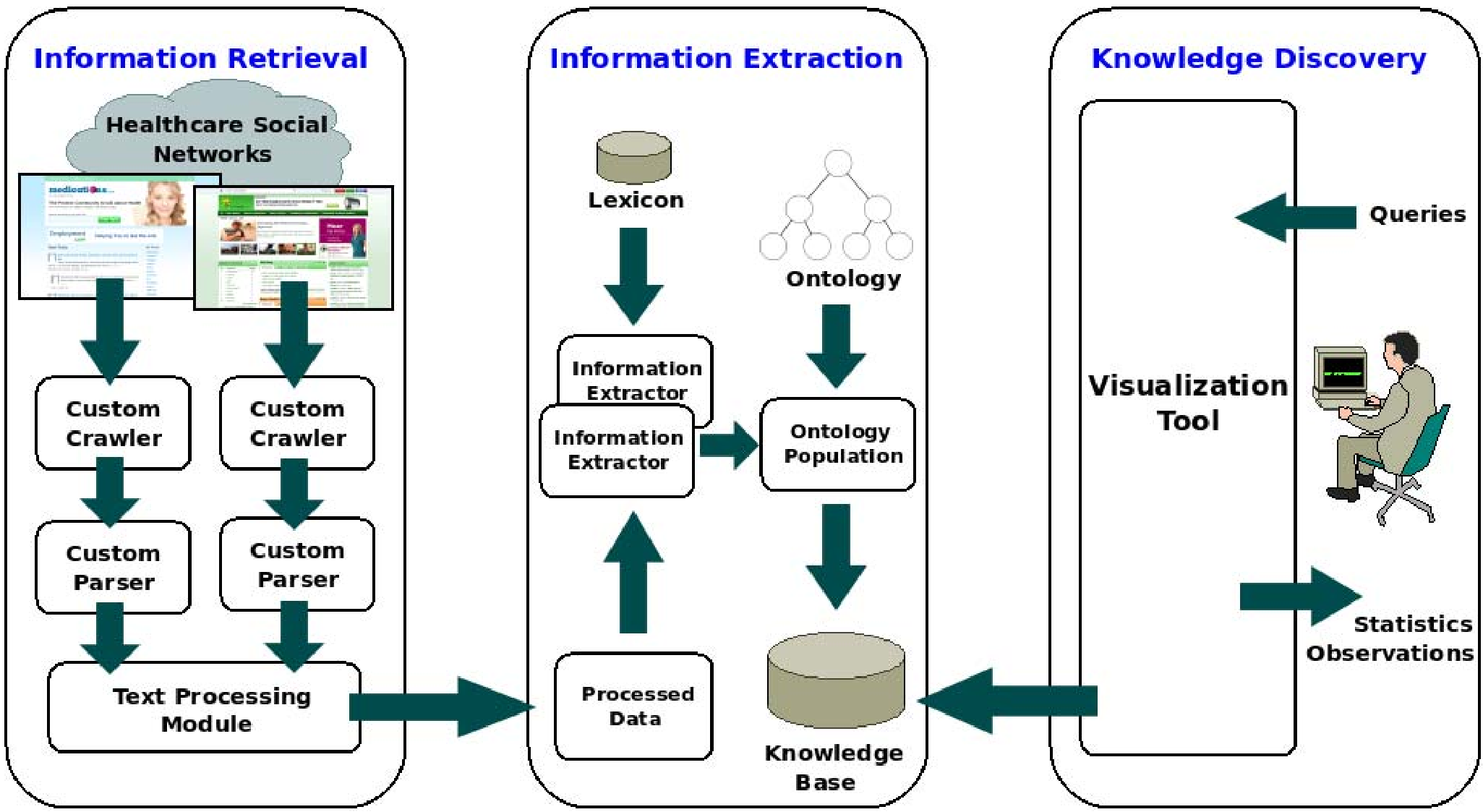
The workflow follows a 3-tier structure:
- Information Retrieval: Using focused crawlers (JSoup) to scrape targeted health communities.
- Information Extraction: Combining rule-based methods for demographics (age, gender) and lexicon-based Named Entity Recognition (NER) for medical entities.
- Knowledge Discovery: Storing results as RDF triples in an Apache Jena TDB and querying them via SPARQL.
Experiments & Results: Visualizing Insights
The authors validated their ontology by populating it with data from Medications.com and SteadyHealth.com.
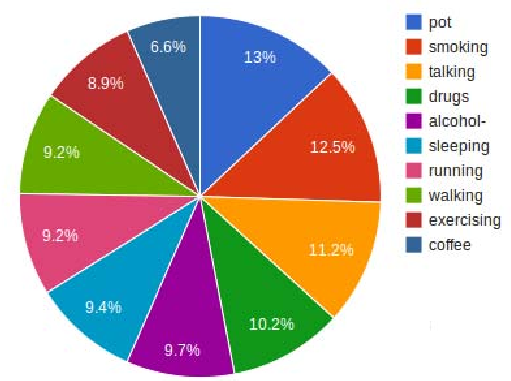
Patient Profiling
By linking demographic data to diseases, the tool can generate aggregate profiles. For instance, researchers can visualize the age and gender distribution of forum users discussing Diabetes.
Drug-Side Effect Associations
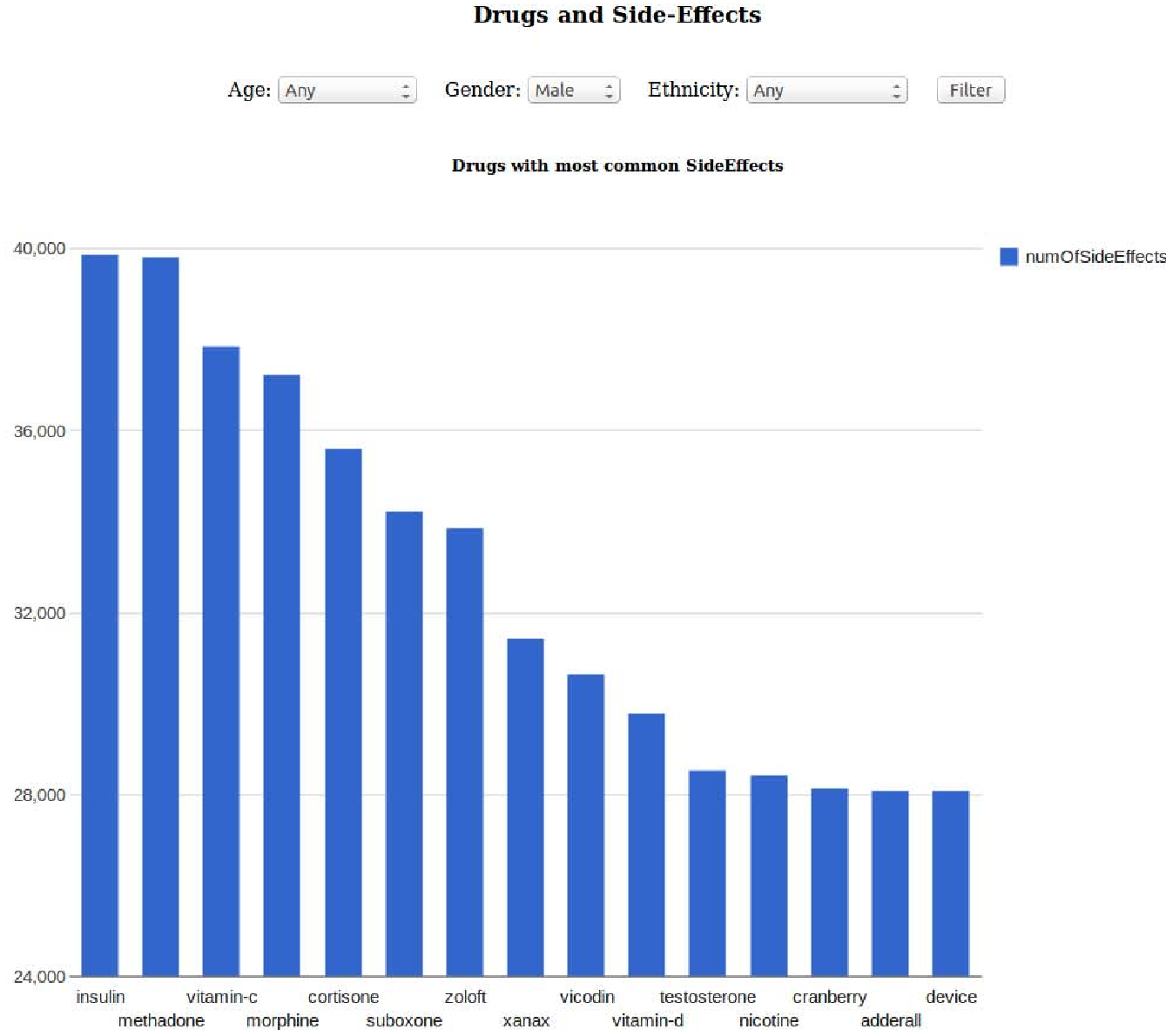
One of the most powerful applications is identifying Adverse Drug Reactions (ADRs). The tool can filter data to show which drugs have the highest frequency of reported side effects within specific genders or age groups.
Critical Analysis & Conclusion
Takeaway
The "Healthcare Forum Mining Ontology" provides a semi-automated way to turn subjective user experiences into objective data points. Its modular design allows it to grow as more medical terms (like dosages or occupations) are added.
Limitations
- Data Veracity: The system assumes forum posts are truthful. There is no mechanism to filter out "fake" medical advice.
- Technical Simplicity: The extraction relies on lexicon and rule-based methods. In the modern era, Large Language Models (LLMs) would likely yield much higher recall for complex sentence structures.
Future Outlook
The authors suggest using this ontology to enhance Hidden Markov Models (HMMs) for ADR prediction. By knowing which conditions a drug is supposed to treat (recorded in the ontology), the system can better distinguish between a "symptom of the disease" and a "side effect of the drug," a classic difficulty in medical text mining.